

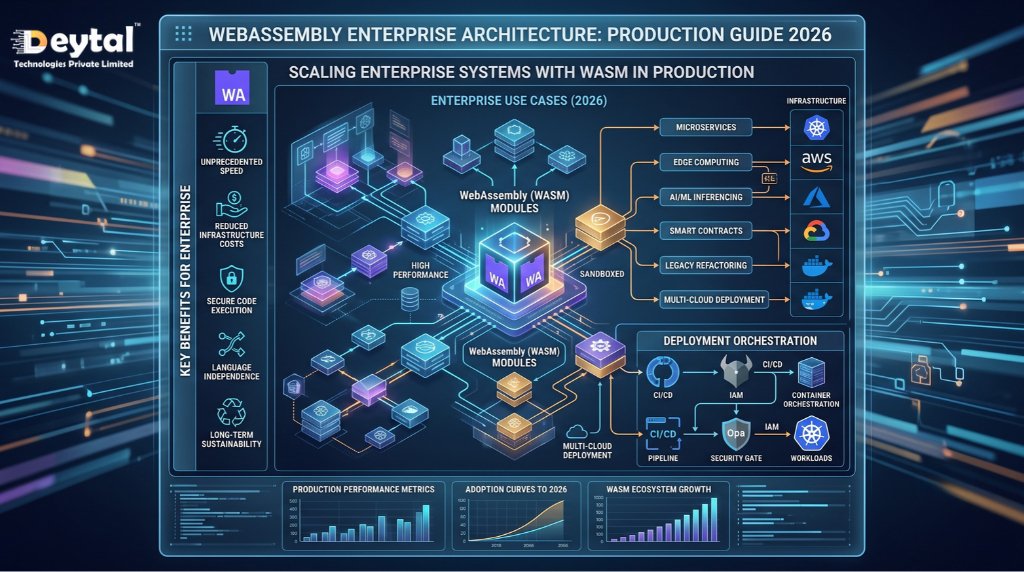
WebAssembly (Wasm) originally entered the software industry as a mechanism to run high-performance C++ and Rust code inside client browsers. For years, it powered browser-based CAD tools, video editors, and game engines. However, the maturation of the WebAssembly System Interface (WASI) and the Wasm Component Model has shifted the technology’s center of gravity from client browsers directly into server-side backends and distributed edge infrastructure.
WebAssembly Enterprise Architecture provides a lightweight, polyglot alternative to conventional container runtimes for targeted workloads. By compiling languages like Rust, Go, and C++ into portable, sandboxed bytecode modules that execute in microseconds with minimal memory overhead, enterprise engineering teams are leveraging Wasm to power high-concurrency edge computing, secure plugin extensions, and real-time API gateways.
The Infrastructure Limits of Container-Only Serverless
While Linux containers (Docker, OCI) remain standard for complex long-running applications, their fundamental design creates bottlenecks for high-throughput, scale-to-zero architectures:
- Cold-Start Latencies: Spun-up Linux container images require hundreds of milliseconds (or multiple seconds) to unpack root filesystems, initialize Linux kernel namespaces, and boot runtimes.
- Heavy Memory Overhead: Even minimal scratch containers carry tens of megabytes of memory baggage, limiting deployment density across edge nodes.
- Coarse-Grained Attack Surfaces: Container breakouts remain a vulnerability because containers share the underlying host kernel via complex, error-prone cgroups and seccomp profiles.
- Polyglot Glue Code Fragility: Sharing high-performance mathematical, cryptographic, or business logic across distinct language stacks typically requires fragile Foreign Function Interfaces (FFI) or complex cross-compilation toolchains.
Traditional Docker Containers vs. Server-Side WebAssembly (Wasm)
| Architectural Metric | Linux OCI Containers (Docker) | Server-Side WebAssembly (Wasm + WASI) |
| Startup / Cold-Start Time | 200ms – 5+ seconds | Sub-millisecond (typically microseconds) |
| Artifact Footprint | Tens to hundreds of Megabytes (MB) | Few Kilobytes to low Megabytes (KB–MB) |
| Security Isolation Model | Shared OS kernel isolation (namespaces) | Capability-based sandboxing, deny-by-default |
| Execution Portability | OS and architecture-specific (x86 vs ARM) | True write-once, run anywhere across architectures |
| Primary Ideal Workload | Heavyweight legacy apps, full OS services | Event-driven microservices, edge functions, plugins |
Core Engineering Pillars of an Enterprise WebAssembly Architecture
1. High-Density Edge Microservices & Asynchronous Pipelines
Deploy event-driven microservices closer to end-users on global edge networks (such as Cloudflare Workers, Fastly Compute, or Akamai Spin). Engineering optimized, low-latency data ingestion services through Custom Software Development Services ensures edge compute instances start instantly on demand without cold-start penalties.
2. Near-Native Web Application Performance
Offload compute-intensive tasks—such as image manipulation, cryptographic verification, and local vector math—directly to Wasm client runtimes. Developing high-speed frontends via Website Development Services prevents browser main-thread freezes and maintains responsive UI performance.
3. Interactive Data Visualizations & Complex UI/UX Engineering
Complex client-side Wasm modules require intuitive, responsive interfaces to present real-time telemetry, 3D models, or high-dimensional data clearly. Designing streamlined workflows, ergonomic dashboard layouts, and low-latency interaction models through UI/UX Design Services ensures complex data processing remains accessible to end users.
4. Portable Cross-Platform Mobile Runtimes
Compile core business logic, proprietary calculation engines, or encryption modules into a single Wasm binary shared across platforms. Embedding modular bytecode within native wrappers using Mobile App Development Services guarantees identical logic execution across iOS, Android, and web without maintaining dual codebases.
5. Clean Content Infrastructure & Core Web Vitals Optimization
Prevent compute-heavy scripts from degrading page load metrics or search engine crawling budgets. Pairing decoupled WordPress Development Services with technical SEO Services maintains top organic search authority, fast indexing, and optimal Interaction to Next Paint (INP) scores.
6. Edge-Personalized Conversion Funnels & Digital Campaigns
Leverage sub-millisecond edge Wasm routines to execute real-time geo-personalization, dynamic pricing, and A/B test routing at the CDN level, systematically scaled through enterprise Digital Marketing Services.
Modernize Enterprise Infrastructure with Deytal Technologies
Adopting WebAssembly on the server and edge requires choosing the right compilation toolchains, defining WASI interfaces, and integrating Wasm runtimes alongside existing container orchestration systems. Deytal Technologies Pvt. Ltd. designs and builds high-performance cloud architectures, custom edge computing solutions, and resilient enterprise web applications engineered for modern scale.
Frequently Asked Questions (FAQ)
Q1: Will WebAssembly completely replace Docker containers?
No. Wasm is not intended to replace containers for all workloads. Linux containers remain ideal for running long-lived legacy applications, databases, and full operating system stacks. Wasm excels at scale-to-zero serverless functions, untrusted third-party plugin systems, edge compute, and high-density microservices.
Q2: What is WASI and why is it essential for server-side Wasm?
WASI (WebAssembly System Interface) is a standardized set of modular system APIs that allows WebAssembly to run securely outside the web browser. It provides controlled, capability-based access to operating system primitives like filesystems, network sockets, environment variables, and system clocks.
Q3: What is the Wasm Component Model?
The Component Model is an architectural standard built on WebAssembly Interface Types (WIT). It allows modules written in different programming languages (e.g., a Rust data processor linked to a Python business rule) to interoperate seamlessly without brittle foreign function interface (FFI) bindings or custom serialization layers.