

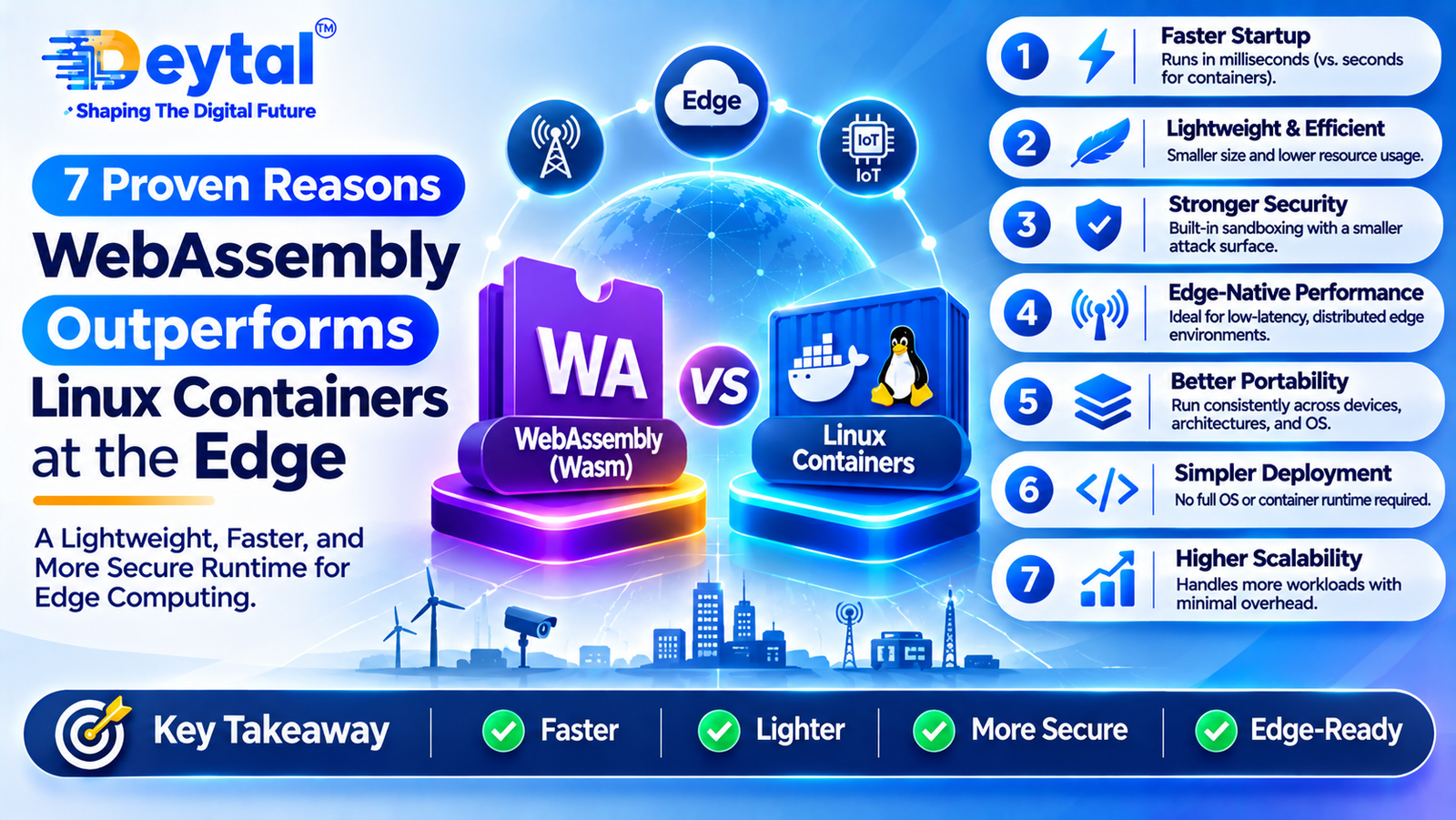
For over a decade, Docker and Open Container Initiative (OCI) Linux containers have served as the undisputed foundation of cloud-native computing. By packaging binaries alongside their underlying root filesystems, libraries, and kernel-isolated namespaces (via cgroups and chroot), containers solved the perennial “works on my machine” crisis. Yet as enterprise infrastructure shifts toward ultra-low latency edge computing, event-driven serverless functions, and high-density multi-tenant workloads, the architectural trade-offs of Linux containers have become increasingly pronounced: heavy memory footprints, multi-megabyte image payloads, and millisecond-to-second cold start times.
WebAssembly (Wasm), originally designed to run high-performance compiled code inside client browsers, has evolved into a formidable server-side and cloud-native runtime. Powered by the WebAssembly System Interface (WASI), Wasm executes sandboxed, compiled bytecode directly on host operating systems without virtualizing an entire Linux user space.
Rather than replacing Linux containers entirely, Wasm is emerging as an indispensable co-runtime. It delivers near-instantaneous startup times, sub-millisecond cold starts, cross-platform portability, and a capability-based security model engineered for high-density microservices.
Why Traditional Linux Containers Hit Limits at the Edge and in Serverless
Standard container runtimes (runc, containerd) introduce unavoidable operational overhead:
- Substantial Cold-Start Delays: Even highly optimized minimal containers (such as those built on Alpine or distroless images) take hundreds of milliseconds or full seconds to pull images, allocate namespaces, configure virtual network interfaces, and initialize application runtimes.
- Resource and Image Bloat: Packaging an entire userspace operating system filesystem alongside an application leads to base images that consume 50MB to 500MB of storage and memory per pod, severely restricting workload density on edge nodes and worker clusters.
- Coarse-Grained Kernel Attack Surfaces: Linux containers share the underlying host kernel. If a process breaks out of its isolated namespace through a kernel vulnerability, the entire node is compromised. Sandboxing requires additional hypervisor-level isolation layers (like Firecracker or gVisor) that add CPU overhead.
- Architecture-Specific Compilation: Linux containers are compiled for a specific target instruction set architecture (ISA) such as
amd64orarm64. Distributing workloads across mixed hardware clusters requires managing multi-arch container registries and complex CI/CD build matrices.
WebAssembly (WASI) vs. Linux Containers (OCI)
| Architectural Dimension | OCI Linux Containers (Docker, runc) | WebAssembly (Wasm / WASI) |
| Execution Abstraction | Process isolation via OS namespaces and cgroups | Bytecode execution in an isolated virtual machine sandbox |
| Startup / Cold-Start Time | 200ms to several seconds | Sub-millisecond (often microseconds) |
| Memory Footprint | Tens to hundreds of megabytes per instance | Kilobytes to low single-digit megabytes |
| Binary Artifact Size | 20MB to 500MB+ (includes libraries & OS files) | 500KB to 5MB (pure compiled bytecode module) |
| Hardware Portability | Architecture-specific binaries (amd64 vs arm64) | Write once, run anywhere on any CPU architecture |
| Security Architecture | Boundary enforced by Linux kernel syscall isolation | Deny-by-default capability-based security model |
| Language Ecosystem | Any language that compiles or runs on Linux | Systems languages (Rust, C/C++, Go, Zig) and Wasm-targeted runtimes |
| Primary Use Cases | Heavy legacy runtimes, long-lived monoliths, complex dependencies | Event-driven serverless, API edge proxies, plugin architectures, fast microservices |
Strategic Pillars for Integrating WebAssembly into Cloud-Native Architectures
1. High-Density Microservices & Micro-Runtime Engineering
Architect ultra-lightweight microservices by compiling domain logic written in Rust, Go, or C++ directly to WASI modules. Developing modular application engines and custom serverless backends via Custom Software Development Services eliminates cold starts and enables thousands of concurrent Wasm worker modules to run concurrently on a single compute node.
2. Lightning-Fast Edge APIs & Dynamic Web Storefronts
Bring application business logic directly to edge nodes nearest the user. Designing decoupled, distributed edge applications and headless web platforms with zero-latency API routing through Website Development Services ensures international users experience sub-10ms response times for dynamic pricing, personalized carts, and real-time inventory lookups.
3. Enterprise Cloud Cockpits & Sandbox UI/UX Design
Operating hybrid environments that blend standard container runtimes with lightweight Wasm nodes requires unified monitoring. Designing developer consoles, sidecar extension visualizers, and cluster deployment dashboards through UI/UX Design Services gives DevOps and platform engineers direct visibility into Wasm module execution speeds and memory consumption.
4. Low-Bandwidth Edge Runtimes for Mobile Backends
Mobile backends often process bursty payload transformations and authentication validations. Deploying Wasm-powered edge microservices via Mobile App Development Services allows mobile applications to offload payload normalization and real-time cryptography to lightning-fast edge workers, preserving mobile battery life and reducing cellular latency.
5. Edge-Optimized Publishing Platforms & Flawless Web Core Vitals
Accelerate content delivery, HTML rewrites, and dynamic paywall calculations at the CDN edge using Wasm plugins rather than bulky origin proxies. Implementing edge-rendered content platforms through WordPress Development Services coupled with data-driven SEO Services maintains top organic search authority, instantaneous Time to First Byte (TTFB), and flawless Core Web Vitals.
6. Edge-First Infrastructure Marketing & Enterprise Positioning
Position the technical and financial benefits of edge-native Wasm infrastructure—such as 90% reduced compute costs and eliminated cold-start dropoffs—as core competitive differentiators in high-conversion sales funnels supported by Digital Marketing Services.
Modernize Your Cloud Infrastructure with Deytal Technologies
Adopting WebAssembly within existing Kubernetes and microservice architectures requires practical expertise across WASI runtimes (Wasmtime, Wasmer), container runtimes (crun, runwasi), and modern systems languages. Deytal Technologies Pvt. Ltd. designs, audits, and builds production-grade cloud-native platforms, high-density edge computing layers, and hybrid container-Wasm infrastructures engineered to maximize compute efficiency and eliminate latency bottlenecks.
Frequently Asked Questions (FAQ)
Q1: Will WebAssembly completely replace Docker and Linux containers?
No. Wasm is not an outright replacement for Linux containers; it is a specialized complement. Linux containers remain the preferred standard for complex legacy applications, software requiring specific Linux kernel extensions, or large monoliths with extensive system-level dependencies. WebAssembly excels at fast event-driven tasks, high-concurrency microservices, plugin frameworks (like Envoy proxy filters), and low-latency edge computing workloads.
Q2: How does WebAssembly achieve sub-millisecond cold starts?
Linux containers must create isolated OS namespaces, mount file systems, set up virtual networking, and boot application runtimes before executing code. WebAssembly modules, by contrast, are self-contained bytecode files executing inside a lightweight virtual machine. Because the host runtime simply instantiates the sandbox and directly executes the pre-compiled bytecode without spinning up an operating system layer, instantiation takes microseconds.
Q3: Can Kubernetes orchestrate WebAssembly workloads alongside standard containers?
Yes. Through initiatives like the CNCF’s runwasi and projects like kwasm or crun, Kubernetes worker nodes can execute Wasm modules natively. By configuring a custom RuntimeClass, Kubernetes directs the node to execute regular containers using runc and Wasm modules using runtimes like Wasmtime, allowing both technologies to coexist seamlessly on the same cluster and network fabric.
