

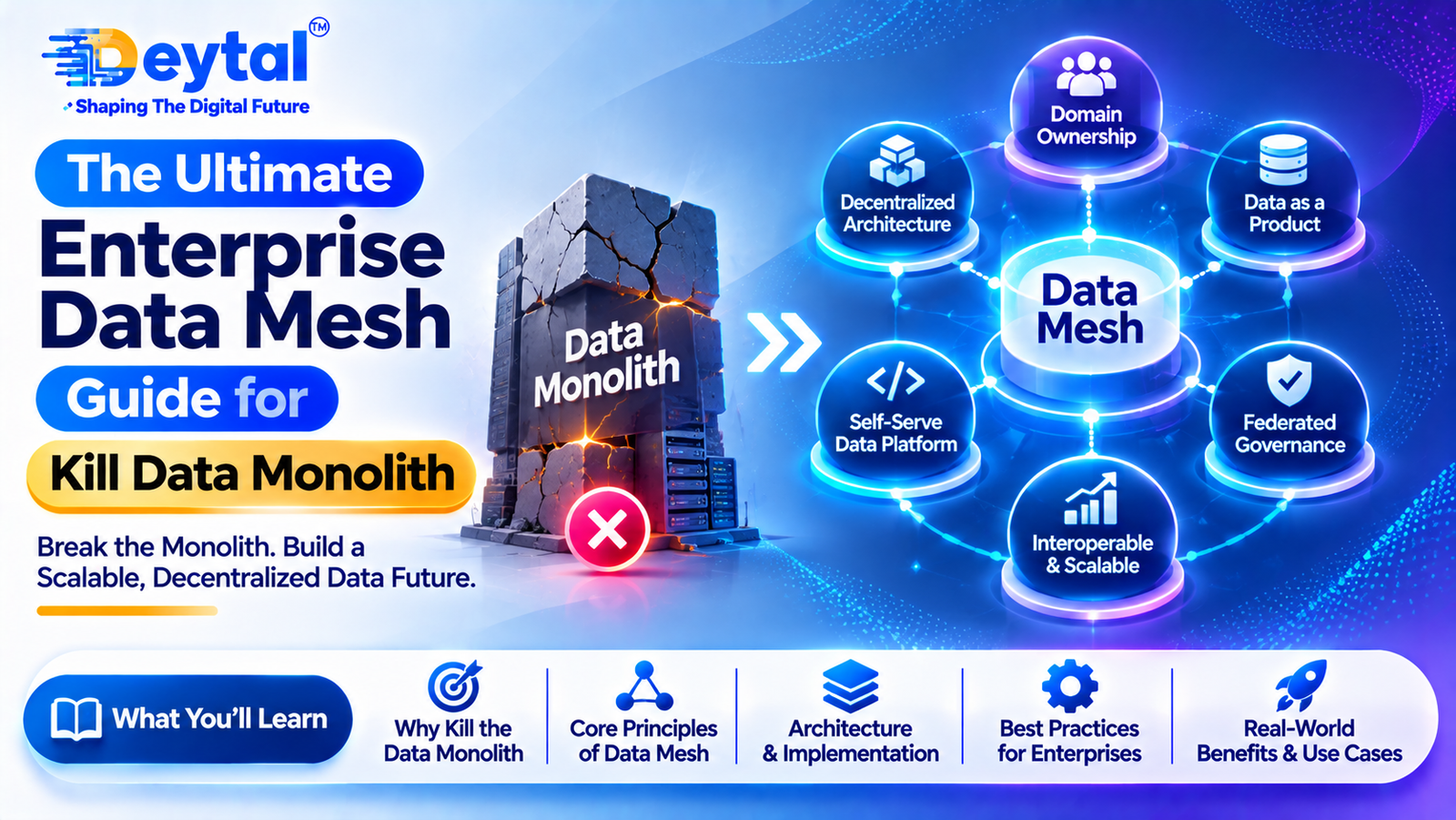
Over the past two decades, enterprise analytical data management has followed a centralized paradigm. Organizations funneled transactional databases, operational events, and third-party SaaS payloads into centralized monolithic data lakes (Hadoop, Amazon S3, Azure Data Lake) or massive cloud data warehouses (Snowflake, BigQuery). While centralization promised a single source of truth, it created a severe organizational and technical bottleneck: a single, overburdened central data engineering team tasked with understanding business domain context across dozens of disparate business units.
The consequence is a persistent crisis of data quality, domain disconnect, and delayed time-to-insight. Upstream application developers frequently modify operational schemas without warning, breaking fragile downstream ETL scripts and leaving central data engineers to untangle corrupted data pipelines.
Enterprise Data Mesh Architecture solves this organizational gridlock by shifting from centralized technical pipelines to a decentralized, domain-driven paradigm. Pioneered by Zhamak Dehghani, Data Mesh treats data not as a passive byproduct dumped into a lake, but as a first-class Data Product owned, tested, and served directly by the cross-functional domain teams that create it. Backed by Federated Computational Governance and a Self-Serve Data Infrastructure Platform, Data Mesh enables large-scale organizations to scale analytics horizontally alongside business growth.
The Structural Failure of Centralized Monolithic Data Lakes
Centralized analytical architectures consistently falter under enterprise operational scale due to systemic structural flaws:
- Domain Disconnect & Lack of Ownership: Central data teams do not own the business domains generating the data. When finance, marketing, or logistics teams request analytical models, central engineers lack the contextual nuances required to model edge cases, resulting in faulty dashboards and endless Jira remediation loops.
- Fragile Hyper-Coupled Pipeline Engineering: Centralized ETL pipelines ingest raw data through brittle, tightly coupled transformations. An unannounced column type migration in an operational checkout service can cascade into catastrophic pipeline failures across dozens of downstream analytical pipelines.
- Monolithic Scaling Bottlenecks: While modern cloud warehouses provide elastic compute scaling, human bandwidth does not scale elastically. The centralized team becomes an organizational gatekeeper, where simple schema updates or fresh data ingestion requests languish in backlogs for weeks or months.
- Ambiguous Data Quality Guarantees: When data lands in a massive centralized data lake, quality validation is often applied as a late afterthought. Without explicit Service Level Objectives (SLOs) or programmatic data contracts enforced at the source domain boundary, low-fidelity and orphaned data proliferate.
Centralized Data Lake / Warehouse vs. Enterprise Data Mesh
| Architectural Dimension | Centralized Data Lake / Lakehouse | Enterprise Data Mesh |
| Organizational Ownership | Centralized, specialized data engineering squad | Decentralized, domain-aligned product engineering teams |
| Primary Data Abstraction | Tables, schemas, and raw file directories in a lake | Autonomous Data Products with explicit data contracts |
| Architecture Paradigm | Monolithic ingestion pipelines and centralized ETL/ELT | Domain-driven distributed nodes connected via standard open APIs |
| Platform Provisioning | Bespoke infrastructure managed manually by data engineers | Self-serve data infrastructure platform providing automated primitives |
| Governance Model | Top-down, manual policy audits and centralized review boards | Federated computational governance enforced programmatically as code |
| Change Management | Brittle; downstream pipelines break unexpectedly on schema changes | Polyglot data contracts with semantic versioning and regression testing |
| Scale Mechanism | Vertical team scaling (adding headcount to central data team) | Horizontal organizational scaling (domains onboard data products independently) |
Strategic Pillars for Engineering an Enterprise Data Mesh
1. Domain-Oriented Data Product Engineering & Data Contracts
Transform operational data into accessible, discoverable Data Products managed directly by domain squads. Implementing programmatic data contracts, event-driven streaming adapters, and automated schema registry validations through Custom Software Development Services ensures every domain exposes cleanly versioned analytical endpoints (such as Apache Iceberg or Delta Lake tables) backed by strict quality SLOs.
2. Self-Serve Data Discovery Catalogs & Enterprise Web Portals
Data products provide zero value if internal analysts, data scientists, and engineers cannot find them. Building responsive data marketplace portals, searchable metadata registries, and automated lineage graphs via Website Development Services allows consumer teams to search, request access to, and inspect documentation for domain-owned datasets in seconds.
3. Data Product Management & Governance UI/UX Design
Decentralized governance fails if the tools are overly complex. Designing streamlined schema registration interfaces, live data contract health monitors, and access approval workflows through UI/UX Design Services empowers domain product managers to manage data access rights and review consumption metrics without filing manual infrastructure tickets.
4. Edge-Aware Analytics Ingestion for Mobile Backends
Mobile application feature teams (such as checkout, search, or recommendation teams) must own their event telemetry end-to-end. Building modular event collection SDKs, schema-validated analytics tracking, and edge pre-aggregation layers via Mobile App Development Services guarantees mobile client telemetry complies with central privacy standards before reaching analytical storage.
5. Clean Content Data Schemas & Authoritative SEO Publishing Architecture
Prevent data model changes from disrupting outward-facing content syndication, corporate reporting, and structured schema graphs. Operating unified headless content repositories and high-speed distribution frameworks through WordPress Development Services coupled with data-backed SEO Services ensures structured corporate knowledge graphs remain accessible, crawlable, and authoritative for organic search engines.
6. Enterprise Trust Signaling & Data Product Market Positioning
Leverage strict compliance, verified domain data quality, and secure self-serve analytics as trust-building differentiators during enterprise security reviews, supported by data-driven positioning and high-conversion B2B growth funnels managed by Digital Marketing Services.
Build Modern Data Platforms with Deytal Technologies
Migrating from a brittle centralized data lake to an agile enterprise data mesh requires deep technical expertise in data contracts, self-serve platform engineering, and federated governance pipelines. Deytal Technologies Pvt. Ltd. designs, audits, and builds production-ready data mesh architectures, domain product frameworks, and automated metadata platforms engineered to eliminate data bottlenecks and unlock high-velocity business analytics.
Frequently Asked Questions (FAQ)
Q1: What exactly constitutes a “Data Product” in a Data Mesh?
A Data Product is an autonomous architectural quantum that encompasses more than just raw data. It includes:
- Code: The transformation pipelines, ingestion logic, and schema definitions.
- Data & Metadata: The structured analytical data (e.g., Iceberg tables, Kafka streams), historical logs, and documentation.
- Infrastructure: The compute and storage resources (provisioned via self-serve platform templates) required to run and persist it.
- Data Contracts & SLOs: Explicit programmatic commitments defining schema integrity, availability, freshness, and quality guarantees for downstream consumers.
Q2: What is “Federated Computational Governance”?
Federated Computational Governance balances global interoperability with local domain autonomy. Instead of relying on manual security review boards, governance policies—such as role-based access controls (RBAC), data masking, PII encryption, audit logging, and data retention rules—are defined centrally by a federated council of domain leads and security architects, and then executed automatically as code within the self-serve platform’s deployment pipelines.
Q3: Does adopting a Data Mesh require throwing away existing data lakes or warehouses like Snowflake or S3?
No. Data Mesh is primarily an organizational and architectural paradigm, not a physical hardware replacement. Existing object stores (AWS S3, Google Cloud Storage) and cloud data warehouses (Snowflake, Databricks, BigQuery) serve as the underlying physical storage and compute engines for the self-serve infrastructure platform. Domains continue to utilize these technologies, but provision and manage their own logical workspaces and data products independently.
