

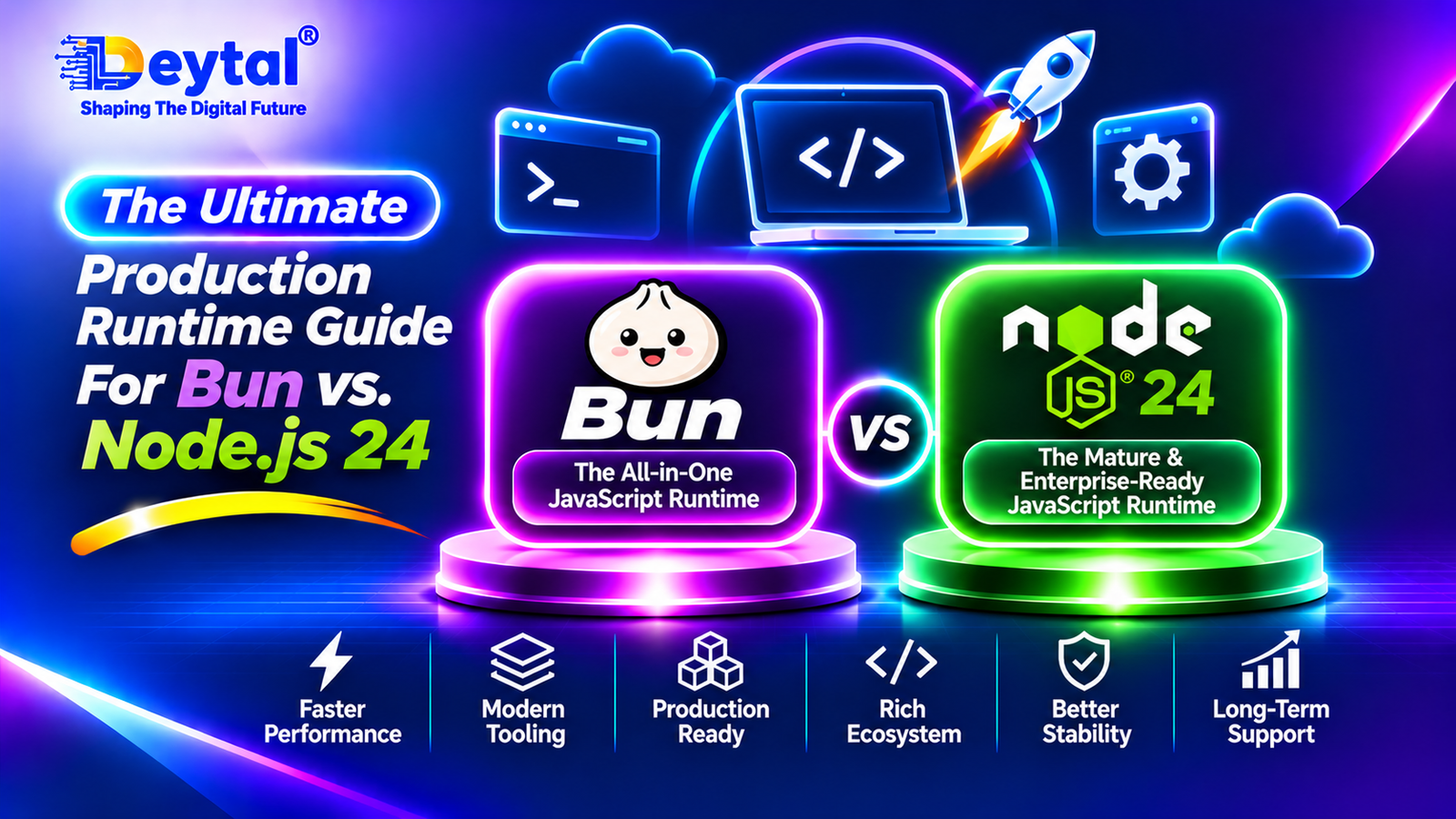
For more than fifteen years, Node.js served as the undisputed foundation of server-side JavaScript. Yet modern full-stack engineering teams routinely suffered from toolchain fragmentation gluing together npm or pnpm for package installation, tsx or tsc for TypeScript transpilation, esbuild or Vite for bundling, Jest or Vitest for testing, and external drivers for SQL and S3.
Now, the server-side JavaScript landscape has reached a historic inflection point defined by two distinct architectures: Node.js 24 (Active LTS, codenamed Krypton) and Bun.
- Node.js 24 LTS, built in C++ atop Google’s V8 engine, has evolved dramatically shipping stable zero-flag native TypeScript execution (via Amaro/SWC type stripping), a built-in
node:testrunner, an explicit--permissionsecurity model, and battle-tested V8 garbage collection tuned over fifteen years for long-lived, high-concurrency servers. - Bun (now rewritten in Rust in its 1.4+ architecture and backed by Anthropic under an open-source MIT license), built atop Apple’s JavaScriptCore (JSC) engine, unifies a drop-in runtime, ultra-fast package manager (
bun install), native bundler, test runner, and built-in C/Rust-speed clients (Bun.sql,Bun.s3,bun:sqlite) into a single lightweight binary.
Choosing between them requires looking past synthetic “Hello World” HTTP benchmarks and evaluating real-world garbage collection behavior, C++ native addon compatibility, observability instrumentation, and workload lifecycles.
The Structural Bottlenecks of Server-Side JavaScript in Production
Deploying JavaScript and TypeScript backends under enterprise concurrency exposes sharp trade-offs between V8 and JavaScriptCore runtimes:
- Synthetic HTTP Throughput vs. I/O-Bound Reality: In isolated plaintext HTTP benchmarks,
Bun.serveregularly outperformsnode:httpby 1.5x to 2x because request parsing and response serialization execute in native compiled code before touching JavaScript. However, once a production endpoint queries PostgreSQL, reads from Redis, and serializes complex JSON payloads, 80%–90% of latency is bound by network and database I/O narrowing real-world throughput differences to 5%–15%. - V8 vs. JavaScriptCore Garbage Collection Under Long-Lived Heaps: JavaScriptCore is engineered for fast browser startup and low baseline RSS memory (often using 30%–60% less RAM on lightweight microservices). Conversely, V8’s generational garbage collector is heavily optimized for multi-hour, high-concurrency server processes with large, churning object heaps avoiding the GC storms and memory growth spikes that allocation-heavy SSR or WebSocket workloads can trigger under extreme sustained load.
- Native C++ Addons & N-API Edge Cases: While Bun supports ~98% of the npm ecosystem out of the box including Express, Fastify, Hono, Next.js,
pg, andsharplegacy packages relying on custom V8 internals,node-gypnative bindings, or low-level child-process/PTY hooks can still break unexpectedly in production. - Native TypeScript Type Stripping vs. Full Transpilation: Node.js 24 executes
.tsfiles directly without flags by stripping erasable TypeScript syntax into whitespace, yet it does not transform legacy non-erasable constructs likeenumsornamespacesand does not readtsconfig.jsonpath aliases. Bun executes full TypeScript and JSX natively while honoringtsconfig.jsonpaths andtsconfigsettings seamlessly.
Bun vs. Node.js 24 LTS: Deep Architectural Comparison
| Architectural Dimension | Bun (v1.4+ Rust / JavaScriptCore) | Node.js 24 LTS (Krypton / V8) |
| Underlying JS Engine & Core | Apple JavaScriptCore (JSC) + Rust/Zig native bindings | Google V8 Engine + C++ / libuv event loop |
| Cold Start & Process Boot | Ultra-fast (~3ms–15ms); ideal for serverless & ephemeral CLI jobs | Moderate (~28ms–65ms); ~2x slower when stripping TypeScript types |
| Long-Lived Heap & GC Stability | Low idle RSS (~16MB–36MB); susceptible to GC spikes on large churning heaps | Industry gold standard; V8 generational GC tuned for multi-day uptime |
| TypeScript Execution | Full native .ts / .tsx execution + tsconfig.json path resolution | Native erasable type stripping (no enums/namespaces; no type-checking) |
| Built-In Toolchain & Clients | All-in-one: bun install, bundler, test runner, Bun.sql (Postgres/MySQL), Bun.s3 | Modular: node --test, external package manager (pnpm/npm), external bundler |
| Package Install Velocity | 13x–29x faster than npm (bun.lock text lockfile) | Standard npm / pnpm / yarn ecosystem tooling |
| Native Addon & APM Maturity | ~98% npm compatibility; occasional edge cases in V8-coupled node-gyp addons | 100% ecosystem compatibility; mature Datadog, New Relic & OTel profilers |
| Security & Permission Model | No runtime sandbox; relies on OS/container-level isolation | Built-in opt-in --permission model restricting filesystem & worker access |
| Ideal Production Use Case | Serverless functions, edge APIs (Hono/Elysia), CI/CD runners, CLIs, greenfield APIs | Mission-critical long-lived APIs, SSR web apps, enterprise systems with native addons |
Strategic Pillars for Engineering Modern JavaScript & TypeScript Platforms
1. Workload-Matched Backend Runtimes & Hybrid Node/Bun Architectures
Enterprise engineering teams do not have to choose a single runtime globally—because both read the exact same package.json and ESM/CJS module graph. Architecting high-concurrency core microservices and payment pipelines on Node.js 24 LTS while deploying Bun for sub-15ms serverless workers, internal CLI automation, and CI/CD build pipelines via Custom Software Development Services captures maximum speed without exposing critical paths to native addon edge cases.
2. High-Speed Full-Stack Web Applications & SSR Edge Portals
Modern React, Next.js, and Astro applications demand fast server-side rendering (SSR) and lightweight container images (65MB–85MB Alpine/Slim deployments). Constructing modern full-stack web portals powered by Hono, Fastify, or Next.js through Website Development Services ensures instant page hydration, rapid CI build pipelines, and resilient API routing.
3. Runtime Telemetry, Memory Profiling & Developer Experience UI/UX
Operating polyglot Node.js and Bun services requires clear visibility into V8/JSC heap growth, event-loop lag, and container memory limits. Designing intuitive microservice health dashboards, latency distribution monitors, and deployment pipeline visualizers through UI/UX Design Services empowers platform teams to detect memory leaks before Out-Of-Memory (OOM) restarts occur.
4. Low-Latency Mobile API Gateways & Serverless Push Workers
Mobile applications rely on burst-scaling serverless functions and lightweight GraphQL/REST aggregators that wake up instantaneously when users open the app. Building serverless mobile API layers and asynchronous notification workers with Bun’s 10ms cold-start runtime via Mobile App Development Services eliminates mobile cold-start lag while cutting cloud function compute bills by up to 35%.
5. Headless CMS Integrations & Core Web Vitals Optimization
Pair modern TypeScript frontend frontends and high-speed API gateways with hardened editorial publishing backends so marketing teams ship content rapidly without touching application runtimes. Operating edge-cached publishing tiers through WordPress Development Services coupled with technical SEO Services guarantees sub-100ms Time to First Byte (TTFB) and top search engine crawl performance.
6. Infrastructure Efficiency & Faster Engineering Delivery Positioning
Translate 10x faster CI/CD build pipelines, leaner container footprints, and lower cloud serverless spend into faster product release cycles—amplified through targeted B2B growth campaigns managed by Digital Marketing Services.
Modernize Your JavaScript & Cloud Architecture with Deytal Technologies
Evaluating whether to standardize on Node.js 24 LTS, migrate serverless workloads to Bun, or adopt a hybrid runtime strategy requires rigorous load testing, memory heap profiling, and dependency auditing. Deytal Technologies Pvt. Ltd. designs, audits, and builds high-throughput TypeScript microservices, serverless API platforms, and full-stack cloud applications engineered for enterprise reliability and speed.
Frequently Asked Questions (FAQ)
Q1: Can we use bun install and bun test in CI/CD while still running Node.js 24 LTS in production?
Yes—and this is the lowest-risk, highest-ROI adoption pattern used by mature engineering organizations. Because Bun adheres strictly to package.json and node_modules resolution standards, replacing npm ci with bun install in GitHub Actions or GitLab CI routinely cuts dependency installation times from 30–90 seconds down to under 5 seconds—while your production Docker containers continue running on battle-tested Node.js 24 LTS.
Q2: Does Node.js 24 completely eliminate the need for tsc or tsx in TypeScript projects?
Node.js 24 includes built-in type stripping by default, allowing you to execute standard .ts files directly (node server.ts) without external loaders like tsx or ts-node. However, Node.js 24 only strips type annotations—it performs zero static type-checking and does not transform legacy TypeScript syntax like enum or namespace unless erasableSyntaxOnly is enabled. You must still run tsc --noEmit in your CI/CD pipeline to catch type errors before deployment.
Q3: When should an enterprise choose Bun as its primary production server runtime over Node.js 24?
Choose Bun as your production runtime for serverless functions (AWS Lambda, Cloud Run) where sub-15ms cold starts cut latency and compute costs, greenfield edge APIs built on modern Web-Standard frameworks like Hono or ElysiaJS, CLI tools compiled into single standalone executables (bun build --compile), and lightweight microservices without legacy C++ node-gyp native addons. Stick with Node.js 24 LTS for stateful, long-running servers with large churning heaps, heavy SSR workloads, or stacks dependent on mature V8 APM profilers.
