

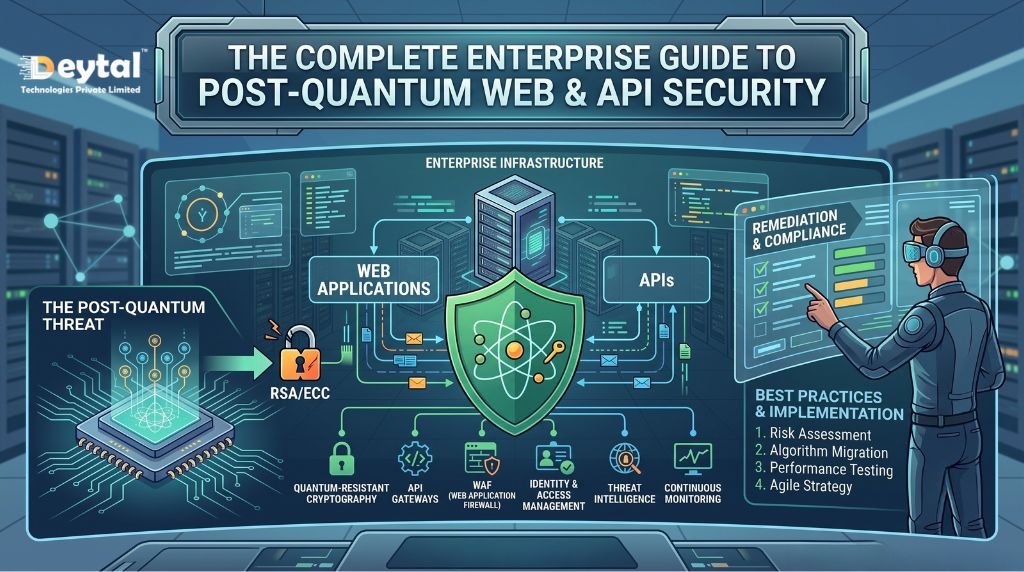
Virtually all modern digital security from HTTPS encryption and TLS certificates to SSH connections, digital signatures, and JWT authentication tokens relies on public-key cryptography (specifically RSA, Diffie-Hellman, and Elliptic Curve Cryptography). These mathematical foundations rely on the computational difficulty of factoring large composite integers or solving discrete logarithms. A Cryptographically Relevant Quantum Computer (CRQC) executing Shor’s algorithm will render these mathematical protections obsolete in minutes.
While fault-tolerant quantum computers are still evolving, the enterprise threat is immediate: “Harvest Now, Decrypt Later” (HNDL) attacks. Adversaries and nation-state actors are intercepting and archiving encrypted enterprise web communications today, intending to decrypt proprietary customer data, intellectual property, and financial records once quantum hardware matures. Post-Quantum Cryptography (PQC) Web Security modernizes web architectures by implementing quantum-resistant algorithms standardized by NIST to ensure long-term data confidentiality.
The Looming Vulnerabilities of Classical Cryptographic Stacks
Failing to audit and modernize enterprise cryptographic implementations exposes digital systems to several critical risks:
- Retroactive Data Decryption (HNDL): Sensitive records with long lifespans (medical data, financial histories, proprietary IP) transmitted over standard TLS 1.3 today are permanently compromised if intercepted.
- Certificate Authority & PKI Collapse: Legacy X.509 certificates rely on classical signatures; when public-key algorithms fall, attackers can forge trusted certificates and impersonate corporate web domains undetected.
- Increased Handshake Latencies: Post-quantum public keys and signatures are substantially larger than classical ECC keys, which can degrade network handshake speeds if edge routing is poorly configured.
- Hidden Cryptographic Dependencies: Hardcoded cryptographic libraries embedded deep within legacy APIs, backend microservices, and client mobile runtimes make rapid algorithm migration difficult.
Classical Web Encryption vs. Post-Quantum Cryptography (PQC)
| Cryptographic Metric | Classical Cryptography (RSA / ECC) | Post-Quantum Cryptography (PQC) |
| Mathematical Basis | Prime factorization, elliptic curve discrete logs | Lattice-based, hash-based, and code-based math |
| Primary Algorithms | RSA-2048/4096, ECDSA, ECDH (X25519) | ML-KEM (Kyber), ML-DSA (Dilithium), SLH-DSA |
| Quantum Resistance | Broken completely by Shor’s algorithm | Resistant to both classical and quantum attacks |
| Key & Ciphertext Size | Extremely small (~32 bytes for X25519) | Larger (~800 to 3,000+ bytes for ML-KEM) |
| Hybrid Mode Support | Single classical algorithm default | Hybrid key encapsulation (Classical + PQC dual-exchange) |
Strategic Pillars for Architecting a Quantum-Resilient Enterprise Stack
1. Cryptographic Agility & Modular Backend Engineering
Decouple cryptography from application business logic so encryption algorithms can be swapped via configuration rather than major code rewrites. Engineering modular security middleware and hardened microservices backends through Custom Software Development Services ensures core data persistence layers transition to quantum-safe standards without service interruptions.
2. Hybrid PQC Key Exchange & Edge Gateway Optimization
Implement hybrid key encapsulation mechanisms (such as X25519 + ML-KEM-768) at the CDN and reverse-proxy layer to protect live data streams without breaking backward compatibility for older browsers. Developing high-performance, quantum-ready web platforms via Website Development Services prevents larger post-quantum TLS handshakes from inflating round-trip latencies.
3. Clear Cryptographic Health Visibility & Security UI/UX
IT administrators and compliance officers need intuitive oversight of certificate expiration, algorithm compliance, and cipher suites across distributed endpoints. Designing clear security telemetry dashboards, compliance alerts, and audit reports through UI/UX Design Services makes complex enterprise security postures immediately accessible.
4. Quantum-Resilient Mobile App Security & API Handshakes
Update mobile application network stacks to support quantum-safe hybrid key exchanges for all internal API calls. Integrating modernized cryptographic libraries into client runtimes using Mobile App Development Services protects mobile data-in-transit from long-term interception risks on both iOS and Android.
5. Clean Caching Architecture & Technical Performance SEO
Ensure larger post-quantum TLS handshakes and packet sizes do not hurt Core Web Vitals or organic crawl efficiency. Pairing decoupled WordPress Development Services with data-driven SEO Services maintains top organic search visibility, sub-second indexing, and lightning-fast Time to First Byte (TTFB).
6. Trust-Driven Brand Authority & Enterprise Digital Marketing
Communicate enterprise security upgrades and compliance readiness to security-conscious enterprise buyers, systematically reinforced through B2B Digital Marketing Services.
Future-Proof Your Enterprise Infrastructure with Deytal Technologies
Migrating to post-quantum cryptography requires conducting comprehensive cryptographic inventories, deploying hybrid TLS configurations, and validating network MTU limits to prevent packet fragmentation. Deytal Technologies Pvt. Ltd. designs and implements quantum-resilient software architectures, modernized API gateways, and enterprise web solutions engineered to protect mission-critical assets against future threats.
Frequently Asked Questions (FAQ)
Q1: What are the primary post-quantum algorithms standardized by NIST?
The National Institute of Standards and Technology (NIST) finalized its core standards: ML-KEM (Module-Lattice-Based Key-Encapsulation Mechanism, formerly CRYSTALS-Kyber) for general encryption and key exchange, and ML-DSA (formerly CRYSTALS-Dilithium) and SLH-DSA (formerly SPHINCS+) for digital signatures.
Q2: What is “Hybrid Key Exchange” in PQC migration?
Hybrid key exchange combines a trusted classical algorithm (such as X25519) with a post-quantum algorithm (such as ML-KEM) in the TLS handshake. A connection is only broken if both algorithms are compromised, ensuring immediate quantum safety while preserving current classical compliance standards (FIPS).
Q3: How does PQC affect enterprise web application performance?
Because post-quantum public keys and digital signatures are larger than classical keys, TLS handshakes require more data transfer, which can cross standard TCP Maximum Segment Size (MSS) thresholds and trigger packet fragmentation. This makes edge caching and connection reuse (HTTP/2, HTTP/3) essential for preventing latency degradation.