

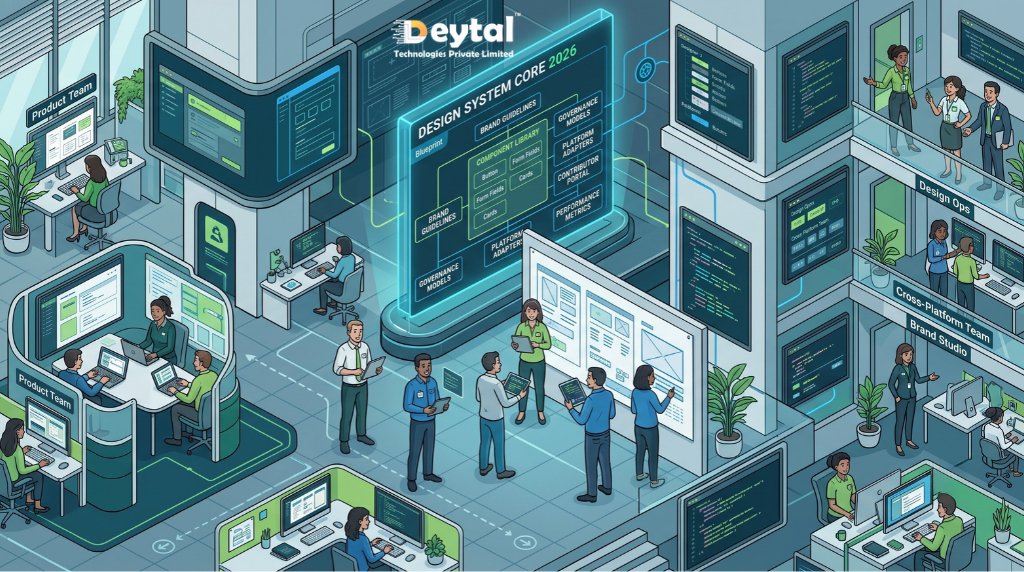
As enterprise software companies scale across multiple product squads, business verticals, and device platforms, digital product design inevitably hits a breaking point. What starts as a shared visual kit in Figma quickly diverges into fragmented component libraries, uncoordinated CSS overrides, duplicated engineering effort, and brand drift. Front-end engineers spend hours reinventing identical modal windows and data tables, while visual designers struggle to update brand palettes without breaking legacy web applications.
Enterprise Design Systems Architecture shifts UI/UX from static design asset kits into living, version-controlled software infrastructure. Built on structured multi-tier design tokens, the official Design Tokens Community Group (DTCG) standards, automated CI/CD transformation pipelines (such as Style Dictionary), and federated governance models, enterprise design systems create an authoritative single source of truth that synchronizes design intent and production code across web, mobile, and desktop environments.
The Hidden Bottlenecks of Unstructured Component Kits
Relying on informal component folders and undocumented style guidelines creates severe operational drag:
- Design-to-Code Drift: Updating a corner radius or accent color in a design file requires manual handoff meetings, Jira tickets, and error-prone copy-pasting across disparate frontend repositories.
- Ballooning Frontend Technical Debt: Without strict system primitives, product squads build custom “snowflake” components to meet tight deadlines, bloating CSS bundles and degrading Core Web Vitals.
- Accessibility and Compliance Failures: Implementing accessibility ad hoc causes widespread WCAG non-compliance, leaving enterprise interfaces vulnerable to legal risks and unusable for assistive tech users.
- Friction in Multi-Brand and White-Label Scaling: Enterprises running multiple sub-brands or white-label SaaS products end up maintaining separate codebases and stylesheets instead of swapping semantic variables dynamically.
Static UI Kits vs. Enterprise Design Systems Architecture
| Architectural Dimension | Static UI / Figma Kits | Enterprise Design Systems Architecture |
| Source of Truth | Disconnected Figma files and static guidelines | Version-controlled design tokens & headless component libraries |
| Token Tiering | Hardcoded hex values and raw pixel units | Three-layer tokens: Primitives $\rightarrow$ Semantics $\rightarrow$ Component overrides |
| Sync Automation | Manual engineering handoffs and spec docs | Automated CI/CD pipelines compiling JSON to CSS/iOS/Android |
| Governance Model | Unmanaged contribution or bottlenecked reviews | Federated governance with automated linters and codeowners |
| Multi-Brand Theming | Forked repositories and duplicate stylesheets | Instant theme switching via semantic token mapping |
Strategic Pillars for Engineering an Enterprise Design System
1. Automated Token Pipelines & Headless Component Runtimes
Establish a centralized repository of design tokens following the vendor-neutral DTCG JSON specification. Automating token distribution via Style Dictionary pipelines directly into CSS variables, Tailwind configurations, Swift, and Kotlin assets through Custom Software Development Services ensures zero-drift synchronization between design tools and production code.
2. Resilient Web Design Systems & Micro-Frontend Integration
Develop decoupled, framework-agnostic component libraries that integrate cleanly across legacy portals, React frameworks, and server-rendered micro-frontends. Constructing high-performance web frontends via Website Development Services prevents layout thrashing, minimizes client runtime overhead, and guarantees predictable responsive behavior across all viewports.
3. Ergonomic Token Architecture & Systematic UI/UX Design
A design system fails if product designers find it too rigid or complex to use during fast-moving sprints. Designing intuitive token hierarchies, comprehensive usage documentation, and accessible component states through UI/UX Design Services bridges the mental models of creative teams and software architects, accelerating sprint velocity.
4. Unified Cross-Platform Mobile Token Consumption
Bring design tokens directly into native mobile platforms so spacing scales, typography ramps, and color palettes match web implementations pixel-for-pixel. Integrating shared token engines within iOS and Android applications via Mobile App Development Services guarantees uniform interaction physics and instant dark-mode transitions across native operating systems.
5. Clean Platform Caching & Technical SEO Performance
Ensure unified UI foundations do not bloat DOM trees or drag down web page speed scores. Pairing clean, semantic HTML patterns through WordPress Development Services with modern SEO Services maintains top organic search authority, fast indexing, and optimal Core Web Vitals (INP and LCP).
6. Brand Consistency Across Enterprise Digital Marketing
Maintain consistent brand equity across campaign landing pages, dynamic display banners, and multi-channel acquisition funnels, systematically governed and scaled through Digital Marketing Services.
Scale Your Digital Foundations with Deytal Technologies
Building a scalable design system requires token architecture design, automated Git-to-Figma sync tooling, and an organizational governance model that encourages product squad contribution. Deytal Technologies Pvt. Ltd. designs and architects enterprise design systems, multi-brand token engines, and high-performance component libraries engineered to accelerate product velocity and eliminate design debt.
Frequently Asked Questions (FAQ)
Q1: What is the difference between Primitive, Semantic, and Component tokens?
- Primitive Tokens: Raw, context-agnostic design values (e.g.,
blue-600: #2563EBorspace-4: 16px). - Semantic Tokens: Intent-based decisions that describe purpose rather than value (e.g.,
color-background-action-primary: {blue-600}). These enable dark mode and multi-brand themes by remapping values without touching component code. - Component Tokens: Specific, scoped overrides tied directly to a single UI element (e.g.,
button-primary-background: {color-background-action-primary}).
Q2: How does a federated governance model keep enterprise design systems from becoming bottlenecks?
In a federated model, a small core platform team maintains system foundations (tokens, build tools, accessibility baselines, documentation), while product squads contribute new patterns and components through peer-reviewed pull requests. This prevents the core team from becoming a bureaucratic gatekeeper and ensures the system reflects real-world product needs.
Q3: How do automated pipelines prevent design drift in production?
Automated pipelines use tools like Style Dictionary triggered by Git hooks or Figma webhooks. Whenever a designer modifies a token value, the build pipeline generates a pull request that updates platform-specific code assets, runs visual regression tests in Storybook, and flags any unmapped hardcoded values (snowflakes) using automated code linters before deployment.