

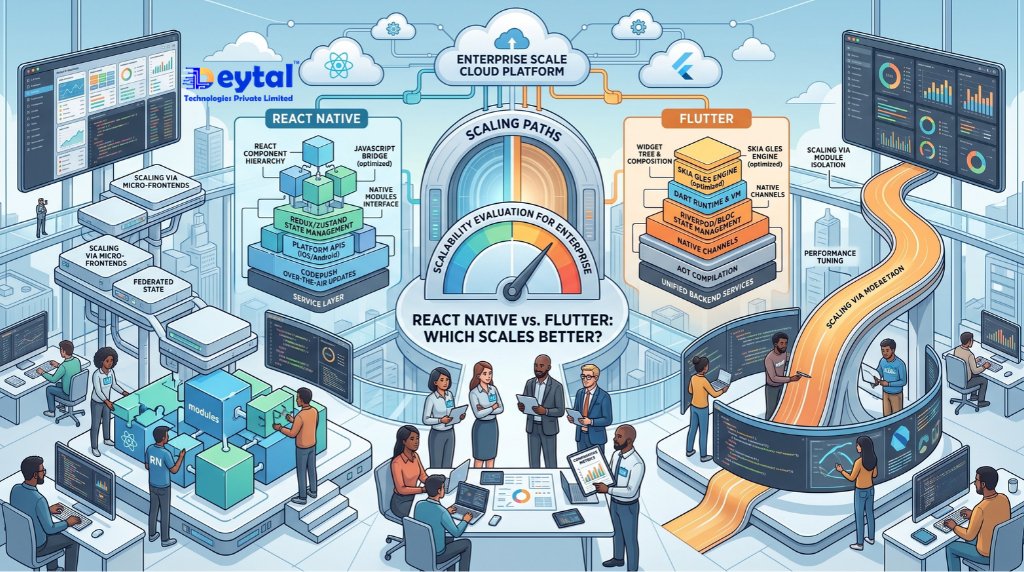
Enterprise engineering teams developing customer-facing or internal mobile apps face a persistent dilemma: build native apps twice using separate Swift and Kotlin codebases, or adopt a cross-platform framework to consolidate engineering velocity. While maintaining separate native teams doubles headcount costs, slows feature parity, and complicates release management, early-generation cross-platform solutions often suffered from sluggish bridge serialization, jank-ridden scrolling, and inconsistent native module support.
Modern Enterprise Cross-Platform App Architecture has evolved significantly. With React Native replacing its legacy JavaScript bridge with the C++ based New Architecture (TurboModules, Fabric, and JSI), and Flutter standardizing its low-latency Impeller rendering engine across iOS and Android, enterprise leaders can now deliver near-native 120 FPS performance and hardware-accelerated interfaces from a unified codebase.
The Hidden Costs of Dual-Native Mobile Development
Maintaining isolated iOS and Android codebases creates distinct organizational friction:
- Desynchronized Release Cycles: Features launch unevenly across platforms, creating fragmented customer experiences, split marketing schedules, and delayed compliance approvals.
- Doubled Engineering Overhead: Teams duplicate business logic, API client serialization, state management machines, and offline caching routines across two distinct programming languages.
- Higher Defect Surface Area: Resolving edge-case bugs twice in separate runtimes inflates QA validation cycles, regression testing overhead, and release risk.
- Talent Siloing: Mobile engineers remain locked into platform-specific stacks, preventing cross-functional resource sharing during critical project delivery windows.
Architectural Showdown: Flutter vs. React Native
| Architectural Dimension | Flutter (Google) | React Native (Meta) |
| Language & Runtime | Dart (Compiled AOT to machine code) | TypeScript / JavaScript (JIT/AOT via Hermes engine) |
| Rendering Strategy | Self-contained engine (Impeller / Skia) | Native OS platform widgets via Fabric renderer |
| Communication Layer | Direct C/C++ engine bindings; zero runtime bridge | JavaScript Interface (JSI); direct C++ memory references |
| UI Consistency | Pixel-identical across all devices & OS versions | Adapts automatically to host OS native look-and-feel |
| Ecosystem & Web Sharing | Strong unified SDK; web targets require canvas | Extensive npm ecosystem; high code-sharing with web React |
| Enterprise Best Fit | High-performance, graphic-heavy, custom brand UI | Dynamic platforms sharing deep web logic and ecosystems |
Strategic Pillars for Engineering an Enterprise Cross-Platform Mobile Stack
1. Modular API Contracts & High-Performance Data Layers
Ensure backend data schemas integrate cleanly into typed client state models. Engineering robust, versioned REST/GraphQL backends and streaming WebSockets through Custom Software Development Services ensures low latency, reliable bi-directional communication, and minimal client memory consumption.
2. Shared Logic Architecture & Web-to-Mobile Synchronization
Leverage monorepo tooling to share business logic, API validation schemas, and utility layers between web applications and mobile clients. Constructing resilient web platforms alongside mobile systems via Website Development Services maximizes engineering reuse and ensures consistent behavior across browsers and native apps.
3. Ergonomic Mobile Interface Physics & Design Systems
Cross-platform apps fail when interactions feel unnatural to platform veterans. Designing native gesture responses, platform-specific navigation hierarchies, and responsive tactile animations through UI/UX Design Services creates seamless, fluid user experiences that match platform expectations on both iOS and Android.
4. Native Hardware Integrations & Core Runtime Engineering
Deploy custom platform channels or native C++ modules for low-level device capabilities like Bluetooth Low Energy (BLE), hardware-backed cryptographic keystores, biometrics, and background geolocation. Building secure native extensions using Mobile App Development Services ensures zero functional compromise when accessing device peripherals.
5. Seamless Content Ingestion & Headless Mobile Feeds
Power dynamic in-app newsrooms, knowledge bases, and product catalogs using decoupled CMS infrastructure. Integrating flexible headless endpoints via WordPress Development Services coupled with SEO Services guarantees fast content synchronization, deep-linking discovery, and strong organic search authority for web-mirrored landing pages.
6. Product-Led Acquisition & Mobile App Store Optimization
Drive sustained organic and paid downloads by aligning technical app store optimization (ASO) with targeted customer acquisition funnels, tracked and continuously scaled via Digital Marketing Services.
Modernize Your Mobile Architecture with Deytal Technologies
Choosing between Flutter and React Native requires a rigorous audit of your engineering capabilities, performance requirements, and long-term product roadmaps. Deytal Technologies Pvt. Ltd. designs and implements scalable enterprise cross-platform mobile architectures, robust backend services, and high-performance native modules engineered to reduce delivery timeframes and maximize user retention.
Frequently Asked Questions (FAQ)
Q1: How has React Native eliminated performance bottlenecks in modern deployments?
React Native introduced the New Architecture, replacing the legacy asynchronous JSON bridge with the JavaScript Interface (JSI). JSI allows JavaScript to invoke methods directly on native C++ host objects without serialization overhead, enabling synchronous execution, faster startup times, and smooth 120 FPS animations via the Fabric rendering engine.
Q2: What advantage does Flutter’s Impeller rendering engine offer over its legacy Skia engine?
Impeller completely eliminates “shader compilation jank.” Legacy mobile rendering engines compiled shaders on-the-fly when a new animation or visual asset first appeared on screen, causing dropped frames. Impeller pre-compiles all necessary shaders during the engine build phase, delivering consistent, stutter-free animations from the first frame.
Q3: When should an enterprise still prefer pure native development (Swift/Kotlin)?
Pure native development remains the best choice for specialized applications that interact heavily with bleeding-edge OS features immediately upon release (such as complex ARKit/ARCore computational geometry, deep system accessibility hooks, or low-level kernel audio processing) where maintaining custom cross-platform bridges would incur excessive ongoing maintenance costs.