

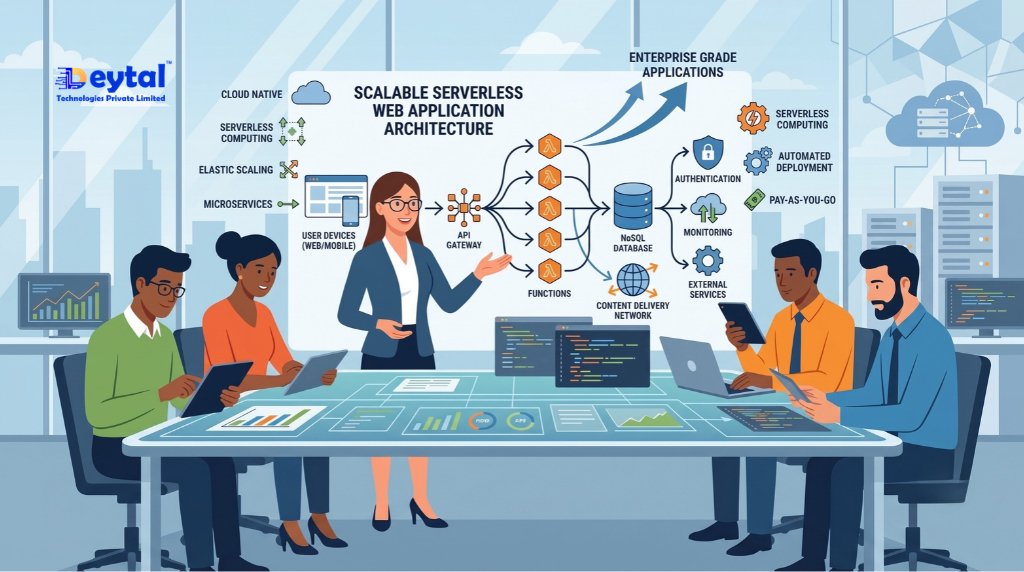
For decades, deploying enterprise web applications required infrastructure engineers to estimate traffic peaks, provision fixed virtual machines, and manage routine OS patch cycles. Even with container orchestration tools like Kubernetes, engineering teams still dedicate significant resources to tuning node pools, managing horizontal pod autoscalers (HPA), and paying for idle infrastructure during off-peak hours.
Serverless Web Application Architecture abstracts compute, storage, and networking entirely into on-demand, event-driven managed services. By shifting from persistent servers to fine-grained Function-as-a-Service (FaaS) runtimes and managed cloud backends (such as AWS Lambda, Google Cloud Run, and Azure Functions), enterprises achieve scale-to-zero cost efficiency, automated fault tolerance, and near-instant horizontal scalability across distributed web applications.
The Infrastructure Overhead of Provisioned Web Servers
Relying on traditional VM- or container-bound server fleets introduces ongoing friction into software delivery:
- Over-Provisioning & Idle Compute Waste: Sizing clusters for worst-case traffic surges leaves significant compute capacity underutilized during low-traffic periods.
- Operational Maintenance Debt: Securing base images, applying operating system security patches, and monitoring hypervisors pull engineering squads away from shipping customer-facing features.
- Sluggish Auto-Scaling Curves: Provisioning and bootstrapping new virtual machine nodes or pulling heavy container images during unexpected traffic spikes can take minutes, causing request throttling and dropped connections.
- Disaster Recovery Complexity: Architecting multi-availability-zone (multi-AZ) active failovers with dedicated VMs requires bespoke load-balancing topologies and high operational costs.
Provisioned Virtual Infrastructure vs. Serverless Web Application Architecture
| Architectural Dimension | Provisioned Servers & Kubernetes | Enterprise Serverless Web Architecture |
| Compute Scaling Model | Coarse-grained node/pod auto-scaling | Fine-grained per-request execution |
| Billing Granularity | Charged hourly/monthly for reserved resources | Billed strictly in millisecond execution slices |
| Idle Capacity Cost | Ongoing fixed overhead for unutilized capacity | Scale-to-zero (zero requests = zero compute cost) |
| Maintenance Burden | OS patching, container base updates, sizing | Cloud provider manages all underlying layers |
| High Availability | Manual multi-AZ replication and routing | Multi-AZ redundancy baked in by default |
Strategic Pillars for Architecting an Enterprise Serverless Web Platform
1. Event-Driven Microservices & Cloud-Native Backends
Deconstruct monolithic application workflows into discrete, single-purpose functions triggered by HTTP calls, queue events, or database change streams. Engineering clean execution runtimes, asynchronous dead-letter queues, and managed API gateway throttling through Custom Software Development Services ensures backend logic executes with minimal memory footprints and sub-second response times.
2. Modern Edge-Rendered Web Frontends
Pair serverless backends with statically generated, globally distributed frontend architectures (JAMstack/Edge SSR). Developing decoupled web frontends via Website Development Services allows static web assets to be cached across edge points of presence (PoPs), serving end users instantly while invoking serverless functions only for dynamic data mutations.
3. Ergonomic Telemetry & Dashboard UI/UX Design
Stateless serverless microservices can complicate end-to-end user tracking without proper interface and telemetry design. Designing clear asynchronous UI patterns—such as optimistic UI states, skeleton loaders, and distributed task monitoring consoles—through UI/UX Design Services keeps asynchronous user interactions responsive and transparent.
4. Lightweight, Data-Efficient Mobile Backends
Power enterprise mobile applications with dedicated serverless endpoints that expose precisely the data view models required by mobile clients. Developing responsive mobile application architectures using Mobile App Development Services reduces mobile payload sizes, speeds up API responses, and optimizes battery consumption across iOS and Android devices.
5. Clean Serverless Content Delivery & Technical SEO
Ensure dynamic serverless rendering patterns do not penalize search bot crawlers or inflate Time to First Byte (TTFB). Pairing headless CMS backends through WordPress Development Services with advanced SEO Services maintains top organic search authority, fast indexing, and optimal Core Web Vitals across millions of dynamically served pages.
6. Edge-Targeted Experiments & Scalable Digital Campaigns
Leverage edge compute functions to run sub-millisecond A/B testing variations, geographic redirections, and personalized landing experiences without origin roundtrips, continuously scaled and monitored via Digital Marketing Services.
Accelerate Your Serverless Journey with Deytal Technologies
Adopting an enterprise serverless web application architecture requires clear observability instrumentation, cold-start mitigation techniques, and robust database connection pooling patterns. Deytal Technologies Pvt. Ltd. designs, builds, and modernizes enterprise cloud platforms, custom event-driven architectures, and scalable web solutions engineered for maximum performance and cost efficiency.
Frequently Asked Questions (FAQ)
Q1: How do modern enterprise serverless architectures resolve the “cold start” latency issue?
Cold starts occur when a cloud provider initializes a new runtime container for a function after an idle period. Modern architectures mitigate this by compiling runtimes to lightweight targets (like Go or Rust), utilizing provider features such as Provisioned Concurrency, minimizing deployment bundle sizes, or deploying latency-critical logic to edge runtimes with V8-isolate architectures.
Q2: How do serverless functions handle relational database connection limits?
Traditional relational databases (PostgreSQL, MySQL) struggle with thousands of rapid, ephemeral connections opened by scaling serverless instances. Enterprises solve this by utilizing managed database connection proxies (like AWS RDS Proxy), connection pooling middleware, or adopting serverless-native distributed databases (like Amazon Aurora Serverless, PlanetScale, or FaunaDB) that connect via HTTP APIs.
Q3: When should an enterprise choose containers over serverless functions?
Containers remain preferable for long-running, continuous compute workloads (e.g., intensive video processing, complex machine learning training), monolithic applications requiring deep OS-level kernel tuning, or legacy applications that cannot be refactored into stateless, event-driven execution models.