

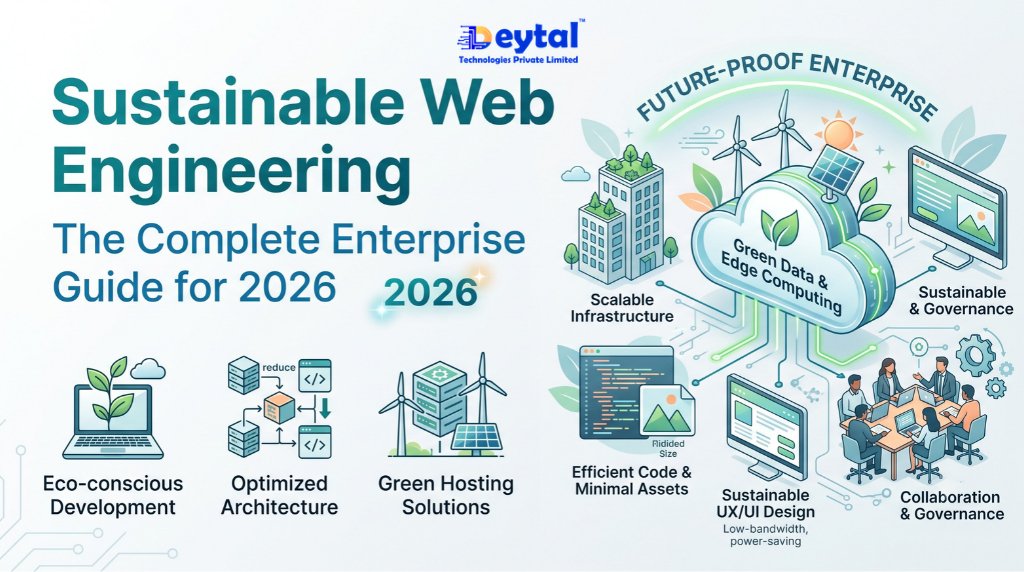
Digital infrastructure accounts for a growing percentage of global electricity consumption and greenhouse gas emissions. For enterprise brands, every unnecessary database query, bloated JavaScript bundle, and over-provisioned idle server incurs both a financial cost on monthly cloud invoices and a measurable carbon footprint.
With stricter ESG reporting mandates and consumer scrutiny rising, sustainability has become an engineering discipline. Sustainable Web Engineering aligns green digital design with web performance. By optimizing compute cycles, adopting carbon-aware cloud scheduling, and trimming front-end payloads, enterprises lower cloud expenditure, achieve near-instant page speeds, and hit corporate decarbonization targets.
The Hidden Environmental and Financial Toll of Bloated Software
Treating cloud compute and network bandwidth as limitless resources introduces major operational inefficiencies:
- Bloated Client Bundles & CPU Churn: Massive JavaScript execution forces end-user devices to draw excessive battery and processing power, creating poor Core Web Vitals and battery drain.
- Over-Provisioned Cloud Compute: Hosting environments configured for peak loads that sit idle 80% of the day burn unnecessary kilowatt-hours and inflate cloud infrastructure budgets.
- Redundant Data Transmission: Serving uncompressed, uncached assets across global backbones consumes network transmission power at every intermediate routing hop.
- ESG Compliance Penalties: Enterprise procurement processes and global regulatory frameworks increasingly require software supply chain carbon disclosures.
Legacy Web Development vs. Sustainable Green Web Engineering
| Engineering Metric | Traditional Web Architecture | Sustainable Web Engineering |
| Compute Efficiency | Over-provisioned, always-on monolithic instances | Auto-scaling, serverless, and carbon-aware scheduling |
| Page Weight & Payloads | Bloated bundles (5MB+), multiple render-blocking tags | Lean payloads (<1MB), tree-shaken, minimal scripts |
| Data Center Selection | Chosen strictly by default pricing | Selected based on regional renewable energy grid mix |
| Caching & Invalidation | Basic browser caching with frequent origin trips | Aggressive edge caching with sub-millisecond invalidation |
| Impact on Core Web Vitals | High INP and LCP degradation from script execution | Perfect green scores via sub-second rendering |
Strategic Pillars of a Sustainable Web Engineering Architecture
1. Energy-Efficient Backend Algorithms & Scalable Systems
Refactor computationally intensive database queries and background cron tasks into streamlined, non-blocking routines. Engineering lean backends through Custom Software Development Services reduces server CPU utilization per transaction, cutting kilowatt consumption and cloud compute costs.
2. Carbon-Conscious, Ultra-Lean Web Frontends
Strip out main-thread blocking code, unneeded third-party libraries, and heavy typography. Constructing high-speed web platforms via Website Development Services ensures web applications consume minimal processing power on mobile phones and desktop browsers.
3. Purpose-Driven, Low-Emissions UI/UX Design
Digital carbon emissions drop when users complete their journeys in fewer clicks. Designing streamlined navigation pathways, system-font fallbacks, and energy-saving dark modes through UI/UX Design Services creates seamless, accessible experiences with zero visual clutter.
4. Battery-Preserving Mobile Application Development
Prevent mobile apps from running battery-draining background polling routines and excessive network calls. Building battery-efficient client applications with Mobile App Development Services keeps CPU wake-locks to a minimum while preserving native performance.
5. Clean Content Delivery & Organic Search Authority
Sustainable websites naturally rank better. Pairing low-carbon, clean-coded themes via WordPress Development Services with high-impact SEO Services optimizes Core Web Vitals (LCP, INP, CLS), earning search engine rewards for speed and technical clarity.
6. High-Intent Conversion Funnels & Sustainable Growth
Replace noisy, high-bounce outbound campaigns with targeted, high-intent conversion journeys managed through Digital Marketing Services to drive customer acquisition with zero wasted digital traffic.
Engineer a Low-Carbon Digital Future with Deytal Technologies
Adopting sustainable web engineering practices is that rare architectural upgrade where environmental responsibility directly drives business ROI: lower cloud bills, higher conversion rates, and faster search rankings. Deytal Technologies Pvt. Ltd. designs, audits, and builds high-performance, carbon-efficient enterprise web applications engineered to scale cleanly.
Frequently Asked Questions (FAQ)
Q1: How does a lightweight, sustainable website improve Core Web Vitals?
Sustainable web design focuses on eliminating unused JavaScript, optimizing image compression (WebP/AVIF), and streamlining the DOM. This directly resolves Interaction to Next Paint (INP) delays and Largest Contentful Paint (LCP) bottlenecks.
Q2: What is carbon-aware cloud computing?
Carbon-aware computing schedules non-urgent, compute-heavy workloads (such as nightly database backups, machine learning batch jobs, or video processing) to run in geographic data regions during times when the local electrical grid is powered by renewable solar or wind energy.
Q3: Does building a green website require sacrificing visual appeal and rich features?
No. Sustainable web engineering is about performance efficiency, not deprivation. By utilizing modern CSS effects over heavy JavaScript animations, serving modern media formats, and relying on edge caching, brands deliver visually striking experiences that remain exceptionally light on energy consumption.