

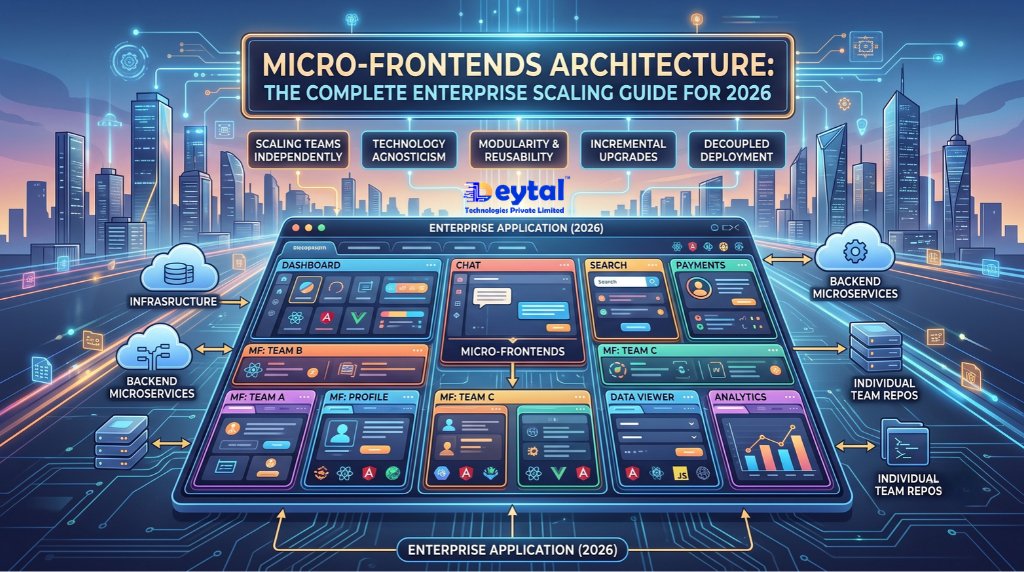
Modern software engineering successfully broke down massive backend monoliths into agile, independently scalable microservices. Yet, many organizations left their user interfaces untouched, creating a massive, monolithic single-page application (SPA) maintained by dozens of separate product squads. As multiple teams commit code to the same massive repository, release pipelines stall, merge conflicts multiply, and a single regression can take down the entire user interface.
Micro-Frontends Architecture extends microservices principles directly into the presentation layer. By decomposing a monolithic frontend into semi-autonomous, feature-driven mini-applications assembled at runtime (using patterns like Webpack Module Federation or native ESM imports), enterprise teams can build, test, and deploy features independently without sacrificing a cohesive end-user experience.
The Bottlenecks of the Frontend Monolith
When hundreds of developers collaborate on a single frontend repository, significant engineering issues emerge:
- Deployment Gridlock: A single failing test in an auxiliary feature module blocks critical production releases across the entire enterprise application.
- Fragile Global Dependencies: Upgrading a core dependency (such as React, Vue, or Angular) requires coordinated refactoring across all teams, often taking months or stalling completely.
- Bloated Bundle Sizes: Monolithic bundles accumulate dead code, duplicate utility libraries, and unnecessary dependencies that severely degrade initial page load speeds and Core Web Vitals.
- Organizational Friction: Code ownership boundaries blur, resulting in slow pull request approvals, extensive cross-team sync meetings, and frequent git merge conflicts.
Monolithic Frontend vs. Micro-Frontends Architecture
| Architectural Dimension | Monolithic SPA Architecture | Micro-Frontends Architecture |
| Codebase Structure | Single massive repo or tightly coupled monorepo | Independent repositories or modular workspaces |
| Team Autonomy | High dependency on cross-team approvals | Autonomous teams deploy their own vertical domains |
| Deployment Cadence | Slow, coordinated, and high-risk releases | Continuous, independent, zero-downtime rollouts |
| Tech Stack Flexibility | Locked to a single framework and version | Freedom to adopt or upgrade frameworks per domain |
| Fault Isolation | A crash in one component breaks the whole screen | Isolated errors handled gracefully with UI fallbacks |
Engineering Pillars of a Modern Micro-Frontends Platform
1. Dynamic Runtime Integration & Module Federation
Orchestrate independent frontend micro-apps dynamically in the user’s browser without hard page refreshes. Engineering robust runtime gateways and decoupled domain logic through Custom Software Development Services ensures that micro-apps share common runtime libraries while deploying independently.
2. Unified Shell Applications & State Management
Build a lightweight host container that manages authentication, global layout, cross-application communication, and routing. Developing responsive shell architectures via Website Development Services ensures seamless navigation between different micro-frontend boundaries.
3. Enterprise Design Systems & Cohesive UI/UX
Independent teams can easily drift into inconsistent user experiences without strict interface governance. Establishing shared, framework-agnostic design tokens, accessible component libraries, and visual guidelines through UI/UX Design Services keeps the look, feel, and interaction patterns uniform across all micro-frontends.
4. Unified Mobile & Micro-App Strategy
Extend modular frontend concepts into native mobile applications via micro-apps and decoupled features. Building unified, modular client experiences using Mobile App Development Services guarantees feature parity and shared design systems across web, iOS, and Android platforms.
5. Clean Content Delivery & Organic Technical SEO
Prevent dynamic client-side loading from hurting crawlability and search indexing. Combining server-side rendered (SSR) headless WordPress Development Services with advanced SEO Services maintains top organic search visibility, rapid indexing, and optimal Core Web Vitals scores.
6. Targeted Funnel Experiments & High-Velocity Optimization
Allow growth teams to launch targeted landing pages, checkout experiments, and conversion funnels rapidly without waiting on enterprise-wide release cycles, all systematically scaled through Digital Marketing Services.
Scale Your Enterprise Frontend with Deytal Technologies
Migrating from a brittle frontend monolith to a performant micro-frontends architecture requires thoughtful routing strategies, shared dependency management, and design system governance. Deytal Technologies Pvt. Ltd. designs and implements scalable enterprise micro-frontends, custom cloud-native portals, and modular engineering architectures built to eliminate organizational bottlenecks and drive sustainable business growth.
Frequently Asked Questions (FAQ)
Q1: What is Webpack Module Federation, and why is it important for micro-frontends?
Module Federation allows a JavaScript application to dynamically load code from another application at runtime. It solves the performance issue of micro-frontends by letting separate builds share common dependencies (like React or Lodash) so users don’t download duplicate libraries multiple times.
Q2: How do independent micro-frontends communicate with each other?
Micro-frontends should be as loosely coupled as possible. When communication is necessary, they typically use standard browser mechanisms like custom events (CustomEvent API), a lightweight pub/sub event bus, or URL query parameters, avoiding tight programmatic coupling between modules.
Q3: Can different micro-frontends use completely different UI frameworks?
Technically, yes. Module Federation and web components make it possible to run React, Vue, and Angular on the same page. However, in an enterprise setting, running multiple heavy frameworks simultaneously hurts performance and bundle size. Best practice is to standardize on a primary framework while allowing teams to upgrade versions independently.