

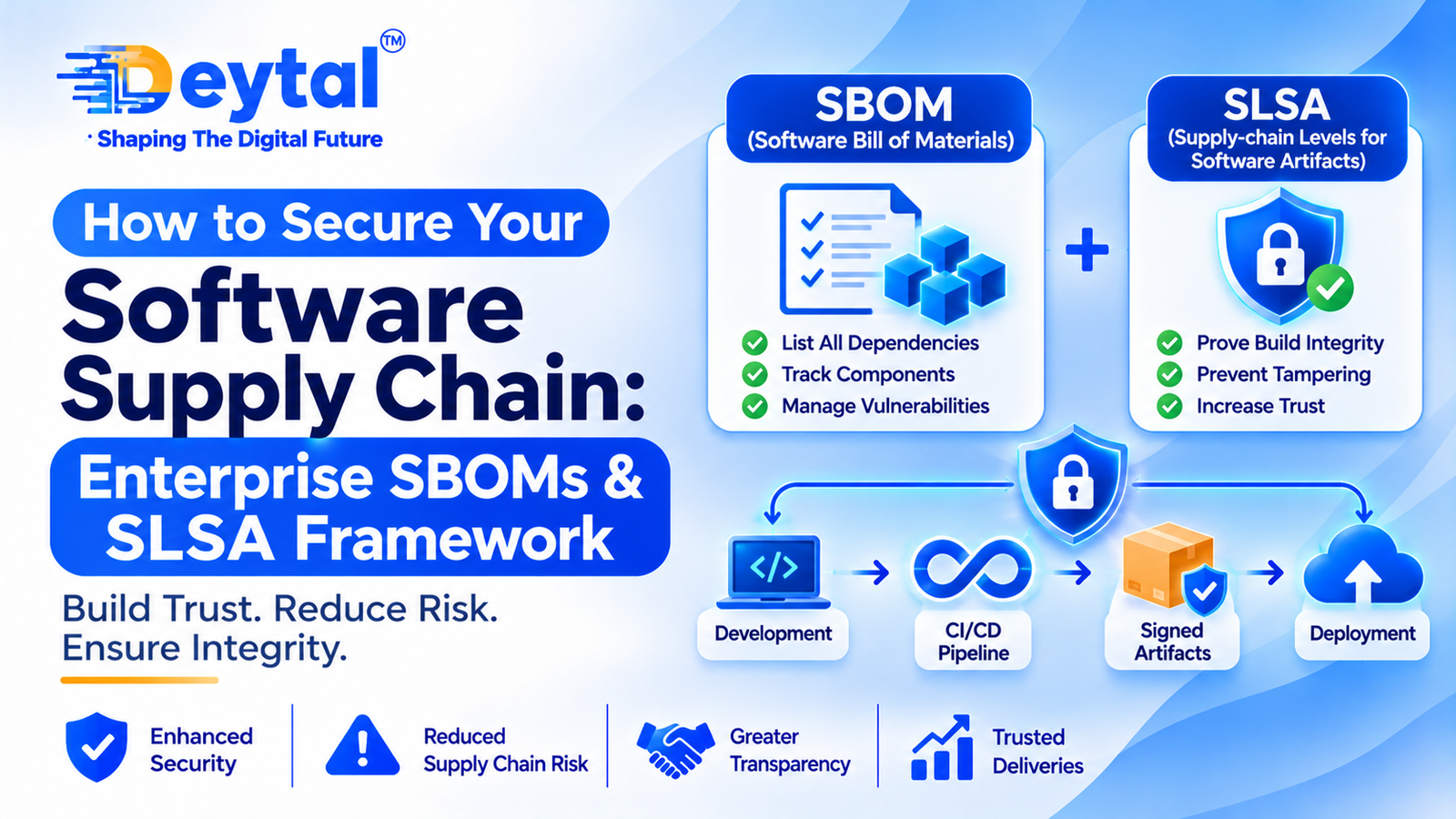
Modern enterprise applications are rarely built entirely from internal source code; upwards of 80% to 90% of a production codebase is composed of open-source third-party dependencies, upstream base images, runtime libraries, and automated CI/CD build scripts. While this composability accelerates development cycles, it has turned the software supply chain into a prime attack surface. Incidents like the SolarWinds build compromise, Log4Shell zero-days, and deliberate open-source backdoor injections have exposed the limits of perimeter-focused security: a cryptographically secure, firewall-protected production cluster is useless if malicious code is compiled directly into the binary during the build process.
Software Supply Chain Security for the Enterprise extends Zero Trust principles across the entire Software Development Life Cycle (SDLC). By operationalizing machine-readable Software Bills of Materials (SBOMs), implementing Supply-chain Levels for Software Artifacts (SLSA) framework controls, and enforcing cryptographic provenance with Sigstore Cosign and in-toto attestations, enterprise engineering teams verify that every deployed container image and binary corresponds exactly to reviewed source commits.
The Anatomy of Modern Supply Chain Vulnerabilities
Relying exclusively on post-deployment vulnerability scanning leaves critical gaps in the delivery pipeline:
- Typosquatting & Dependency Confusion: Attackers publish malicious packages with names nearly identical to legitimate open-source libraries or internal private packages, tricking package managers (npm, PyPI, Go) into executing unvetted code during CI runs.
- Compromised Build Infrastructure: If CI/CD runners (such as GitHub Actions or GitLab runners) lack ephemeral isolation, adversaries can modify compiler binaries or inject malicious backdoors into intermediate build steps without altering a single line of Git source code.
- Tampered Container Registries: Storing container images without cryptographic signatures allows malicious actors with registry write permissions to swap legitimate production tags with infected images.
- Blind Dependency Sprawl: Without dynamic, machine-readable dependency inventories, identifying which production microservices run a newly disclosed critical CVE (such as an unpatched serialization utility) can take weeks of manual log auditing.
Enterprise SBOM Standards: CycloneDX vs. SPDX
| Dimension | CycloneDX (OWASP / Ecma Standard) | SPDX (Linux Foundation / ISO 5962) |
| Origin & Focus | Purpose-built for application security, vulnerability tracking, and BOM types | Built around open-source license compliance and intellectual property tracking |
| Document Architecture | Lightweight, flat component-centric model with native dependencies array | Detailed package-and-relationship graph with element profiles (SPDX 3.0) |
| Vulnerability & VEX Integration | Native, mature Vulnerability Exploitability eXchange (VEX) embedded schema | Historically external; introduced via Security profile in SPDX 3.0 |
| BOM Scope Diversity | Broad coverage: Software (SBOM), SaaS (SaaSBOM), Hardware (HBOM), AI/ML | Focused primarily on system packages, source files, and embedded software stacks |
| Industry Standard Status | Ecma International Standard (ECMA-424) | International Standard ISO/IEC 5962:2021 |
| Common Enterprise Ecosystem | AppSec tooling, Dependency-Track, Trivy, container scanners | Corporate legal compliance, OSPOs, embedded Linux, Linux kernel |
Strategic Pillars for Securing the Enterprise Supply Chain
1. Ephemeral Build Environments & Cryptographic Attestations (SLSA)
Harden build pipelines to meet SLSA Level 3 compliance by isolating build runners in ephemeral environments that discard state after every execution. Generating signed build provenance using in-toto attestations and keyless Sigstore Cosign—orchestrated via custom CI/CD automation built by Custom Software Development Services—ensures no binary reaches production without verifiable source commits.
2. Automated Admission Control & Resilient Web Delivery
Prevent untrusted images from running on production Kubernetes clusters using admission controllers like Kyverno or OPA Gatekeeper that reject unverified signatures at runtime. Building unified, edge-delivered management portals through Website Development Services ensures deployment status, build health, and signed releases are tracked reliably across all engineering units.
3. Visual Dependency Graphs & Risk Explorer UI/UX Design
Transitive dependencies often span thousands of nested packages across an enterprise portfolio. Designing clear dependency trees, vulnerability impact maps, and VEX statement management consoles via UI/UX Design Services helps security teams prioritize real exploitable risks over harmless, non-callable library warnings.
4. Secure SDK Verification for Mobile Application Ecosystems
Mobile apps routinely embed third-party advertising, analytics, and social login SDKs that can act as supply chain trojans. Auditing binary dependencies, enforcing strict binary signing, and implementing runtime tamper-detection routines via Mobile App Development Services guarantees mobile clients deployed on iOS and Android run vetted, authenticated code.
5. Clean Dependency Governance & Headless Platform Integrity
Maintain security hygiene across public-facing enterprise content hubs and technical documentation sites. Hardening decoupled content management runtimes, locking down plugin ecosystems, and automating dependency patching through WordPress Development Services coupled with data-backed SEO Services prevents third-party script compromises that harm Core Web Vitals, organic search authority, and customer trust.
6. Trust-Driven Enterprise Positioning & Compliance Growth Funnels
Position verified supply chain security postures (including compliance with EU Cyber Resilience Act, Executive Order 14028, and SOC 2 Type II supply chain controls) as core differentiators in enterprise B2B sales pipelines, supported by Digital Marketing Services.
Fortify Your Software Supply Chain with Deytal Technologies
Securing modern delivery pipelines requires moving beyond periodic code reviews to automated provenance validation, signed container workflows, and continuous SBOM governance. Deytal Technologies Pvt. Ltd. designs, audits, and implements end-to-end software supply chain security frameworks, automated SLSA-compliant CI/CD pipelines, and zero-trust cloud architectures engineered to prevent unauthorized tampering, safeguard sensitive data, and pass strict enterprise compliance audits.
Frequently Asked Questions (FAQ)
Q1: What is the practical difference between an SBOM and an in-toto Attestation?
An SBOM (Software Bill of Materials) is an inventory list detailing all open-source libraries, packages, versions, and licenses bundled into a piece of software. An in-toto attestation is an authenticated statement about the software creation process—it cryptographically verifies who built the software, which source repository and commit SHA was used, which compiler was invoked, and whether all designated security tests passed. In short: an SBOM shows what is in the artifact; an attestation proves how and by whom it was built.
Q2: What is VEX (Vulnerability Exploitability eXchange) and why is it critical?
Standard dependency scans flag every known CVE found in an application’s dependencies, creating high volumes of alert fatigue. VEX is a companion document to an SBOM that allows development teams to declare whether a specific vulnerability is actually exploitable within their specific deployment context (e.g., “CVE-XXXX is present in the codebase, but the vulnerable function is never invoked in this runtime”). This eliminates noise and helps incident responders focus on genuine production risks.
Q3: How does Sigstore Cosign work without traditional long-lived private keys?
Sigstore provides “keyless” signing by leveraging short-lived cryptographic certificates. When a developer or CI runner signs an artifact, Sigstore’s certificate authority (Fulcio) issues an ephemeral certificate tied to the signer’s verified OIDC identity (e.g., a specific GitHub Actions workflow running on an authenticated repository). The signature and cryptographic proof are logged in a tamper-evident public transparency log (Rekor), allowing deployment admission controllers to verify provenance without managing and rotating private keys on long-lived servers.
