

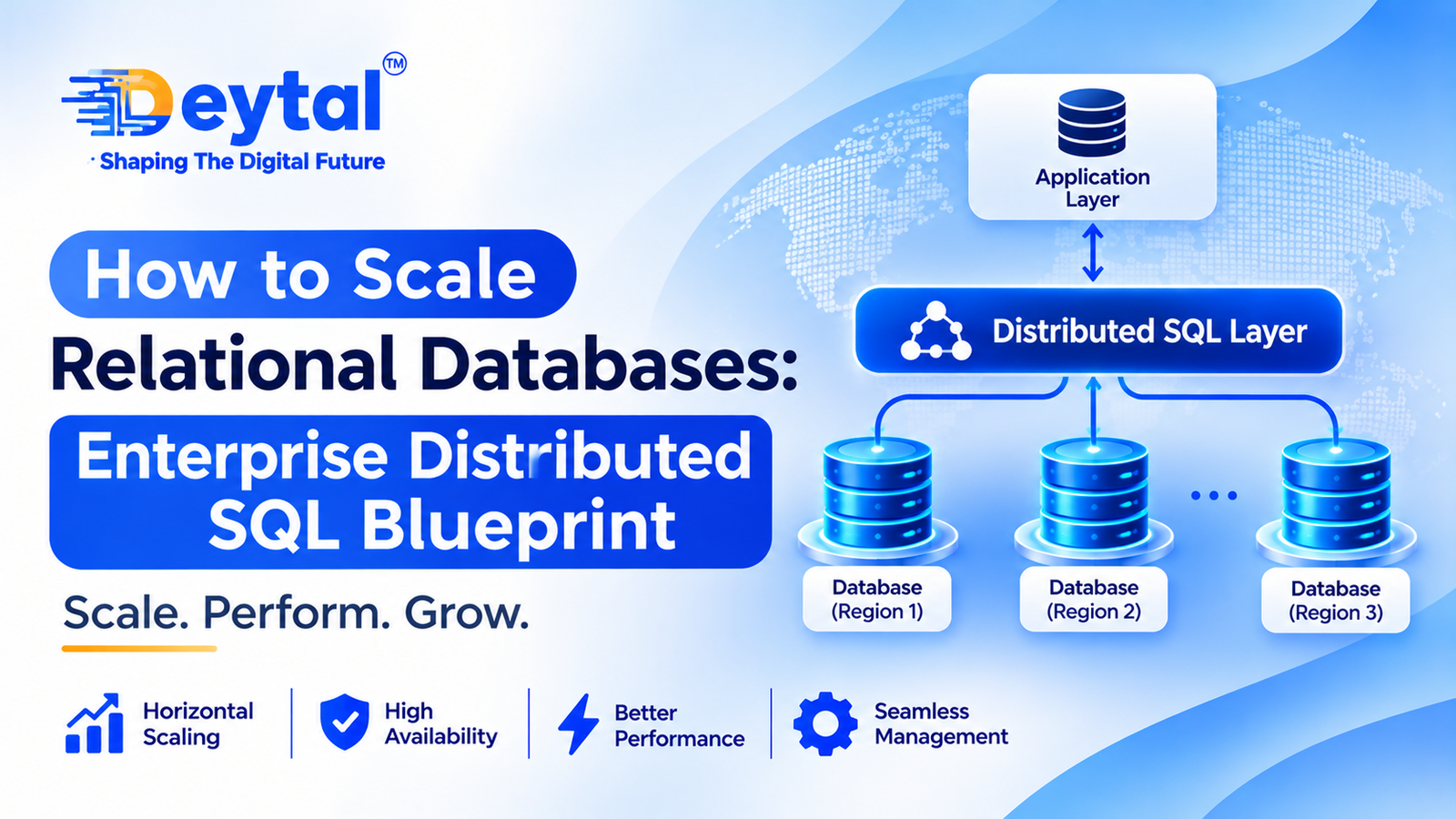
For decades, scaling relational transactional datastores (RDBMS) like MySQL and PostgreSQL past the capacity of a single physical server forced enterprise engineering organizations down a painful road: manual application-level database sharding. By introducing sharding keys, custom routing middleware, and multiple discrete database instances, teams managed to scale write throughput. However, this introduced major architectural technical debt: the loss of cross-shard ACID transactions, broken foreign key constraints, fragmented backup windows, and complex resharding operations.
As systems require global multi-region presence, continuous uptime, and strict transactional correctness, legacy sharding has become an operational liability. Enterprise Distributed SQL Architecture resolves the traditional trade-off between the horizontal scalability of NoSQL systems and the strict ACID guarantees of relational databases. Powered by engines like CockroachDB, YugabyteDB, and Google Cloud Spanner, distributed SQL presents a single logical SQL interface to application clients while distributing data, managing range splits, and enforcing distributed consensus automatically.
The Hidden Engineering Tax of Manual Application Sharding
While manual sharding initially solves single-node disk and IOPS bottlenecks, scaling sharded clusters over time exposes significant operational liabilities:
- Destruction of Cross-Shard ACID Semantics: Executing atomic transactions that span multiple shards requires complex two-phase commit (2PC) orchestration in application code, which introduces deadlocks, latency spikes, and data corruption risks during network partitions.
- Resharding Nightmares & Rebalancing Downtime: When a shard reaches maximum capacity or experiences a hot spot due to skew in the sharding key, splitting and migrating shards requires custom data migration scripts, elevated read replicas, and maintenance windows.
- Application Layer Pollution: Developers must structure every query around the sharding key. Cross-shard joins, aggregation queries, and global sorting must be handled by application-level memory maps, cluttering business logic.
- Fragmented Disaster Recovery & Backups: Restoring an enterprise to a single, globally consistent point in time across 32 or 64 independent MySQL/PostgreSQL shards is mathematically difficult without coordinated distributed snapshots.
Manual Database Sharding vs. Enterprise Distributed SQL
| Architectural Dimension | Manual Application Sharding | Enterprise Distributed SQL |
| Data Partitioning | Hardcoded by application routing logic & shard keys | Dynamic, automated range/hash splitting & online rebalancing |
| Transaction Isolation | Local ACID only; cross-shard consistency broken | Strict serializable / snapshot isolation across all nodes |
| Replication & Consensus | Asynchronous master-replica replication (data loss risk) | Synchronous Raft / Paxos consensus per data range |
| SQL Capabilities | Restricted; cross-shard JOIN and foreign keys disabled | Full relational SQL, distributed joins, triggers, and secondary indexes |
| High Availability & Failover | Fragile failover scripts (e.g., Orchestrator, MHA) | Automated sub-second failover with zero manual intervention |
| Developer Ergonomics | High cognitive overhead; developers manage shard topologies | Transparent; behaves like a single standard PostgreSQL/MySQL instance |
Strategic Pillars for Engineering a Distributed SQL Ecosystem
1. Distributed Consensus Topologies & Dynamic Range Slicing
Implement distributed consensus protocols (such as Multi-Raft or Paxos) where data is partitioned into ordered byte ranges and replicated across distinct failure domains. Engineering custom distributed transaction coordinators, atomic commit pipelines, and conflict-detection systems via Custom Software Development Services guarantees full ACID compliance with minimal cross-region latency.
2. Globally Responsive Web Frontends & Regional Read Pinning
Prevent multi-region database latency from degrading user interfaces. Structuring client applications to leverage localized follower reads, stale read allowances (AS OF SYSTEM TIME), and geographic table partitioning through Website Development Services ensures web portals achieve sub-100ms response times globally.
3. Visual Cluster Topology & Administrative Cockpit UI/UX Design
Distributed databases distribute state across dozens of nodes, making cluster health monitoring challenging without proper tooling. Designing real-time range-distribution heatmaps, node hardware telemetry dashboards, and query execution plan analyzers via UI/UX Design Services gives database administrators immediate visibility into query hot spots and rebalancing operations.
4. Resilient Edge Syncing & Mobile State Coordination
Ensure mobile applications connect to the nearest regional database node while gracefully handling intermittent connectivity. Engineering low-latency distributed APIs, optimized connection pools, and offline-resilient local sync caches via Mobile App Development Services guarantees seamless transaction execution across global iOS and Android fleets.
5. High-Availability Headless CMS Backbones & Search Engine Uptime
Prevent database failovers from returning HTTP 500 errors to search engine bots, which can degrade organic search rankings. Backing decoupled enterprise CMS architectures through WordPress Development Services coupled with data-driven SEO Services maintains top organic search authority, fast indexing, and optimal Core Web Vitals across multi-region domains.
6. Data Sovereignty Compliance & Global Expansion Funnels
Leverage native row-level geo-partitioning to pin customer records to specific geographic regions (e.g., storing EU data strictly within Frankfurt for GDPR compliance), unlocking new international markets and enterprise B2B sales pipelines supported by Digital Marketing Services.
Modernize Your Data Tier with Deytal Technologies
Migrating an enterprise from a brittle sharded database architecture to a resilient Distributed SQL engine requires careful schema refactoring, consensus group tuning, and data migration testing. Deytal Technologies Pvt. Ltd. designs, audits, and builds production-grade Distributed SQL databases, multi-region cloud backends, and scalable enterprise web platforms engineered for zero downtime, horizontal scale, and strict ACID data integrity.
Frequently Asked Questions (FAQ)
Q1: How does Distributed SQL achieve horizontal scalability without sacrificing ACID transactions?
Distributed SQL achieves this by separating the stateless SQL execution layer from the underlying distributed storage engine. Data is automatically partitioned into ordered ranges and replicated using consensus algorithms like Raft or Paxos across independent storage nodes. When a transaction spans multiple ranges or nodes, the database coordinates execution using distributed transaction protocols (like Two-Phase Commit combined with Multi-Version Concurrency Control), ensuring changes either fully commit or cleanly roll back without corrupting data.
Q2: What is the primary difference between CockroachDB and Google Cloud Spanner?
Google Cloud Spanner relies on Google’s proprietary hardware infrastructure, including atomic clocks and GPS receivers (TrueTime API), to maintain absolute clock synchronization globally. CockroachDB is an open-architecture, cloud-agnostic platform that uses Hybrid Logical Clocks (HLC) and the Raft consensus protocol, allowing it to run across any cloud provider (AWS, Azure, GCP) or on-premise Kubernetes clusters without dedicated hardware dependencies.
Q3: Does migrating from traditional PostgreSQL or MySQL to Distributed SQL require rewriting applications?
Most modern Distributed SQL engines are wire-protocol compatible with existing relational databases (for example, CockroachDB and YugabyteDB support the PostgreSQL wire protocol and dialect). While applications can typically reuse existing drivers and ORMs, schemas should be audited to eliminate anti-patterns that induce cross-node distributed locks, such as reliance on global auto-incrementing sequential primary keys instead of UUIDs.
