

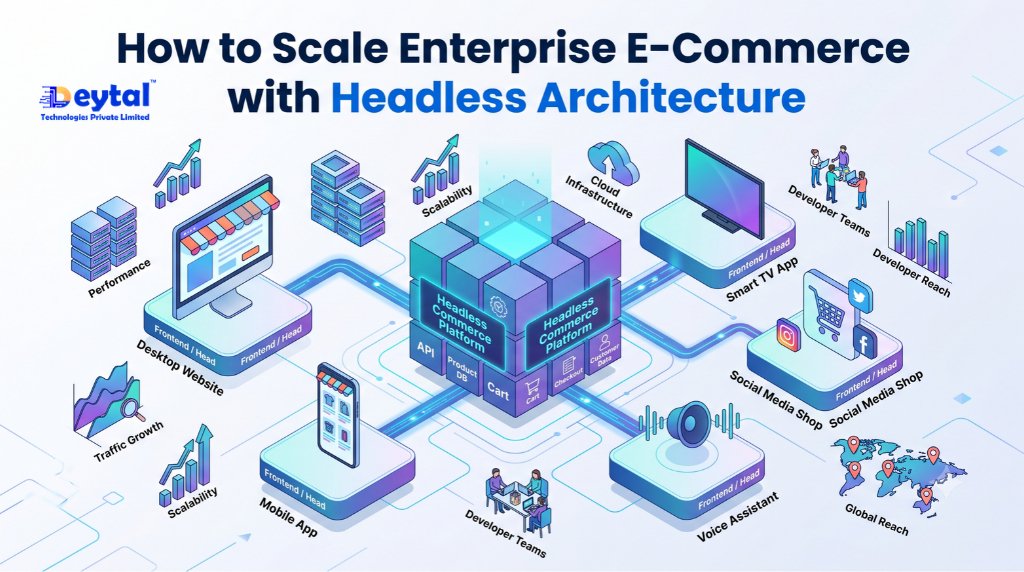
Traditional e-commerce platforms (such as legacy all-in-one monoliths) tightly bind the customer-facing storefront to the underlying transactional engine, database, and business logic. While this monolithic pattern simplifies early store launches, it introduces severe architectural friction at enterprise scale. Deploying a minor promotional banner or layout change requires testing the entire core checkout and inventory codebase, slowing deployment cadence, degrading Core Web Vitals, and limiting omnichannel flexibility across mobile, web, and IoT touchpoints.
Enterprise Headless Commerce completely decouples the presentation layer (the “head”) from the transactional backend via standardized, high-performance APIs. Operating under modern MACH (Microservices, API-first, Cloud-native, and Headless) principles, enterprises can engineer bespoke, lightning-fast digital storefronts across multiple frontends while leveraging enterprise backends for payment processing, ERP synchronization, and catalog management.
The Bottlenecks of Monolithic E-Commerce Stacks
Scaling digital commerce on a tightly coupled monolith leads to predictable engineering and operational roadblocks:
- Deployment Risk & Monolithic Release Cycles: Simple UI enhancements carry the risk of breaking critical checkout gateways or ERP sync logic, requiring lengthy testing cycles and off-peak deployments.
- Slow Page Performance & Poor Core Web Vitals: Monolithic themes carry legacy template overhead, bloated CSS/JS payloads, and heavy server-side rendering pipelines that inflate Time to First Byte (TTFB) and Interaction to Next Paint (INP).
- Restricted Omnichannel Expansion: Introducing non-traditional channels such as native mobile applications, point-of-sale (POS) systems, or in-store interactive displays demands complex, duct-taped integrations because the backend logic cannot serve raw data cleanly.
- Rigid Vendor Lock-In: Upgrading a single capability (such as searching, merchandising, or tax calculation) requires finding an approved monolithic plugin rather than integrating best-of-breed microservice APIs.
Monolithic Commerce vs. Enterprise Headless Commerce
| Architectural Dimension | Monolithic E-Commerce Platform | Enterprise Headless Commerce |
| Frontend/Backend Coupling | Tightly bound; unified codebase | Fully decoupled; API-driven integration |
| Frontend Technology Stack | Locked to platform-specific templating engines | Modern web frameworks (Next.js, Remix, Vue) |
| Omnichannel Flexibility | Web-first; mobile requires custom wrappers | Native support for Web, Mobile, POS, and IoT via single API |
| Release Velocity | Slow, coordinated releases with risk of downtime | Independent frontend deployments without backend risk |
| Global Edge Scalability | Centralized server rendering bottlenecks | Static site generation (SSG) & Edge SSR cached globally |
Strategic Pillars for Engineering an Enterprise Headless Commerce Architecture
1. Modular Middleware & Custom Transactional Orchestration
Build robust backend abstraction layers and microservices that harmonize data across ERPs, Product Information Management (PIM) systems, and inventory pools. Engineering resilient middleware workflows through Custom Software Development Services guarantees high-throughput order ingestion and reliable third-party payment gateway orchestration without database lock contention.
2. Lightning-Fast Composable Web Storefronts
Deliver sub-second page loads using modern frontend frameworks compiled to static or edge-rendered targets. Developing high-performance, composable digital storefronts via Website Development Services ensures fluid product browsing, instant client-side filtering, and responsive catalog navigation across diverse global audiences.
3. Frictionless Checkout Ergonomics & UI/UX Design
A decoupled frontend allows complete freedom to eliminate standard multi-step checkout friction. Designing unified design tokens, intuitive cart drawers, and single-click checkout flows through UI/UX Design Services removes usability hurdles, boosts average order value (AOV), and significantly reduces cart abandonment rates.
4. Omnichannel Mobile Commerce & Native Runtimes
Consume the same decoupled commerce APIs within native mobile applications without maintaining duplicate backend endpoints. Developing feature-rich native shopping applications via Mobile App Development Services unlocks biometric checkouts (Apple Pay / Google Pay) and instant push-notification campaigns across iOS and Android ecosystems.
5. Clean Content Governance & Headless CMS Architecture
Enable marketing squads to launch dynamic merchandising campaigns, shoppable content, and landing pages independently. Combining flexible headless CMS backends through WordPress Development Services with advanced technical SEO Services ensures structured product schema, rapid search indexing, and stellar Core Web Vitals across millions of SKUs.
6. Data-Driven Customer Journeys & High-Velocity Optimization
Leverage decoupled edge endpoints to execute lightning-fast dynamic pricing, personalized merchandising rules, and segmented promotional funnels, continuously analyzed and scaled through Digital Marketing Services.
Scale Your Digital Commerce Platform with Deytal Technologies
Migrating from a monolithic storefront to an enterprise headless commerce ecosystem requires comprehensive data mapping, API gateway engineering, and resilient cache invalidation strategies. Deytal Technologies Pvt. Ltd. designs and implements composable e-commerce architectures, custom API integrations, and modern enterprise storefronts engineered to maximize performance, scalability, and long-term revenue growth.
Frequently Asked Questions (FAQ)
Q1: How does headless commerce improve mobile conversion rates?
Headless storefronts leverage client-side routing, static generation, and edge-cached product catalogs to make page transitions virtually instant. By eliminating the multi-second page loads typical of legacy monolithic themes, mobile shoppers experience an app-like feel that directly reduces bounce rates and checkout drop-offs.
Q2: What is the difference between composable commerce and headless commerce?
Headless commerce specifically refers to separating the frontend presentation layer from the backend commerce engine. Composable commerce goes a step further: it replaces the single monolithic backend with a modular ecosystem of specialized, best-of-breed microservices (e.g., using one specialized service for search, another for checkout, and another for loyalty) connected via APIs.
Q3: How is secure payment processing managed in a headless architecture?
Payment processing in a headless architecture typically utilizes hosted tokenization fields (such as Stripe Elements or native Apple/Google Pay APIs) or secure hosted redirect checkouts. Sensitive payment credentials never touch the custom frontend application servers, maintaining strict PCI-DSS Level 1 compliance while ensuring a frictionless checkout experience.