

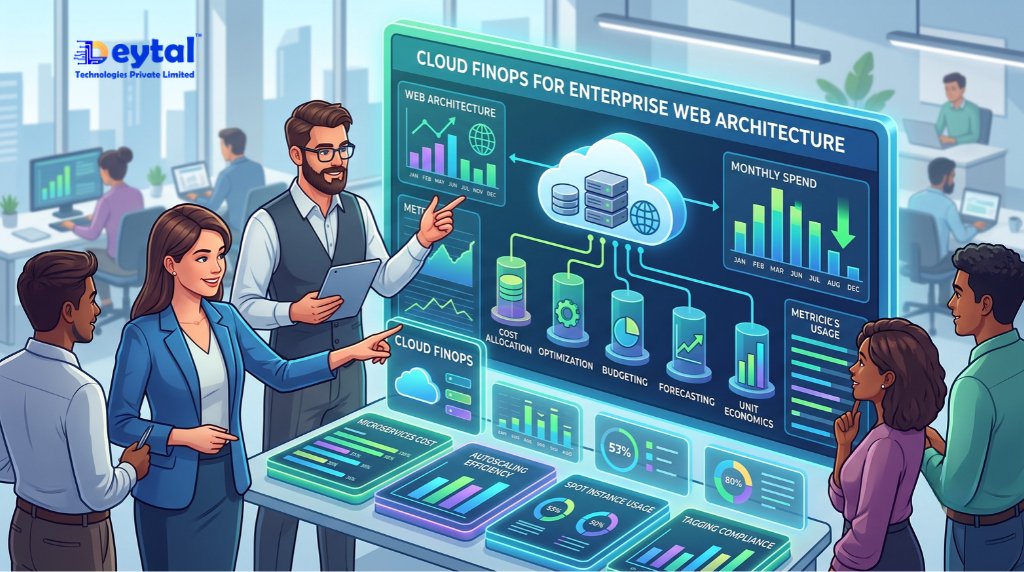
The enterprise transition to public cloud and serverless computing solved agility and operational scale, but it fundamentally fractured traditional corporate IT budgeting. Instead of predictable, capitalized data center hardware, engineering teams now operate with variable, usage-based operational expenses (OpEx). Without strict architectural discipline, microservices sprawl, oversized Kubernetes clusters, uncapped log ingestion, and silent cloud data transfer penalties quietly inflate monthly cloud invoices.
Cloud FinOps for Enterprise Web Platforms bridges the operational divide between software engineering, cloud operations, and corporate finance. By transforming cost accountability into a fundamental architectural metric alongside latency, uptime, and throughput enterprises eliminate wasteful infrastructure spend, optimize unit economics per transaction, and maximize capital return without compromising system reliability.
The Silent Drivers of Cloud Infrastructure Waste
Unchecked cloud growth introduces recurring architectural inefficiencies across enterprise web stacks:
- Over-Provisioned Container Environments: Development and production Kubernetes nodes running with 70% CPU/memory buffers that are rarely utilized during normal operational hours.
- Runaway Serverless & Edge Unit Economics: Scale-to-zero architectures misconfigured with recursive invocations, long execution runtimes, or unoptimized memory allocations that create sudden billing spikes.
- Data Egress Traps & Cross-Region Penalties: Routing high-volume microservices traffic across cloud regions and availability zones without peering or caching, incurring massive per-gigabyte egress charges.
- Idle Ephemeral Resources & Orphaned Volumes: Abandoned staging environments, unattached persistent disks (EBS/PVCs), and outdated snapshots accumulating passive monthly charges.
Traditional IT Budgeting vs. Enterprise Cloud FinOps
| Operational Metric | Traditional Cloud Management | Enterprise Cloud FinOps Architecture |
| Cost Accountability | Finance reconciles invoices post-month | Engineering teams own real-time unit economics |
| Resource Provisioning | Manual sizing based on peak hypothetical load | Automated autoscaling, rightsizing, and spot instances |
| Visibility & Attribution | Blended, undifferentiated infrastructure bills | Granular tagging by domain, microservice, and team |
| Purchasing Strategy | On-demand pricing by default | Systematic blending of Savings Plans and Reserved Instances |
| Optimization Focus | Reactive, periodic cost-cutting initiatives | Continuous, automated architectural governance |
Strategic Pillars for Building a Capital-Efficient Web Architecture
1. Cost-Aware Backend Architecture & Algorithmic Optimization
Refactor computationally inefficient database queries, uncompressed payloads, and chatty API integrations. Engineering lean, resource-conscious backend services through Custom Software Development Services directly lowers CPU utilization cycles, slashing compute requirements and database IOPS fees.
2. High-Performance Frontends & Edge Caching Efficiency
Offload repeat traffic from expensive origin servers by pushing static assets and dynamic API responses to the edge. Constructing modern, decoupled web frontends via Website Development Services minimizes cloud origin hits, cuts bandwidth consumption, and delivers sub-second page performance.
3. Ergonomic Financial Observability & Dashboard UI/UX
Engineering teams need intuitive, real-time feedback on infrastructure expenditure to stay accountable. Designing accessible telemetry dashboards, cost-anomaly alerts, and resource utilization views through UI/UX Design Services makes complex cloud spend actionable and visible across technical squads.
4. Network-Efficient Mobile API Payloads
Prevent mobile apps from constantly polling backend servers with large, uncompressed payloads. Building data-conscious mobile clients and lean networking layers using Mobile App Development Services preserves user battery life while drastically reducing mobile API data egress fees.
5. Clean Caching Layers & Organic Search Authority
Ensure server-level performance optimization does not hurt discoverability or load speed. Pairing low-overhead headless backends via WordPress Development Services with technical SEO Services maintains top organic search authority, fast indexing, and optimal Core Web Vitals at minimal hosting cost.
6. High-Efficiency Acquisition & Measurable Unit Economics
Eliminate wasted acquisition spend by aligning paid customer traffic with high-converting conversion funnels, monitored and scaled continuously through Digital Marketing Services.
Maximize Your Cloud Return with Deytal Technologies
Adopting Cloud FinOps requires more than just buying cloud discount plans; it requires architectural rightsizing, continuous tagging hygiene, and developer-first cost observability. Deytal Technologies Pvt. Ltd. designs and implements capital-efficient cloud systems, custom microservices architectures, and high-performance web platforms engineered to deliver maximum business value at minimum compute overhead.
Frequently Asked Questions (FAQ)
Q1: What are the three fundamental phases of the FinOps lifecycle?
The FinOps Foundation defines three continuous phases: Inform (gaining visibility into costs, setting up tagging, and understanding unit economics), Optimize (rightsizing workloads, eliminating waste, and utilizing committed-use discounts), and Operate (embedding continuous governance and automated policies into daily engineering operations).
Q2: How does Kubernetes rightsizing directly reduce cloud spending?
In Kubernetes, pods reserve CPU and memory via “requests.” Cloud providers charge for the underlying virtual machine capacity needed to fulfill those reservations, regardless of whether the application actually consumes that capacity. Rightsizing aligns configured resource requests with historical usage patterns, allowing organizations to consolidate workloads onto fewer or smaller nodes.
Q3: What is the most effective way to eliminate cloud data egress costs?
Data egress fees are minimized by keeping network traffic within the same availability zone where possible, utilizing private VPC endpoints instead of routing over the public internet, and placing a Content Delivery Network (CDN) in front of origin servers to absorb asset requests directly at edge locations.