

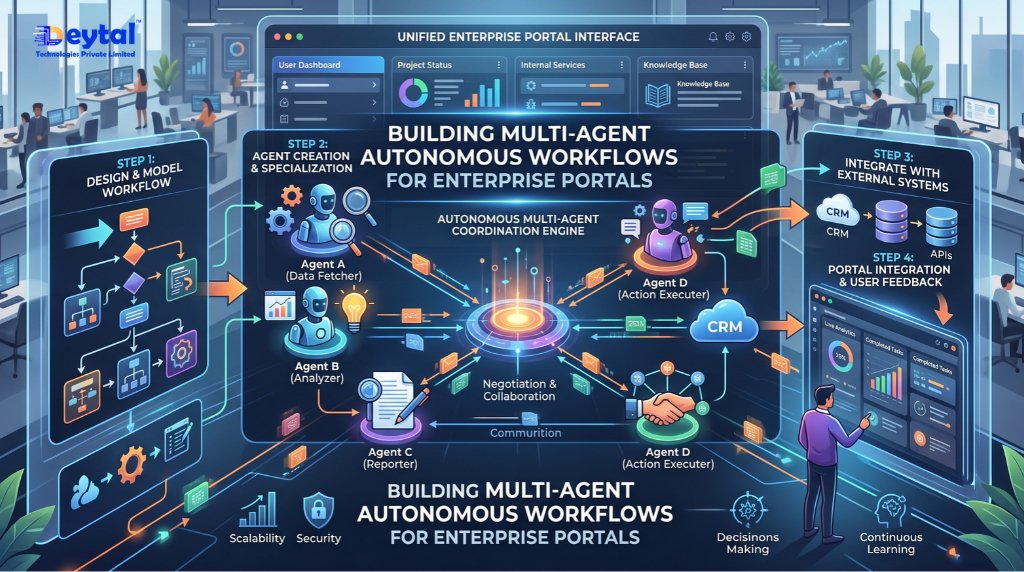
First-generation generative AI implementations in enterprise applications focused primarily on single-turn chat interfaces and static Retrieval-Augmented Generation (RAG). While effective for summarization and internal Q&A, these isolated implementations lacked the operational autonomy required to handle complex, asynchronous business operations. When an enterprise task requires planning, data validation across disparate APIs, human-in-the-loop approvals, and self-correcting retries, simple prompt-and-response paradigms break down.
Enterprise AI Agent Architecture transitions web applications from passive query engines into active transactional execution layers. By chaining specialized, stateful AI agents into collaborative graph networks (using frameworks like LangGraph, AutoGen, or CrewAI), modern enterprise portals delegate complex, multi-step workflows such as supply chain reconciliation, automated loan underwriting, and dynamic customer provisioning to autonomous agents operating within deterministic software boundaries.
The Operational Limits of Static Generative AI
Deploying single-turn language models into enterprise workflows introduces severe practical limitations:
- Inability to Execute Multi-Step Plans: Single prompts cannot maintain long-term execution state or recover gracefully when an intermediate tool or API call fails.
- Hallucination Cascades: Without automated reflection and programmatic validation steps, a small reasoning error in step one corrupts the entire downstream transaction.
- Lack of Guardrails & System Determinism: Pure language models are probabilistic, making it difficult to enforce strict business compliance, security auditing, and deterministic API parameters.
- Unbounded Context Windows & Cost Sprawl: Feeding entire enterprise schemas and past conversations into massive context windows drives up latency, token consumption, and cloud inference costs.
Static Generative AI (RAG) vs. Multi-Agent Autonomous Architectures
| Operational Dimension | Static Generative AI / Basic RAG | Multi-Agent Autonomous Workflows |
| Execution Model | Single prompt-response completion | Stateful, iterative execution loops (Plan $\rightarrow$ Act $\rightarrow$ Verify) |
| Tool Integration | Limited, read-only search retrieval | Dynamic read/write tool calling across private APIs |
| Error Recovery | Fails silently or returns hallucinations | Self-correction, automated retries, and critique agents |
| Task Specialization | One generalist model handles all logic | Specialized agents (Researcher, Critic, Validator, Executor) |
| State Management | Stateless or basic conversational history | Checkpointed, durable state graphs with rollbacks |
| Human Oversight | Ad-hoc post-generation review | Programmatic Human-in-the-Loop (HITL) pause states |
Strategic Pillars for Engineering an Enterprise Multi-Agent System
1. Stateful Agent Orchestration & Deterministic Tool Calling
Architect durable execution graphs using stateful orchestrators where agents communicate via strictly typed schemas. Engineering hardened backend connectors, sandboxed runtimes, and transactional API integrations through Custom Software Development Services guarantees agents read and write to enterprise databases securely without unintended side effects.
2. Reactive Web Consoles & Streaming Agent Telemetry
Enterprise users need full transparency into an agent’s reasoning steps, intermediate scratchpads, and execution status. Developing event-driven, responsive user interfaces via Website Development Services utilizes streaming protocols (Server-Sent Events) to display agent thought processes and tool actions in real time.
3. Human-in-the-Loop (HITL) & Ergonomic Control UI/UX
Autonomous systems must pause for human confirmation before executing irreversible or high-value business actions (e.g., executing large financial transfers or deleting records). Designing clear approval gates, confidence score visualizers, and state-editing consoles through UI/UX Design Services ensures operators maintain complete operational control with zero interface friction.
4. Real-Time Push & Mobile Agent Interfaces
Enable managers and field operators to approve agent actions on the move. Integrating asynchronous push notifications, biometrics, and secure approval dialogues using Mobile App Development Services guarantees high-priority agent decision gates are resolved quickly on iOS and Android devices.
5. Clean Platform Caching & Technical Performance SEO
Prevent dynamic client-side AI modules from degrading site performance or search visibility. Pairing clean headless architectures via WordPress Development Services with data-driven SEO Services maintains fast crawl rates, strong domain authority, and clean Core Web Vitals across public-facing enterprise hubs.
6. High-Intent Automated Funnels & Conversational Acquisition
Deploy specialized outbound and conversion agents that qualify leads, answer technical integration inquiries, and schedule enterprise demos in real time, continuously optimized through Digital Marketing Services.
Build Autonomous Enterprise Workflows with Deytal Technologies
Moving from basic AI experimentation to dependable multi-agent production systems requires robust evaluation harnesses, state-machine design, and strict security sandboxing. Deytal Technologies Pvt. Ltd. designs and implements scalable enterprise AI agent architectures, custom model integrations, and high-performance cloud platforms engineered to automate complex business operations safely and efficiently.
Frequently Asked Questions (FAQ)
Q1: What is the primary role of a “Critic” or “Validator” agent in a multi-agent system?
In a multi-agent graph, a Critic or Validator agent inspects the output of an execution agent before any external action is taken. It checks generated responses against strict programmatic rules, schema definitions, and compliance guardrails, requesting revisions if errors or hallucinations are detected.
Q2: How do Human-in-the-Loop (HITL) checkpoints work in agentic state graphs?
HITL uses durable state machines (such as LangGraph checkpoints). When an agent encounters a high-risk action node (like executing a database update), the graph transitions to an interrupt state, persists its execution memory to a database, and sends a notification to a human reviewer. The workflow only resumes once the human submits an approval or edits the state payload.
Q3: How do you prevent multi-agent systems from getting stuck in infinite execution loops?
Production agent systems implement deterministic loop breakers. These include setting a strict recursion limit (maximum steps allowed per run), enforcing execution timeouts, tracking similarity scores across iterative outputs to detect cycle traps, and falling back to a human review queue when progress stalls.