

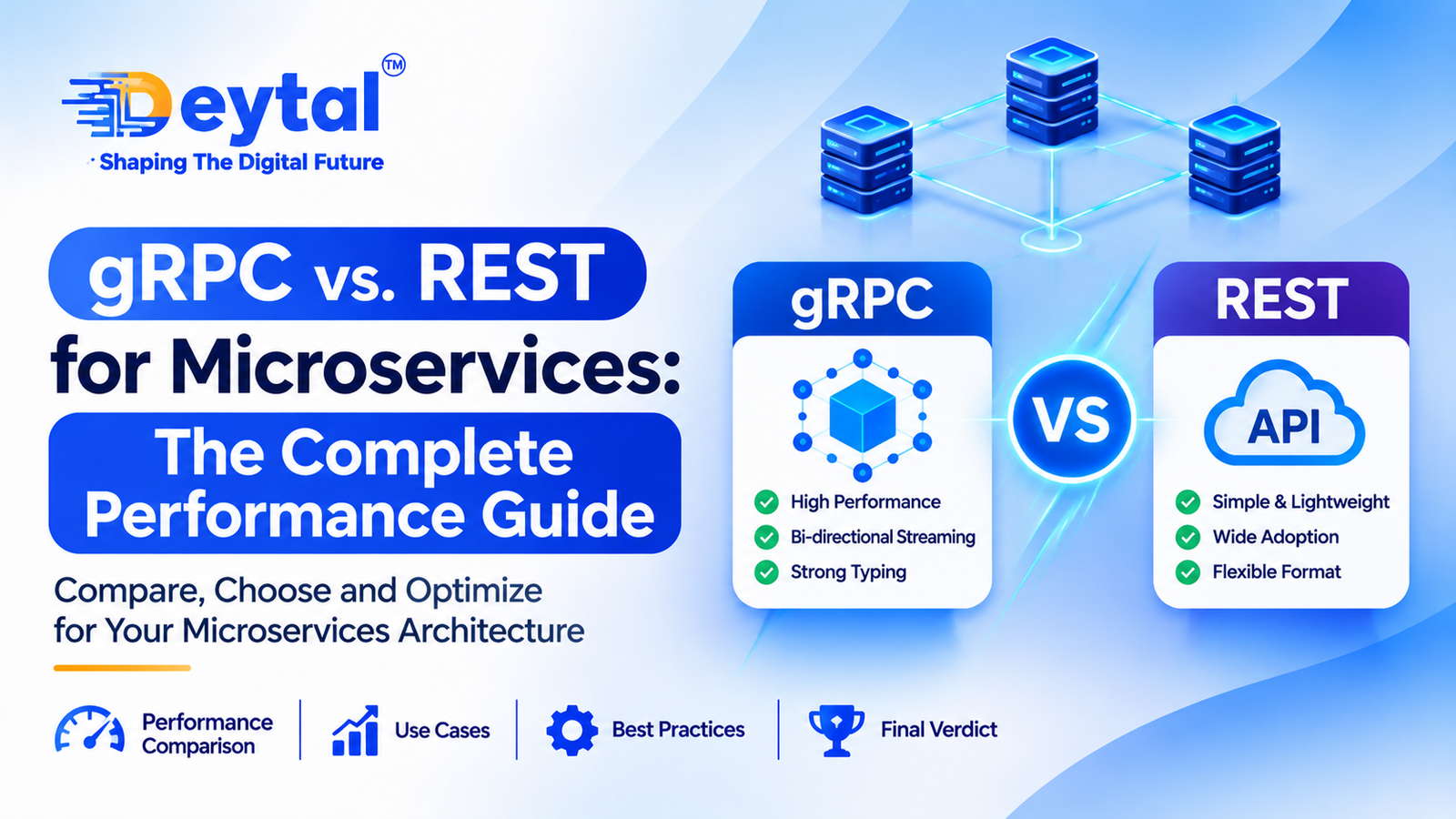
In large-scale microservice ecosystems, internal service-to-service communication constitutes the majority of network traffic. While REST over HTTP/1.1 with JSON payloads remains the standard for external public-facing APIs due to its human readability and universal client support, using it as an internal backbone introduces severe operational penalties. Parsing textual JSON repeatedly across dozens of internal microservice hops consumes massive CPU cycles, uncompressed HTTP headers bloat wire payloads, and HTTP/1.1 head-of-line blocking forces clusters to churn through thousands of concurrent TCP connections.
Enterprise gRPC Microservices Architecture replaces chatty, text-based REST endpoints with an open-source, high-throughput Remote Procedure Call (RPC) framework developed by Google. Powered by binary Protocol Buffers (Protobuf) serialization, HTTP/2 multiplexed streams, and strongly typed contract code generation, gRPC slashes p99 tail latency and allows polyglot backend fleets to communicate with minimal transport overhead.
The Latency and Compute Drain of Internal REST Microservices
Relying on synchronous REST/JSON APIs for east-west internal traffic leads to common infrastructure bottlenecks:
- High CPU Serialization Bottlenecks: Deserializing string-heavy JSON into internal memory objects consumes significantly more CPU than parsing binary streams, driving up cloud compute bills on high-throughput services.
- Head-of-Line Blocking & Socket Churn: HTTP/1.1 processes a single active request-response exchange per TCP socket at a time. High-concurrency architectures must open large pools of ephemeral TCP connections, driving up memory overhead and TLS handshake latency.
- Loose Schema Drift & Runtime Contract Failures: REST lacks natively enforced compile-time contracts. Field name typos, missing null checks, or type coercions are caught only at runtime or in production, causing silent failures across teams.
- Payload Bloat Over the Wire: Repetitive JSON keys and uncompressed text headers consume substantial internal bandwidth, increasing network egress costs and degrading internal routing latency.
REST over HTTP/1.1 vs. Enterprise gRPC over HTTP/2
| Architectural Dimension | REST over HTTP/1.1 (JSON) | Enterprise gRPC over HTTP/2 (Protobuf) |
| Data Payload Format | Text-based, human-readable JSON/XML | Compact, schema-compiled binary Protocol Buffers |
| Underlying Transport | HTTP/1.1 (Single request-response per socket) | HTTP/2 (Full duplex multiplexing over single TCP pipe) |
| API Contract Enforcement | Optional (OpenAPI/Swagger documentation) | Strict, compile-time .proto contracts across languages |
| Streaming Capabilities | Unidirectional/awkward (Server-Sent Events, WebSockets) | Native unary, client, server, and bidirectional streaming |
| Load Balancing Layer | Layer 4 (TCP connection level) or Layer 7 standard | Requires Layer 7 application load balancing (Envoy proxy) |
| Browser Compatibility | Native and universally supported across all browsers | Requires grpc-web proxy translation layer for browsers |
| Typical Serialization Speed | Baseline JSON parsing speeds | 30% to 50%+ faster serialization/deserialization |
Strategic Pillars for Engineering an Enterprise gRPC Platform
1. Protocol Buffer Governance & Automated Schema Stubs
Define clear domain boundaries using .proto interface definitions managed in a centralized schema repository. Generating type-safe client stubs and server skeletons across Go, Node.js, Java, and Python via Custom Software Development Services ensures consistent data contracts and backwards compatibility across polyglot microservice engineering teams.
2. Transcoding Ingress & Hybrid Web Frontends
Browsers cannot natively execute raw HTTP/2 framing required by full gRPC. Implementing Envoy proxy transcoding (such as grpc-gateway) allows frontend single-page applications to query standard REST/JSON endpoints at the edge, while internal clusters translate and route those calls as pure gRPC over internal networks. Developing these edge-connected web applications via Website Development Services ensures client compatibility with backend efficiency.
3. Ergonomic Developer Tooling & API Catalog UI/UX Design
Moving from curl-able JSON to binary Protobuf can hinder developer debugging if tooling is neglected. Designing intuitive internal service catalogs, automated contract documentation viewers, and web-based gRPC test benches through UI/UX Design Services simplifies local testing and accelerates engineering onboarding.
4. Low-Bandwidth Native Streaming for Mobile Applications
Mobile devices operating over volatile cellular connections benefit from compact binary transfers. Integrating native gRPC client libraries with bidirectional streaming into Android and iOS runtimes via Mobile App Development Services slashes battery drain, reduces data usage, and delivers real-time notifications with minimal latency.
5. Clean Edge Caching & Technical Content Discovery
Ensure public-facing APIs powering headless content repositories remain discoverable by search engine crawlers without running into binary serialization barriers. Pairing high-performance, edge-cached headless delivery through WordPress Development Services with advanced SEO Services maintains top organic search authority, fast indexing, and optimal Core Web Vitals across public web properties.
6. High-Throughput Partner Ecosystems & B2B Integration Funnels
Monetize high-volume, real-time data feeds by offering enterprise partners dedicated gRPC streaming channels alongside standard REST APIs, packaged and marketed through Digital Marketing Services.
Modernize Your Microservices Architecture with Deytal Technologies
Migrating an enterprise microservices mesh from REST to gRPC requires careful Layer 7 load balancer configuration, automated protobuf code-generation pipelines, and resilient schema versioning rules. Deytal Technologies Pvt. Ltd. designs and implements production-grade gRPC backends, service mesh integration layers, and scalable cloud-native architectures engineered for low latency, cross-language type safety, and massive throughput.
Frequently Asked Questions (FAQ)
Q1: Why does gRPC require special Layer 7 load balancers like Envoy?
Because gRPC operates over persistent HTTP/2 TCP connections multiplexing multiple concurrent streams, traditional Layer 4 (L4) load balancers route the entire connection to a single backend pod. This concentrates load on one server while other instances sit idle. Layer 7 (L7) proxies, such as Envoy or modern cloud ingress controllers, inspect the individual HTTP/2 frames, distributing requests evenly across the entire backend replica set.
Q2: When should an enterprise continue using REST instead of gRPC?
REST remains the preferred standard for public, third-party, and browser-facing APIs where developer accessibility, native browser compatibility, and standard HTTP caching (via CDNs and reverse proxies) are essential. gRPC is typically reserved for internal east-west microservice traffic, real-time streaming, and native mobile-to-backend communication where bandwidth efficiency and low latency are critical.
Q3: How does Protocol Buffers maintain backwards compatibility when schemas change?
Protobuf identifies fields by unique numeric tags (e.g., string user_name = 1;) rather than field names. When an API schema changes, existing numeric tags must not be reused or renumbered. New fields can be added with new numbers, and deprecated fields are marked as reserved. Old clients receiving new payloads simply ignore unrecognized field numbers, preventing deserialization errors during rolling upgrades.
