

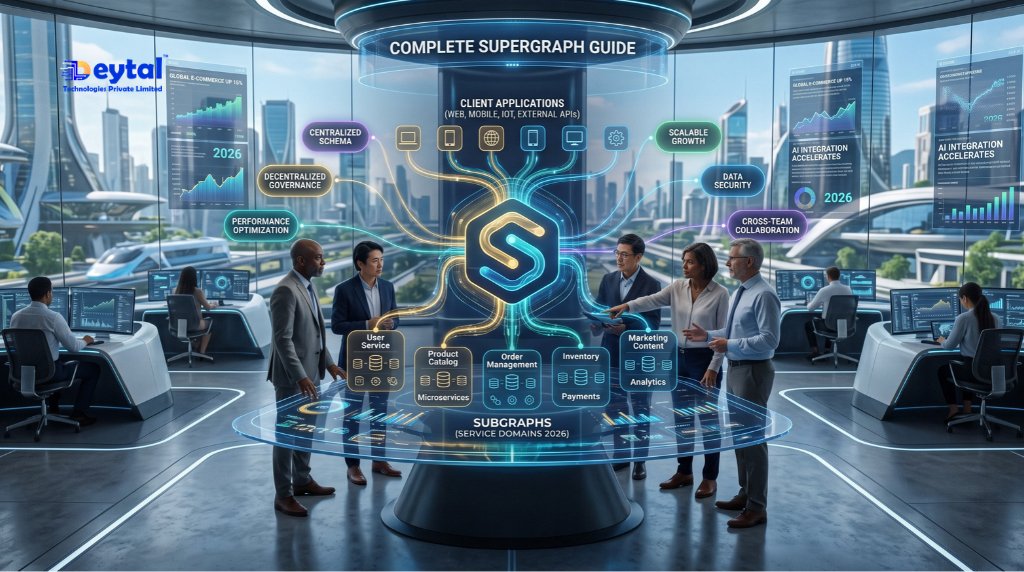
Over years of rapid digital transformation, enterprises inevitably accumulate a fragmented landscape of backend systems: legacy SOAP services, dozens of RESTful microservices, third-party SaaS endpoints, and custom databases. For frontend engineering squads, building a modern digital experience requires coordinating data across multiple heterogeneous endpoints, triggering over-fetching, under-fetching, and severe “waterfall” network requests on the client.
Enterprise GraphQL Federation solves this operational bottleneck. Instead of building a fragile, monolithic GraphQL backend or requiring clients to orchestrate multiple REST calls, federation enables autonomous backend teams to declare domain-specific schemas (subgraphs) that are automatically composed into a single, federated data graph via a high-performance routing gateway (such as Apollo Router or Cosmo).
The Architectural Pitfalls of REST Sprawl and Monolithic Gateways
Without a unified, federated schema layer, large-scale enterprise application development faces recurring friction:
- Client-Side Waterfall Inefficiencies: A mobile or web application often has to execute 5 to 10 sequential API calls just to render a single product detail or dashboard screen, degrading Interaction to Next Paint (INP) and Time-to-Interactive (TTI).
- Over-Fetching and Bandwidth Waste: REST endpoints return rigid payloads containing dozens of unused fields, consuming precious cellular bandwidth and battery life on mobile devices.
- Monolithic GraphQL Bottlenecks: Organizations attempting to solve this with a single monolithic GraphQL server create a massive code repository where changes require shared approvals, causing organizational gridlock and deployment failure points.
- Brittle Frontend Orchestration Logic: Frontend engineers waste sprint cycles writing complex data-stitching and normalization glue code instead of focusing on user experience.
Fragmented REST Gateways vs. Enterprise GraphQL Federation
| Architectural Dimension | Sprawling REST Gateways | Enterprise GraphQL Federation |
| Data Fetching Paradigm | Multiple roundtrips; rigid, over-fetched endpoints | Single network request; exact client-specified data |
| Schema Governance | Fragmented OpenAPI/Swagger docs per service | Strongly typed, single composable enterprise schema |
| Service Ownership | Loosely coordinated endpoints; client joins data | Autonomous teams own declarative subgraphs |
| Gateway Performance | Monolithic BFFs (Backend-for-Frontend) bottleneck | Compiled, high-throughput Rust/Go query routers |
| Schema Evolution | High risk of breaking field changes across clients | Safe, field-level deprecation and automated linting |
Strategic Pillars for Implementing Enterprise GraphQL Federation
1. Declarative Subgraph Engineering & Domain Decomposition
Divide enterprise data models cleanly across domain boundaries (e.g., Accounts, Products, Billing, Inventory) where each squad retains total ownership of its subgraph schema. Engineering resilient subgraph resolvers and microservices backends through Custom Software Development Services ensures independent deployments without breaking global schema composition.
2. High-Performance API Routers & Composable Web Frontends
Deploy compiled, low-latency edge gateways (such as Apollo Router written in Rust) to parse incoming client queries, generate optimized execution query plans, and resolve federated data across microservices concurrently. Constructing high-speed, dynamic web portals via Website Development Services ensures sub-second rendering for complex, data-heavy enterprise portals.
3. Ergonomic Data Presentation & Dashboard UI/UX Design
A unified graph allows rich, context-dense user interfaces, but presentation must remain clean, accessible, and intuitive. Designing unified design tokens, progressive loading states, and data dashboards through UI/UX Design Services ensures multi-source data is displayed with clarity and low cognitive burden.
4. Bandwidth-Optimized Native Mobile Applications
Empower native mobile teams to fetch only the exact fields required for specific device viewports, dramatically reducing cellular data usage and battery drain. Engineering responsive client data layers via Mobile App Development Services keeps apps lightning-fast across iOS and Android ecosystems.
5. Technical SEO and Server-Side Rendering (SSR) Performance
Ensure that dynamic GraphQL client queries do not hinder search bot crawling or web page speed metrics. Pairing server-rendered, clean-coded CMS foundations through WordPress Development Services with comprehensive SEO Services maintains top organic search authority, fast indexing, and optimal Core Web Vitals.
6. Data-Driven User Journeys & Conversion Optimization
Leverage fine-grained data querying to deliver dynamic personalization, modular landing pages, and rapid conversion experiments across the digital funnel, systematically analyzed and scaled through Digital Marketing Services.
Unify Your Enterprise APIs with Deytal Technologies
Migrating from disparate REST microservices or legacy BFFs to a federated GraphQL architecture requires careful schema contract design, entity resolution planning, and query-cost analysis. Deytal Technologies Pvt. Ltd. designs and implements robust enterprise GraphQL federation, high-throughput API gateways, and modular software architectures engineered for modern scalability.
Frequently Asked Questions (FAQ)
Q1: How does GraphQL Federation differ from traditional schema stitching?
Schema stitching relies on imperative code in a central gateway that manually merges schemas and coordinates data fetching. GraphQL Federation is declarative: individual microservices define their own entities and relations using federation directives (like @key, @shareable, and @provides), and an automated router composes them into a single schema without manual stitching code.
Q2: Does GraphQL Federation increase latency compared to direct REST calls?
When implemented with a modern, native gateway (such as Apollo Router), federated queries often reduce overall page load latency. Because the router plans the query execution tree and requests multiple subgraphs concurrently over fast internal networks, the client eliminates the multi-roundtrip overhead of public network waterfall requests.
Q3: How do you prevent malicious or overly deep queries in an enterprise GraphQL graph?
Enterprise GraphQL architectures protect routers by enforcing static query-cost analysis, query depth limiting, operation allowlisting (persisted queries), and strict rate-limiting policies at the gateway layer before any request hits the underlying subgraphs.