

In distributed, event-driven enterprise topologies, maintaining synchronization across relational datastores (OLTP), search indexes (Elasticsearch/OpenSearch), distributed caches (Redis), and real-time analytical data warehouses (Snowflake, BigQuery, ClickHouse) is a persistent operational challenge. Historically, engineering teams relied on two brittle patterns: periodic batch polling queries (SELECT * FROM table WHERE updated_at > last_check) or application-layer dual writes (writing to MySQL and publishing to a message broker in the same API call).
Batch polling introduces latency, misses hard deletes, and strains primary transactional databases with heavy table scans. Dual writes inevitably cause data drift when the application crashes between updating the database and publishing to the message bus.
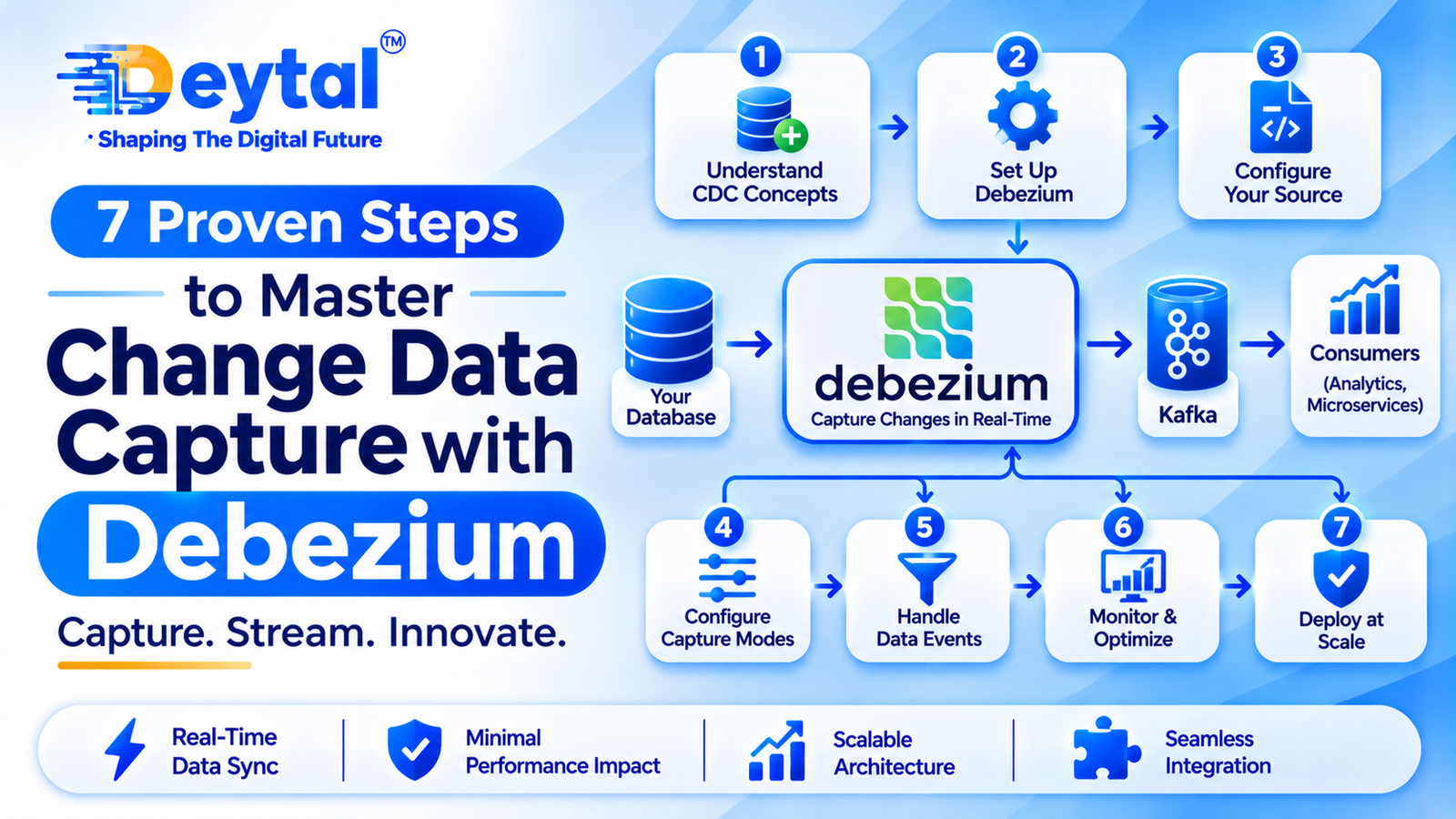
Enterprise Change Data Capture (CDC) Architecture resolves this synchronization challenge at the storage engine level. By leveraging Debezium running on Apache Kafka Connect, enterprises read commit logs directly from engines like PostgreSQL (pgoutput via WAL) and MySQL (binlog). Every INSERT, UPDATE, and DELETE is transformed into an ordered, immutable event stream with sub-second latency and zero dual-write vulnerabilities.
The Hidden Vulnerabilities of Legacy Synchronization Patterns
Relying on application-layer dual writes or recurring batch queries introduces critical production failure points:
- Dual-Write Consistency Loss: A microservice successfully commits a record to PostgreSQL, but the network drops before it can produce an event to Kafka. The primary database and downstream search indexes drift out of sync with no native recovery mechanism.
- Query Load & Read Lock Contention: Scheduled polling jobs running index-scans on high-traffic transactional tables lock rows, increase query contention, and degrade application API throughput during business hours.
- Missed Intermediary States & Deletes: Polling every 60 seconds captures only the final state of a row. If a status changes from
PENDINGtoPROCESSINGtoFAILEDbetween polling intervals, intermediary audit states are lost. Hard deletions leave orphan records downstream unless soft-delete columns are enforced. - Schema Evolution Drift: Modifying an upstream relational schema without coordinating downstream event consumers breaks deserialization pipelines, corrupting data lakes and real-time dashboards.
Legacy Database Polling vs. Log-Based CDC (Debezium + Kafka)
| Synchronization Dimension | Batch Polling / Dual-Writes | Log-Based CDC (Debezium + Kafka) |
| Data Extraction Mechanism | Application SQL polling (updated_at) or dual API calls | Low-level transaction log tailing (WAL, Binlog, Oplog) |
| Performance Impact on DB | High; frequent table scans and index lockups | Negligible; reads append-only disk logs without locking tables |
| Hard Delete Capture | Difficult; requires soft-deletes or custom audit triggers | Native; captures hard deletes as explicit delete/tombstone events |
| Latency | High; bound to polling batch windows (minutes/hours) | Sub-second; streamed as soon as transactions commit to disk |
| Event Capture Fidelity | Captures snapshot state; misses rapid intermediate updates | Captures exact, ordered sequence of all state mutations |
| Fault Tolerance & Guarantees | Prone to split-brain states and silent data corruption | Exactly-once / at-least-once delivery with Kafka offset tracking |
Strategic Pillars for Engineering an Enterprise CDC Ecosystem
1. Log-Tailing Connectors & The Transactional Outbox Pattern
Deploy Debezium source connectors directly against database replication slots to stream atomic state mutations without touching application layers. For microservices that must guarantee message delivery alongside transactional updates, implementing the Transactional Outbox Pattern via Custom Software Development Services ensures domain events write to an outbox table within the local ACID boundary before Debezium routes them safely to Kafka topics.
2. Low-Latency Search Hydration & Responsive Web Frontends
Deliver instantaneous search and filter experiences by streaming database changes directly into read-optimized search indices and localized caches. Building responsive single-page web portals that consume real-time updates via WebSockets and event-driven backends through Website Development Services ensures inventory counters, order tracking, and product catalogs reflect transactional reality with zero page reloads.
3. Data Pipeline Monitoring & Stream Topology UI/UX Design
Operating dozens of streaming connectors across multi-tenant environments requires robust observability. Designing clear replication lag visualizers, schema evolution timelines, and connector health monitoring dashboards through UI/UX Design Services empowers data platform engineers and SREs to spot blocked replication slots and serialization errors before downstream pipelines lag.
4. Real-Time Push Invalidation for Mobile Client Caches
Mobile applications depend heavily on aggressive local caching to conserve cellular data and reduce latency. Streaming CDC events through lightweight push notifications and edge delta syncs via Mobile App Development Services guarantees mobile clients invalidate stale SQLite records and render updated account balances instantaneously.
5. Instant Content Synchronization & Headless CMS Uptime
Ensure public-facing e-commerce storefronts, dynamic pricing tables, and publishing portals reflect backend inventory and content updates immediately without invalidating whole-site CDN caches. Integrating decoupled content streaming backbones through WordPress Development Services coupled with data-driven SEO Services maintains top organic search authority, fast indexing, and optimal Core Web Vitals while serving fresh content globally.
6. Real-Time Data Products & High-Value B2B Funnels
Leverage real-time operational event streams to feed event-driven CRM synchronizations, automated customer onboarding workflows, and instantaneous enterprise reporting, accelerating high-conversion B2B growth funnels managed by Digital Marketing Services.
Modernize Your Event Pipelines with Deytal Technologies
Migrating from fragile polling scripts and dual writes to an enterprise-grade Change Data Capture streaming pipeline requires deep expertise in database internals, Kafka topic topologies, and schema registry management. Deytal Technologies Pvt. Ltd. designs, audits, and builds production-grade CDC architectures, high-throughput Kafka streaming fabrics, and low-latency data integration engines engineered for sub-second synchronization, zero data loss, and uninterrupted scalability.
Frequently Asked Questions (FAQ)
Q1: How does Debezium capture database changes without impacting application query performance?
Debezium does not query tables using SQL SELECT statements. Instead, it operates as an external replication client, directly reading the database engine’s write-ahead transaction log (such as the MySQL Binary Log or the PostgreSQL Write-Ahead Log). Because these commit logs are written sequentially to disk during standard transactional execution, reading them introduces virtually zero lock contention or CPU overhead on the database’s primary query execution engine.
Q2: What is the Transactional Outbox Pattern and why is it used with Debezium?
The Transactional Outbox Pattern prevents distributed data inconsistencies when a microservice needs to update its local database and emit an event to a message broker. Instead of attempting a risky two-phase commit across different systems, the service inserts the event payload into a dedicated outbox table within the exact same local database transaction. Debezium then tails the transaction log of the outbox table and safely publishes the events to Kafka, guaranteeing at-least-once message delivery without dual-write race conditions.
Q3: How does log-based CDC handle schema modifications and migrations?
Production CDC architectures pair Debezium with an enterprise Schema Registry (such as Confluent Schema Registry or Apicurio). When an upstream table undergoes an ALTER TABLE operation, Debezium detects the structural change, registers the updated Avro or JSON Schema with the registry, and checks compatibility (e.g., backward, forward, or full compatibility). If the schema change adheres to the governance rules, downstream consumers automatically adapt without pipeline crashes or dropped messages.
