

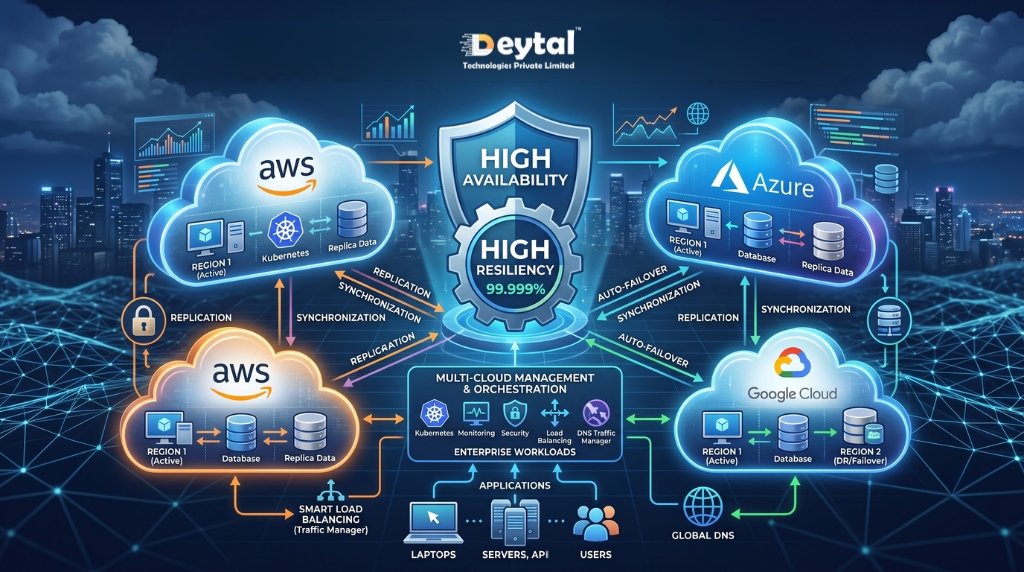
Relying entirely on a single public cloud provider creates an underappreciated single point of failure for enterprise organizations. Major cloud provider outages, sudden price increases, or unexpected regulatory data localization mandates can instantly disrupt digital operations and destroy customer trust.
A structured Multi-Cloud Enterprise Strategy distributes mission-critical workloads, storage arrays, and microservices across multiple platforms—such as AWS, Google Cloud, and Microsoft Azure ensuring seamless operational continuity, regulatory compliance, and cost efficiency.
The Hidden Risks of Single-Cloud Dependency
Consolidating an entire digital infrastructure within a single provider’s ecosystem introduces severe operational and financial vulnerabilities:
- Crippling Provider Outages: When an entire cloud region or global control plane experiences an outage, single-provider platforms suffer catastrophic, unavoidable downtime.
- Aggressive Vendor Lock-in: Proprietary databases and compute tools make migrating away from an existing provider cost-prohibitive.
- Sub-Optimal Cost Governance: Lack of workload portability strips enterprises of price leverage, leaving them subject to arbitrary compute and egress rate increases.
- Geographic & Regulatory Non-Compliance: Multinational enterprises often struggle to comply with stringent local data residency laws using only one cloud provider’s regional footprint.
Single-Cloud Dependency vs. Multi-Cloud Architecture
| Infrastructure Metric | Single-Cloud Dependency | Multi-Cloud Enterprise Strategy |
| Outage Resilience | Vulnerable to provider-wide downtime | Automated cross-cloud failover & zero disruption |
| Vendor Independence | High lock-in to proprietary cloud tools | Containerized, open-standard portable workloads |
| Cost Optimization | Fixed pricing with limited negotiation | Dynamic workload routing to lowest-cost provider |
| Latency & Performance | Dependent on one provider’s edge coverage | Best-of-breed edge routing across multiple CDNs |
| Regulatory Compliance | Constrained by local data center presence | Compliant with regional data governance worldwide |
Strategic Pillars of a Resilient Multi-Cloud Architecture
1. Containerized Workloads & Cloud-Agnostic Backend Design
Build services that run seamlessly on any infrastructure using Docker and Kubernetes. Engineering cloud-agnostic microservices via Custom Software Development Services ensures applications can shift across cloud environments without requiring code refactoring.
2. Distributed, High-Availability Web Frontends
Deploy edge-rendered web interfaces across distributed Content Delivery Networks. Implementing decoupled web platforms with Website Development Services ensures instant global page loads, regardless of backend host locations.
3. Unified Multi-Cloud Management & Telemetry UI
Managing multiple cloud providers simultaneously requires a single pane of glass. Designing streamlined management dashboards, resource monitors, and cost-tracking consoles through UI/UX Design Services gives engineering leadership full operational transparency.
4. Resilient Mobile API Routing & Cloud Sync
Protect mobile end-users from cloud disruptions. Developing dynamic multi-cloud endpoint failovers with Mobile App Development Services guarantees continuous, real-time data sync on iOS and Android platforms even during regional cloud outages.
5. Robust Content Hubs & Technical SEO Reliability
Prevent unexpected platform downtime from damaging your search rankings. Combining reliable cloud-managed WordPress Development Services with proactive SEO Services protects organic visibility and guarantees strong Core Web Vitals performance.
6. Multi-Platform Lead Funnels & Demand Capture
Leverage guaranteed multi-cloud uptime to drive uninterrupted enterprise acquisition campaigns, managed and scaled through data-driven Digital Marketing Services.
Modernize Your Cloud Infrastructure with Deytal Technologies
Executing a multi-cloud strategy demands deep DevOps expertise, container orchestration mastery, and comprehensive security compliance. Deytal Technologies Pvt. Ltd. designs and implements secure multi-cloud architectures, custom microservices frameworks, and enterprise-grade software engineered to support sustained business growth.
Frequently Asked Questions (FAQ)
Q1: What is the primary difference between hybrid cloud and multi-cloud?
Hybrid cloud combines private, on-premise infrastructure with a public cloud service. Multi-cloud refers to utilizing two or more distinct public cloud providers (e.g., AWS, GCP, Azure) to distribute operational workloads.
Q2: How does a multi-cloud strategy prevent vendor lock-in?
By containerizing applications using Kubernetes and open-source standards, services remain portable. If a provider raises prices or alters terms, workloads can be transitioned to another host without re-engineering the application.
Q3: Doesn’t a multi-cloud approach increase management complexity?
While managing multiple clouds introduces architectural challenges, using modern Infrastructure as Code (IaC) tools like Terraform and unified monitoring dashboards centralizes governance, balancing operational complexity with high availability.