

Over the past decade, the industry embraced the ethos of “you build it, you run it.” However, pushing the full operational burden of Kubernetes manifests, Terraform configurations, IAM policies, network security groups, and CI/CD pipelines directly onto application developers has created cognitive overload. Instead of building customer-facing product features, software engineers spend significant portions of their sprints debugging cloud infrastructure, wrestling with misconfigured YAML files, or waiting on overburdened central DevOps teams to approve access tickets.
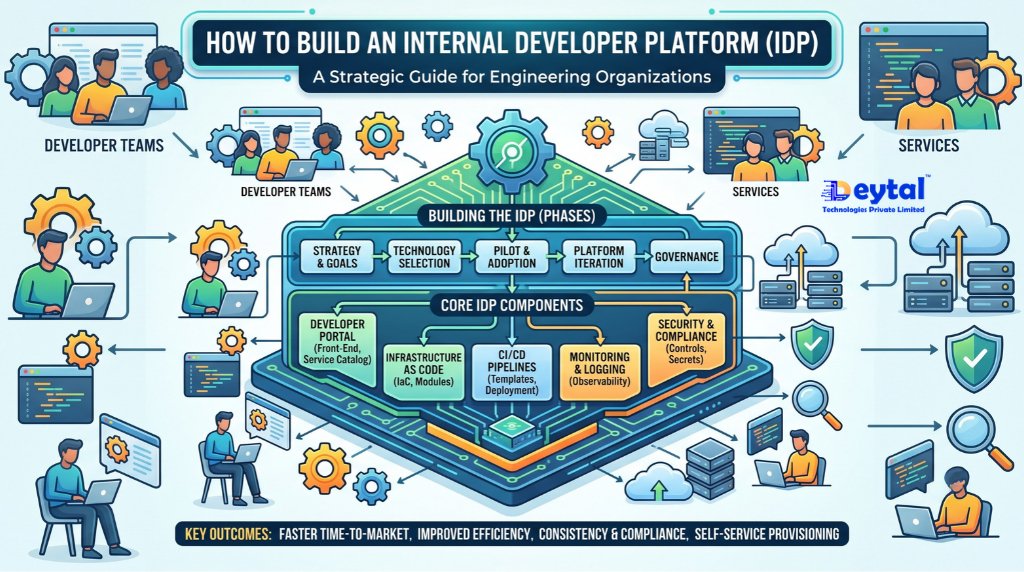
Platform Engineering resolves this operational friction by treating the platform itself as an internal product. Engineering organizations build an Internal Developer Platform (IDP) that encapsulates underlying infrastructure complexities behind self-service portals, automated orchestration planes, and standardized “Golden Paths.” By abstracting low-level cloud tooling behind declarative interfaces—using orchestrators like Humanitec, Port, or open-source portals like Spotify’s Backstage enterprises eliminate ticket queues and establish secure, automated deployment workflows.
The Cognitive Overload of Traditional DevOps Ticket Workflows
Forcing product squads to manually manage full-stack cloud plumbing leads to common organizational failure modes:
- Ticket-Driven Operations & Lead Time Drag: Deploying a simple microservice or provisioning a managed PostgreSQL database requires opening Jira tickets with centralized DevOps, introducing multi-day delivery delays.
- Configuration Drift & Snowflake Infrastructure: When individual developers modify Terraform files or cluster settings manually, environments drift out of sync, causing runtime bugs between staging and production.
- Security & Governance Blindspots: Application developers lack deep infrastructure security expertise, frequently committing hardcoded credentials, misconfiguring public S3 buckets, or granting overly permissive IAM roles.
- Context Switching & Developer Fatigue: Switching continuously between writing business logic and troubleshooting complex infrastructure tooling drains developer focus and drastically inflates time-to-market.
Fragmented DevOps vs. Platform-Engineered Internal Developer Platforms
| Operational Dimension | Fragmented DevOps (“You Build It, You Run It”) | Enterprise Internal Developer Platform (IDP) |
| Service Provisioning | Manual Terraform scripting or Jira infrastructure tickets | Self-service catalogs and one-click Golden Paths |
| Developer Cognitive Load | Extreme; developers must master Docker, K8s, IAM, and cloud APIs | Lean; developers focus purely on business logic and app config |
| Environment Parity | High drift; environments provisioned inconsistently | Ephemeral and preview environments generated dynamically |
| Governance & Policy Enforcement | Post-hoc security reviews and manual compliance audits | Shift-left Policy as Code (OPA/Kyverno) enforced automatically |
| Developer Onboarding | Weeks spent setting up local tools, secrets, and cluster contexts | Hours; new hires spin up isolated environments via central portal |
| Infrastructure Scalability | Linear DevOps team hiring required as squads expand | Central platform team scales leverage across hundreds of engineers |
Strategic Pillars for Engineering an Enterprise Platform Ecosystem
1. Declarative Golden Paths & Automated Cloud Workflows
Build self-service workload specifications (such as Score or Kusion) that translate developer intentions into fully hydrated cloud resources. Engineering automated orchestration backbones, CI/CD pipelines, and infrastructure modules through Custom Software Development Services ensures consistent, compliant cloud environments with zero manual intervention.
2. Standardized Developer Portals & Service Catalogs
Consolidate fragmented dashboards into a centralized developer portal (like Backstage or Port) providing software catalogs, technical documentation (TechDocs), and real-time dependency graphs. Constructing modular web-based internal developer tools via Website Development Services gives engineering teams clear visibility into service ownership and deployment health.
3. Frictionless Developer Portals & Ergonomic UI/UX Design
Internal tools fail when clumsy user interfaces force engineers back to writing manual terminal scripts. Designing intuitive service catalogs, clear parameter input forms, and digestible deployment status views through UI/UX Design Services makes complex cloud orchestration accessible across all engineering skill levels.
4. Mobile Developer SDKs & Accelerated App Delivery
Extend platform engineering practices into mobile engineering squads by standardizing native build toolchains, automated artifact signing, and distribution pipelines. Building reusable modular SDKs and cloud build runners via Mobile App Development Services slashes mobile compilation times and accelerates release cycles across iOS and Android.
5. Clean Documentation Hubs & Technical SEO Discovery
Ensure public-facing API references, developer hubs, and open-source platform tooling retain fast search discovery and effortless navigation. Pairing modern documentation systems via WordPress Development Services with advanced SEO Services maintains top organic search authority, fast indexing, and optimal Core Web Vitals for public technical documentation.
6. Talent Brand Authority & Engineering Growth Funnels
Showcase an organization’s modern developer experience, open-source platform contributions, and engineering culture to attract top-tier technical talent, promoted and scaled via targeted Digital Marketing Services.
Modernize Your Engineering Velocity with Deytal Technologies
Building an enterprise Internal Developer Platform requires balancing developer autonomy with strict security and governance standards. Deytal Technologies Pvt. Ltd. designs and implements production-grade platform engineering architectures, Backstage service portals, and automated cloud delivery pipelines engineered to eliminate developer cognitive overload and accelerate product delivery.
Frequently Asked Questions (FAQ)
Q1: What is the difference between Platform Engineering and DevOps?
DevOps is a cultural philosophy emphasizing collaboration between software development and IT operations teams to shorten the systems development lifecycle. Platform Engineering is the practical discipline of designing and operating Internal Developer Platforms (IDPs) that provide automated, self-service infrastructure capabilities, operationalizing DevOps principles so developers do not have to perform infrastructure management manually.
Q2: What is a “Golden Path” in platform engineering?
A Golden Path (or Golden Road) is an opinionated, supported, and automated route for building and deploying software. It provides developers with pre-packaged templates, CI/CD pipelines, and cloud resources configured with security, monitoring, and compliance best practices out of the box, allowing teams to deliver software rapidly without figuring out infrastructure plumbing from scratch.
Q3: How does an Internal Developer Platform handle ephemeral environments?
Modern IDPs integrate with container orchestrators and Infrastructure-as-Code engines to dynamically spin up short-lived, isolated preview environments for each pull request. When a developer submits a code change, the platform automatically provisions lightweight compute, seeds test data, and configures ephemeral routing, automatically tearing the environment down once the pull request is merged to avoid cloud waste.
