

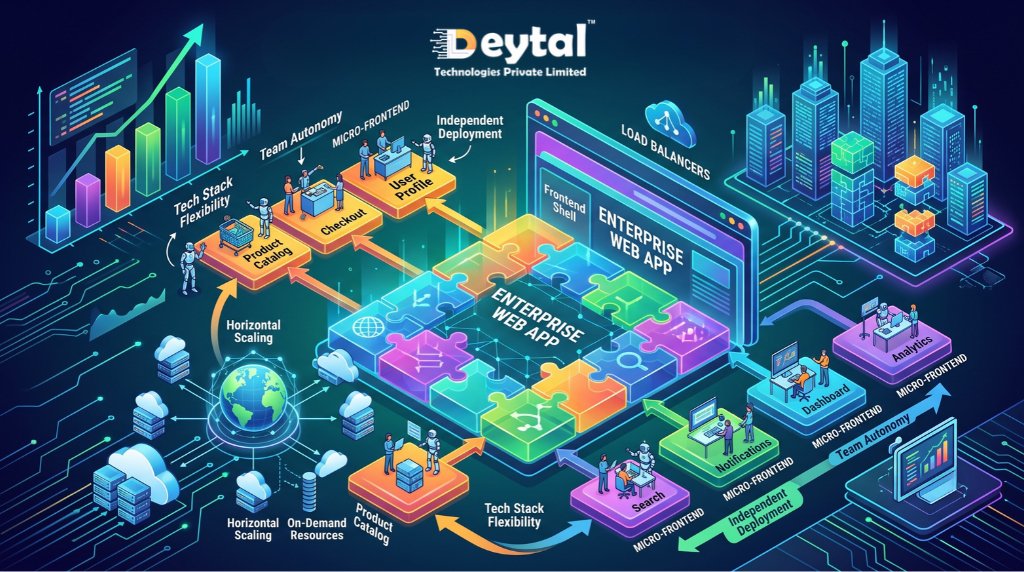
Modern enterprise software organizations have spent years decomposing backend monoliths into scalable, independently deployable microservices. However, the client layer frequently remains a massive, tightly coupled single-page application (SPA). As dozens of cross-functional engineering squads commit code to a single frontend repository, release coordination breaks down. A minor styling regression in an account settings tab can block a critical checkout deployment, continuous integration (CI) build times surge into hours, and shared dependency conflicts turn minor upgrades into organization-wide migrations.
Micro-Frontend Architecture extends the core principles of microservices into the presentation layer. By decomposing complex browser applications into semi-autonomous, domain-driven micro-applications orchestrated via modern runtime integration patterns like Webpack Module Federation or native ECMAScript modules (ESM), enterprise product teams can build, test, and deploy features independently without risking the stability of the global user experience.
The Operational Drag of Monolithic Frontend Repositories
Scaling a high-traffic web application on a unified frontend codebase introduces distinct architectural bottlenecks:
- Deployment Lockstep & Coordinated Releases: Product squads cannot release independently. Deployments require synchronizing merge freezes, manual regression testing, and off-peak rollout windows across multiple teams.
- Cascading Runtime Failures: In an un-isolated SPA, an uncaught JavaScript runtime error or memory leak inside one feature module can crash the entire browser window for the end user.
- Creeping Build & CI/CD Pipelines: Massive codebases with hundreds of thousands of lines of TypeScript inflate linting, unit testing, and asset bundling times, grinding deployment velocity to a halt.
- Technology Stagnation & Upgrade Paralysis: Upgrading major framework versions or core UI libraries requires a coordinated, high-risk refactor of the entire frontend surface area rather than incremental, domain-by-domain upgrades.
Monolithic SPAs vs. Enterprise Micro-Frontend Architecture
| Architectural Dimension | Monolithic Single-Page Application (SPA) | Enterprise Micro-Frontend Architecture |
| Codebase Ownership | Single unified repository or tangled monorepo | Domain-isolated repositories or bounded workspaces |
| Deployment Cadence | Coordinated, high-risk monolithic deployments | Independent, continuous deployments per product domain |
| Runtime Failure Boundary | Single uncaught exception crashes the entire page | Isolated error boundaries prevent blast-radius spread |
| Dependency Management | Global version locks across all features | Shared federated dependencies with scoped fallbacks |
| Build & CI Pipeline Speed | Linear build time growth; slow verification | Fast, modular builds scoped only to changed domains |
| Technology Agility | Locked to a single framework and version | Allows incremental modernization and framework experimentation |
Strategic Pillars for Engineering an Enterprise Micro-Frontend Stack
1. Federated Integration Contracts & Host-Shell Orchestration
Architect a lightweight root application (the “app shell”) that manages global authentication states, cross-application event buses, and routing boundaries without coupling itself to domain business logic. Engineering resilient Module Federation configurations and shared dependency resolution via Custom Software Development Services guarantees dynamic runtime loading with zero duplicated core libraries.
2. Decoupled Web Frontends & Incremental Delivery
Ensure independent micro-applications stitch together seamlessly inside browser runtimes while maintaining sub-second transition speeds and isolated routing. Developing modular frontend architectures via Website Development Services ensures each business unit deploys high-velocity user interfaces without causing layout shifts or page reloads.
3. Cohesive Cross-Domain Design Tokens & UI/UX Governance
A micro-frontend application must never look like a patchwork of disparate teams. Establishing shared design tokens, unified component primitives, and responsive layout standards through UI/UX Design Services maintains strict visual harmony, accessible component states, and seamless user journeys across all application micro-domains.
4. Hybrid Native Runtimes & Cross-Platform Module Sharing
Extend modular frontend domains into enterprise mobile applications using embedded WebViews or federated JavaScript bundles. Engineering clean native wrappers and bridge interfaces via Mobile App Development Services allows specialized product teams to push instant web-based feature updates into native apps without waiting for app store review cycles.
5. Clean Server-Side Composition & Technical SEO Authority
Micro-frontends can harm crawlability if client-side rendering is uncoordinated. Pairing edge-composed server-side rendering (SSR) pipelines via WordPress Development Services with data-backed SEO Services guarantees fast bot indexing, automated metadata synchronization, and strong Core Web Vitals (LCP and INP) across public-facing domain portals.
6. Product-Led Experimentation & Targeted User Funnels
Empower product squads to run isolated A/B tests, targeted conversion optimizations, and customized user onboarding flows within their specific micro-domain without altering neighboring features, monitored and scaled via Digital Marketing Services.
Modernize Your Frontend Architecture with Deytal Technologies
Migrating from a brittle frontend monolith to an enterprise micro-frontend architecture requires rigorous dependency management, shared routing strategies, and automated contract testing. Deytal Technologies Pvt. Ltd. designs and implements production-grade micro-frontend systems, Module Federation pipelines, and scalable enterprise web platforms engineered for maximum velocity, fault tolerance, and organizational autonomy.
Frequently Asked Questions (FAQ)
Q1: How does Webpack Module Federation enable micro-frontend architecture?
Module Federation allows a JavaScript application to dynamically import code from another build at runtime over the network. Instead of publishing shared components as npm packages that require recompilation of the host app, Module Federation enables individual micro-frontends to act as independent remotes, exposing modules that the host shell fetches on demand while sharing vendor libraries (like React or Vue) to prevent duplicate downloads.
Q2: What is the primary difference between build-time and runtime micro-frontends?
Build-time micro-frontends compile separate packages together at build time (e.g., via npm dependencies inside a monorepo). While simple, this preserves the deployment coupling of a monolith because updating one package requires rebuilding and redeploying the container application. Runtime micro-frontends (using Module Federation or dynamic script injection) load independent builds in the browser or at the edge, achieving true independent deployments.
Q3: How do enterprise micro-frontends manage global state and cross-app communication?
Rather than using a single global Redux or Zustand store, best practices recommend keeping state local to each micro-frontend domain. Cross-domain communication is handled via loosely coupled mechanisms: standard browser CustomEvents, a lightweight shared event emitter, or query parameters in the URL route, preventing tight architectural coupling between separate squad codebases.