

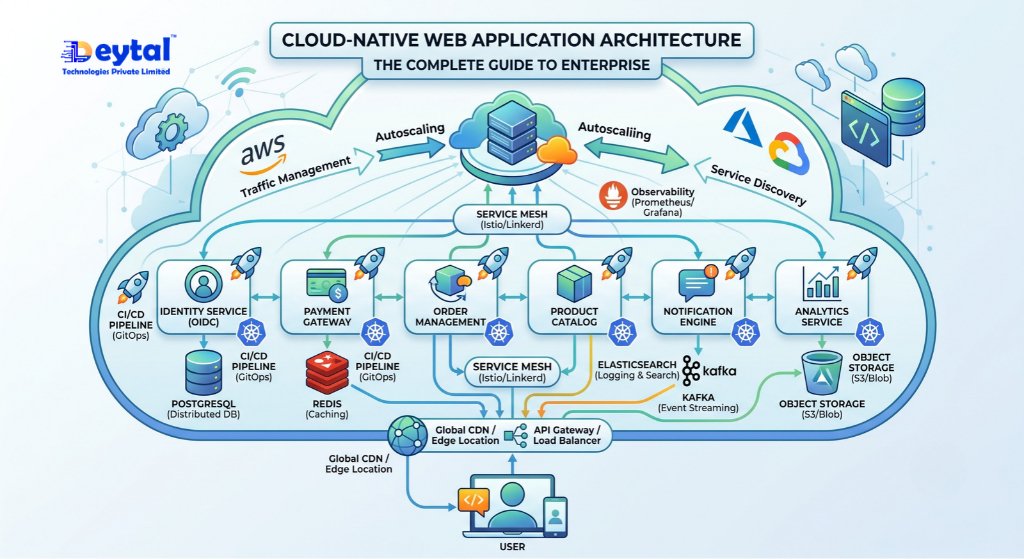
Modern enterprise software can no longer afford the architectural constraints of legacy hosting. Traffic spikes during product launches, unexpected market events, or regional server outages frequently overwhelm monolithic systems, leading to costly downtime and lost conversions.
A Cloud-Native Web Application Architecture leverages microservices, containerization, and dynamic orchestration to build platforms designed from the ground up to thrive in elastic cloud environments delivering continuous uptime, sub-second latency, and seamless deployments.
The Operational Risks of Legacy Server Environments
Running modern web applications on traditional virtual machines or dedicated on-premise hardware creates significant technical debt:
- Static Resource Bottlenecks: Legacy setups cannot dynamically spin up compute capacity during sudden traffic surges, causing slow page responses or total service crashes.
- Complex, High-Risk Deployments: Releasing updates requires manual intervention or scheduled downtime, slowing down product iteration cycles.
- Single Points of Failure: When an application instance fails, the entire platform goes offline, halting business operations and damaging enterprise credibility.
- High Infrastructure Inefficiencies: Paying for peak-capacity hardware year-round results in massive server waste during off-peak hours.
Traditional Web Hosting vs. Cloud-Native Web Architecture
| Architecture Metric | Traditional Web Hosting | Cloud-Native Web Architecture |
| Scalability | Manual vertical scaling (requires reboots) | Automated horizontal scaling in seconds |
| Fault Isolation | Low (A failure crashes the whole app) | High (Self-healing containers isolate failures) |
| Deployment Model | Monolithic releases with maintenance windows | Zero-downtime CI/CD continuous delivery |
| Resource Efficiency | Fixed, paid-in-advance hardware limits | Pay-as-you-scale serverless and container usage |
| Recovery Time (MTTR) | Hours (requires manual diagnostics) | Seconds (automated container restarts & failovers) |
Strategic Pillars for Building Cloud-Native Web Platforms
1. Modular Backend Services & Container Orchestration
Package discrete business functions into lightweight Docker containers managed via Kubernetes. Structuring resilient backend microservices through Custom Software Development Services ensures independent scalability and fault isolation across your application stack.
2. High-Performance, Edge-Rendered Web Frontends
Deploy headless, modern frontends to global edge networks. Building responsive, decoupled interfaces using Website Development Services ensures near-instant Time to First Byte (TTFB) and seamless user interactions worldwide.
3. Intuitive Administrative UI & Cloud Dashboards
Complex cloud environments require clear operational visibility. Creating centralized monitoring consoles, log viewers, and administrative interfaces through UI/UX Design Services empowers teams to monitor system health effortlessly.
4. Real-Time Mobile Cloud Synchronization
Extend cloud-native resilience directly to mobile devices. Developing low-latency, event-driven API endpoints via Mobile App Development Services guarantees instant data synchronization across both iOS and Android platforms.
5. Scalable Content Hubs & Technical SEO Infrastructure
Preserve search engine authority by decoupling dynamic marketing platforms from transactional databases. Pairing cloud-hosted WordPress Development Services with proactive SEO Services maintains top organic search visibility and flawless Core Web Vitals performance.
6. Automated Growth Funnels & High-Volume Acquisition
Harness elastic cloud infrastructure to run high-volume marketing campaigns without fear of performance drops, managed by targeted Digital Marketing Services.
Build Future-Ready Cloud Platforms with Deytal Technologies
Transitioning to a cloud-native architecture requires deep engineering expertise, containerization strategy, and automated deployment pipelines. Deytal Technologies Pvt. Ltd. designs and develops high-performance cloud architectures, custom backend systems, and scalable digital solutions tailored to accelerate enterprise growth.
Frequently Asked Questions (FAQ)
Q1: What does “cloud-native” actually mean in web development?
Cloud-native refers to building and running applications specifically to exploit the scale, elasticity, and resilience of cloud computing, typically using microservices, containers, serverless functions, and automated CI/CD pipelines.
Q2: How does a cloud-native architecture achieve zero-downtime deployments?
Through techniques like blue-green deployments or rolling updates, new application versions are launched and health-checked in separate containers before traffic is routed to them, ensuring uninterrupted user service.
Q3: Can existing monolithic applications be converted to a cloud-native model?
Yes. Legacy systems can be systematically modernized using the “Strangler Fig” pattern, where individual features are extracted into independent microservices over time until the legacy monolith is fully deprecated.