

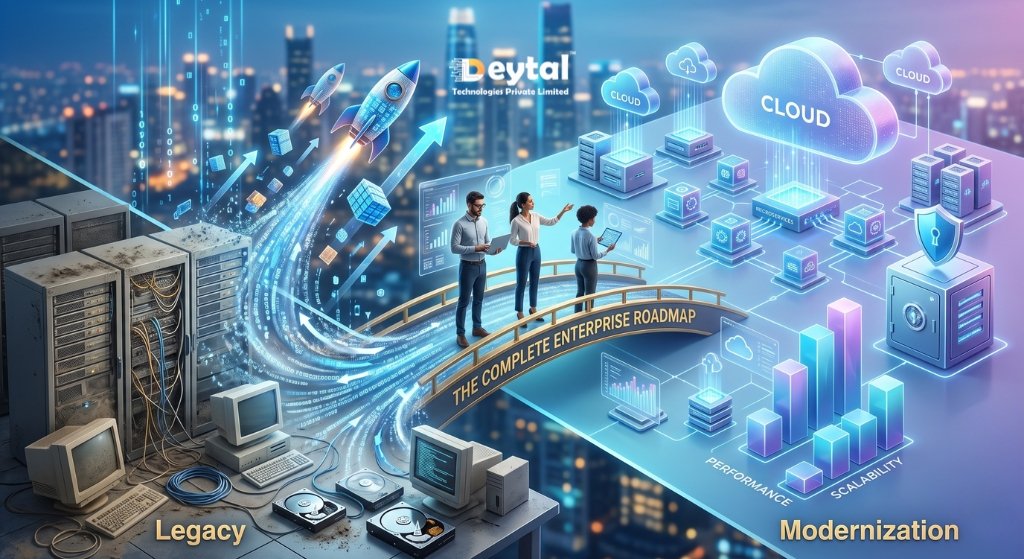
Relying on outdated legacy systems and on-premise infrastructure creates major operational bottlenecks for growing businesses. Monolithic codebases, slow server responses, and frequent downtime actively limit your company’s ability to innovate and scale.
Transitioning from rigid legacy setups to agile cloud architecture reduces maintenance overhead, secures mission-critical data, and builds a foundation for long-term commercial growth.
The Hidden Risks of Outdated Legacy Systems
Continuing to run core operations on legacy architectures carries severe technical and financial costs:
- High Infrastructure Overhead: Maintaining on-premise hardware and outdated server stacks requires constant manual monitoring and unpredictable maintenance expenses.
- Scalability Bottlenecks: Legacy systems struggle to handle sudden traffic spikes during marketing campaigns or peak commercial cycles.
- Data Silos & Integration Roadblocks: Outdated applications cannot easily connect with modern third-party APIs, automation tools, or advanced analytics platforms.
- Heightened Security Exposures: Older codebases often contain unpatchable dependencies that leave enterprise assets vulnerable to modern cyber exploits.
Legacy Architecture vs. Modern Cloud Ecosystems
| Capability / Factor | On-Premise Legacy Architecture | Cloud-Native Enterprise Architecture |
| System Scalability | Manual, expensive hardware upgrades | Automated elastic auto-scaling based on real-time traffic |
| Uptime & Reliability | Vulnerable to single points of server failure | Multi-region redundancy with 99.99% uptime SLAs |
| Deployment Agility | Slow, risky release cycles with downtime | Seamless CI/CD deployment pipelines with zero downtime |
| Data Protection | Localized backups vulnerable to data loss | Automated distributed backups and encrypted cloud vaults |
| Cost Efficiency | High fixed capital expenses (CapEx) | Predictable, scalable operational pay-as-you-go pricing (OpEx) |
Strategic Phases for Modernizing Your Digital Stack
1. Modular Code Refactoring & Backend Modernization
Modernizing legacy software does not always mean rebuilding from scratch. Decoupling monoliths into scalable microservices and optimizing database schemas through Custom Software Development Services ensures smooth, reliable data processing.
2. Modernizing User Interfaces for Peak Engagement
Legacy enterprise tools often feature cluttered, confusing interfaces that reduce team productivity and client retention. Re-engineering administrative portals with intuitive, responsive workflows via UI/UX Design Services makes complex workflows effortless.
3. Migrating Core Web Assets with Zero Downtime
Moving public-facing storefronts and business sites to high-speed cloud servers requires precision. Partnering with seasoned specialists in Website Development Services prevents broken links, data loss, and traffic drops during migration.
4. Building Scalable Cross-Platform Mobile Cloud Apps
Extend the power of your modern cloud backend directly into users’ hands. Deploying robust mobile endpoints and offline-ready sync features through Mobile App Development Services keeps teams and clients connected on any device.
5. Protecting Search Engine Visibility During Migration
Improper server transitions can severely disrupt organic search rankings. Safeguarding URL structures, technical schema, and metadata through proactive WordPress Development Services and comprehensive SEO Services preserves your search presence.
6. Driving Scalable Traffic to High-Speed Cloud Platforms
Once your infrastructure is lightning-fast and resilient, turn your modern platform into a growth driver with targeted lead-generation funnels executed through Digital Marketing Services.
Modernize Your Digital Infrastructure with Deytal Technologies
Migrating mission-critical systems demands deep technical expertise, robust data governance, and strategic planning. Deytal Technologies Pvt. Ltd. helps forward-thinking companies migrate, refactor, and scale their applications with custom cloud architectures, secure API integrations, and end-to-end full-stack development.
Frequently Asked Questions (FAQ)
Q1: What is the main difference between “Lift-and-Shift” and Legacy Modernization?
Lift-and-shift simply moves an existing application to a cloud server without code changes. Legacy modernization refactors the underlying codebase and database into cloud-native microservices for maximum speed, security, and scalability.
Q2: Will migrating to the cloud cause website or business downtime?
No. By setting up staging environments, performing incremental database synchronization, and executing blue-green deployments, the entire migration process can occur with zero interruption to your live operations.
Q3: How does cloud migration improve page speed and Core Web Vitals?
Cloud-native infrastructure leverages Content Delivery Networks (CDNs), edge computing, and elastic server resources to deliver assets from locations closest to your visitors, dramatically reducing server response times.