

Traditional cloud web applications follow a rigid request-response lifecycle: every user click triggers an HTTP/GraphQL round trip across the internet to an API server, which queries a centralized database and returns JSON while the frontend renders loading spinners. Even with optimistic UI patches and client caching libraries like TanStack Query, complex enterprise interfaces project trackers, collaborative CRMs, financial workspaces suffer from cache invalidation bugs, multi-tab state drift, and perceptible network latency.
To deliver desktop-grade sub-millisecond UI reactivity alongside multi-user real-time collaboration, modern frontend and systems architects are adopting Local-First and Sync-Engine Architectures. By streaming filtered subsets of backend PostgreSQL data directly into an embedded client-side database (IndexedDB, SQLite WASM, or PGlite), read queries execute locally in zero milliseconds with zero network hops.
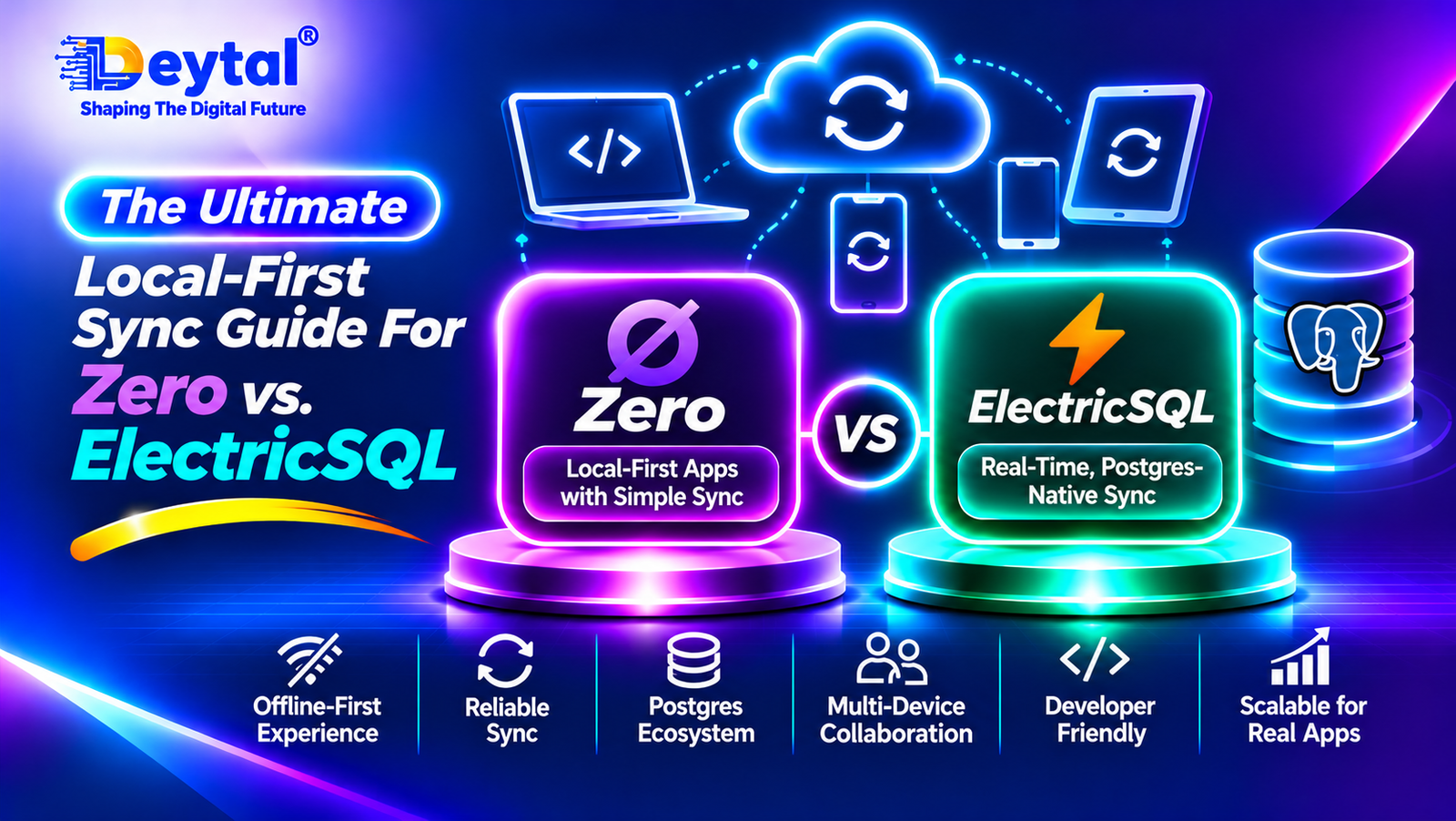
Within the PostgreSQL sync-engine ecosystem, two architectures lead production adoption: Zero (by Rocicorp) and ElectricSQL.
- Zero (Rocicorp) is a full bidirectional, query-driven sync engine powered by ZQL (Zero Query Language) and Incremental View Maintenance (IVM) synchronizing live query results into a client-side cache via WebSockets while executing optimistic mutations locally and validating them authoritatively on the server.
- ElectricSQL is a read-path PostgreSQL sync engine that tails Postgres logical replication logs and streams filtered table subsets (Shapes) over standard, CDN-cacheable HTTP decoupling real-time read synchronization from your existing REST, GraphQL, or PGlite write APIs.
Selecting between them determines your CDN cacheability, offline write capabilities, authorization model, and backend infrastructure footprint.
The Structural Bottlenecks of Real-Time Client Sync at Scale
Streaming relational database mutations to tens of thousands of concurrent browser clients introduces demanding distributed systems challenges:
- The Partial Replication & Authorization Boundary: Syncing an entire multi-terabyte PostgreSQL database to a user’s browser is impossible. Sync engines must enforce partial replication streaming only the exact rows a user is permitted to see—and dynamically revoking or pruning local records the moment a user’s workspace permissions change.
- Fan-Out Thundering Herds on Hot Shapes: When 50,000 connected users view the same public dashboard or shared workspace channel, a single
UPDATEin PostgreSQL must fan out to all 50,000 subscribers simultaneously. Stateful WebSocket brokers scale differently than stateless HTTP long-polling streams cached behind Cloudflare or Fastly edge CDNs. - Client-Side Query Expressiveness vs. Bandwidth: Downloading flat database tables and joining them manually in JavaScript wastes bandwidth, whereas running complex multi-table relational joins on the client requires an incremental query engine capable of updating reactive UI views in microseconds as individual rows mutate.
- Optimistic Mutation Rollbacks & Conflict Resolution: Applying writes locally before server confirmation eliminates spinner delays, but if concurrent users modify the same record or server-side business rules reject a mutation, the sync engine must cleanly rebase or revert local optimistic state without corrupting UI components.
Zero (Rocicorp) vs. ElectricSQL: Deep Architectural Comparison
| Architectural Dimension | Zero (by Rocicorp) | ElectricSQL |
| Core Sync Philosophy | Full bidirectional sync (reads + writes) with server-authoritative validation | Read-path Postgres sync over HTTP; BYO write path (API or PGlite) |
| Sync Definition & Query Model | Query-driven sync (ZQL); client queries define what syncs via Incremental View Maintenance | Shape-driven sync; declarative table + WHERE filter subscriptions (useShape) |
| Transport & Caching Layer | Stateful WebSockets (zero-cache middleware backed by NVMe SQLite replica) | Standard HTTP streaming; natively cacheable at Cloudflare/Fastly edge CDNs |
| Client-Side Storage & Joins | Built-in IndexedDB / SQLite replica with native relational .related() joins in ZQL | Pluggable client store: TanStack DB, in-memory reactive maps, or PGlite (full WASM Postgres) |
| Write & Mutation Architecture | Isomorphic Custom Mutators (TypeScript functions run optimistically on client, authoritatively on server) | Standard REST/GraphQL/Server Actions (online) or PGlite changelog outbox (offline) |
| Offline Write Support | Primarily online/transient-disconnect oriented; not built for prolonged offline write queues | Full offline reads and writes when paired with PGlite or TanStack DB outbox patterns |
| Backend Scaling & Dataset Ceiling | zero-cache maintains a local NVMe SQLite replica (recommended for syncable datasets under ~100GB) | Stateless Elixir sync service tailing Postgres WAL; scales to massive fan-out via CDN edge caching |
| Ideal Production Use Case | Linear-style interactive SaaS, CRMs, project workspaces with complex client-side joins | High-fan-out dashboards, read-heavy Postgres apps, offline-first field tools with PGlite |
Strategic Pillars for Engineering Local-First & Reactive Web Platforms
1. PostgreSQL Logical Replication & Sync-Engine Backend Engineering
Delivering zero-millisecond UI responsiveness requires configuring PostgreSQL WAL logical replication slots, high-throughput zero-cache or Electric sync services, and row-level authorization filters without overloading primary database IOPS. Engineering custom isomorphic mutators, CDN-cached HTTP Shape topologies, and incremental view pipelines via Custom Software Development Services transforms sluggish request-response backends into real-time reactive engines.
2. Instant-Load Reactive Web Applications & Collaborative Workspaces
Modern B2B SaaS buyers expect web applications to feel as instantaneous as native desktop software. Constructing reactive React, Next.js, and SolidJS interfaces powered by local client query caches and optimistic state mutations through Website Development Services eliminates loading spinners across complex multi-tab dashboards and collaborative workspaces.
3. Optimistic UI States, Sync Status & Conflict Resolution UI/UX Design
When data mutates locally before reaching the cloud, users need subtle, reassuring visual cues showing synchronization health, offline queue status, and conflict recovery. Designing non-intrusive sync indicators, offline-ready workspace banners, and graceful mutation rollback notifications through UI/UX Design Services builds deep user confidence during spotty network conditions.
4. Offline-Capable Mobile Apps & Field-Force Synchronization
Field technicians, warehouse operators, and mobile sales teams routinely work inside dead zones where standard cloud APIs fail completely. Building offline-first iOS and Android applications backed by local SQLite/PGlite stores, background sync queues, and deterministic conflict resolution via Mobile App Development Services ensures uninterrupted mobile productivity anywhere.
5. Hybrid Content Publishing & Technical Search Engine Optimization
While authenticated SaaS workspaces thrive on client-side sync engines, public marketing pages, documentation hubs, and landing pages require fast server-rendered HTML for search engine crawlers. Pairing reactive client applications with high-speed, edge-cached editorial publishing tiers through WordPress Development Services and data-backed SEO Services maximizes both organic search rankings and logged-in product velocity.
6. Desktop-Class UX Speed & Enterprise Product Differentiation
Highlight sub-millisecond UI responsiveness, real-time multi-user collaboration, and zero-spinner reliability as signature product differentiators in competitive B2B demos, reinforced by conversion-focused digital campaigns managed by Digital Marketing Services.
Build Zero-Latency Reactive Applications with Deytal Technologies
Transitioning from legacy REST polling and spinner-heavy frontends to a modern PostgreSQL sync-engine architecture requires deep systems mastery across WAL logical replication, incremental view maintenance, CDN shape caching, and optimistic conflict resolution. Deytal Technologies Pvt. Ltd. designs, audits, and builds reactive web platforms, local-first SaaS applications, and high-throughput PostgreSQL architectures engineered for instant user experiences.
Frequently Asked Questions (FAQ)
Q1: How does ElectricSQL use standard CDNs to scale real-time Postgres sync to tens of thousands of users?
Unlike sync engines that maintain stateful per-user WebSocket connections on custom backend servers, ElectricSQL streams database changes over standard HTTP/1.1 and HTTP/2 requests using Shape offsets (offset=...&handle=...). Because each shape chunk request is an immutable, deterministic HTTP URL parameterized by replication log offsets, edge CDNs like Cloudflare or Fastly can cache and collapse thousands of identical concurrent client requests at the network edge dramatically reducing origin database load and hosting costs for read-heavy applications.
Q2: What makes Rocicorp Zero’s ZQL (Zero Query Language) unique compared to simple table replication?
Most sync engines sync flat tables or predefined filters and force developers to write manual client-side join logic. Zero implements Incremental View Maintenance (IVM) across both its zero-cache server and client runtime. Developers write expressive relational queries directly in TypeScript (e.g., fetching open issues alongside their nested assignee, labels, and comments), and Zero automatically tracks the exact dependency graph streaming only minimal row diffs whenever any underlying table changes.
Q3: When should an engineering team choose ElectricSQL over Rocicorp Zero?
Choose ElectricSQL when you want to adopt real-time read sync incrementally alongside an existing REST/GraphQL API without rewriting all backend mutations, when your application broadcasts shared shapes to massive concurrent audiences where CDN edge caching cuts infrastructure costs, or when you need true prolonged offline write support by pairing Electric’s read shapes with PGlite or TanStack DB outbox queues. Choose Zero when building a heavily interactive, Linear-style online SaaS app where an all-in-one bidirectional sync engine, nested client-side relational joins, and isomorphic TypeScript mutators accelerate development velocity.
