

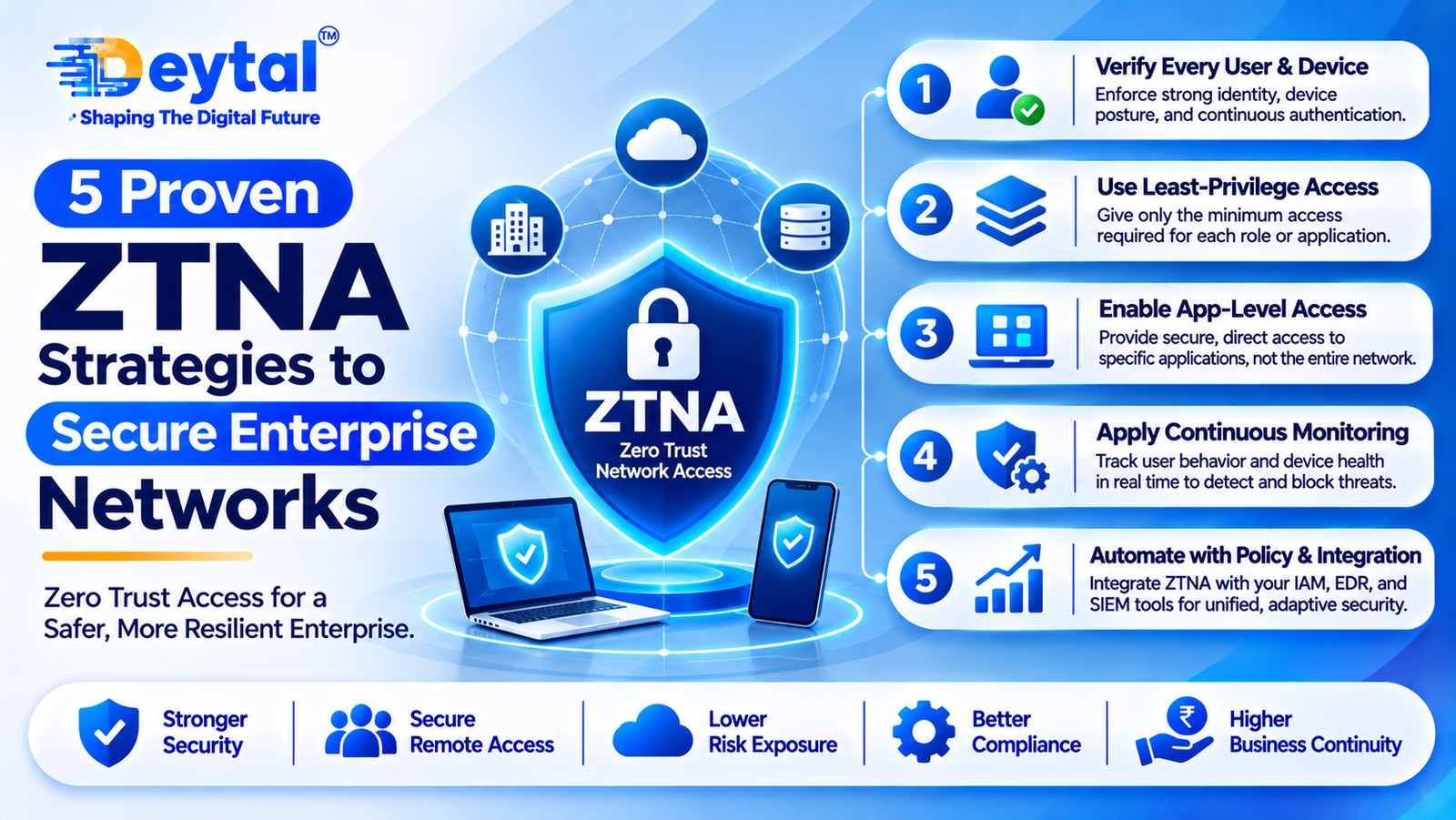
For decades, enterprise security adhered to a simple castle-and-moat perimeter: build a fortified boundary around corporate office networks and data centers, verify users once at the gate via traditional Virtual Private Networks (VPNs), and grant broad internal trust to any device operating behind the firewall. In a modern environment characterized by hybrid workforces, multi-cloud platforms, and containerized microservice architectures, this perimeter model has collapsed. Once an attacker breaches a VPN gateway or compromises an employee’s machine via phishing, they gain uninhibited lateral movement across entire internal subnets.
Enterprise Zero Trust Network Access (ZTNA) Architecture replaces this outdated perimeter with a continuous, identity-centric verification model. Built upon principles pioneered by Google’s BeyondCorp framework, Software-Defined Perimeters (SDP), and Mutual TLS (mTLS), ZTNA enforces a fundamental axiom: never trust, always verify.
Instead of placing devices directly onto corporate networks, ZTNA abstracts network connections through Identity-Aware Proxies (IAP). Access is granted strictly on a per-session, per-application basis, dynamically modulated by real-time device posture checks, behavioral signals, and cryptographic identities.
The Fatal Vulnerabilities of Legacy Corporate VPNs
Relying on standard hub-and-spoke VPN appliances introduces critical enterprise attack surfaces:
- Unrestricted Lateral Movement: Traditional VPNs operate at Layer 3 (Network Layer). Connecting a remote worker grants their device an internal IP address on the corporate subnet, enabling automated port scanning and lateral movement across internal databases and file shares.
- Coarse-Grained, Point-in-Time Authentication: Legacy VPNs check credentials only once during initial tunnel negotiation. If a device is infected with malware or credentials are leaked mid-session, the connection remains active and trusted indefinitely.
- Appliance Vulnerabilities & Single Points of Failure: Concentrating all remote traffic through centralized VPN hardware creates massive throughput bottlenecks, increases latency for distributed employees, and presents an attractive, internet-facing target for zero-day exploits.
- Lack of Contextual and Device Health Verification: Standard VPN clients cannot dynamically block access if an employee disables full-disk encryption, falls behind on OS security patches, or attempts to access production infrastructure from an unauthorized geographic location.
Legacy Enterprise VPN vs. Next-Gen ZTNA Architecture
| Architectural Dimension | Legacy Corporate VPN | Enterprise ZTNA (BeyondCorp / SDP) |
| Network OSI Layer | Layer 3 / Layer 4 (Network/Transport routing) | Layer 7 (Application-level proxying) |
| Access Model | Network-centric: Grants broad access to subnets | Application-centric: Connects authorized users strictly to specific apps |
| Trust Evaluation | Point-in-time check during tunnel login | Continuous evaluation on every single request |
| Lateral Movement Risk | Extreme; compromised device accesses entire subnet | Zero; network is dark to unauthenticated users |
| Network Visibility | Broadcasts internal IP ranges; open ports exposed | Software-Defined Perimeter hides private infrastructure completely |
| Data Plane Encryption | Single IPsec or OpenVPN tunnel | End-to-end Mutual TLS (mTLS) with short-lived ephemeral certificates |
Strategic Pillars for Engineering an Enterprise ZTNA Ecosystem
1. Identity-Aware Proxies & Microsegmentation
Decouple corporate applications from direct internet exposure by deploying Identity-Aware Proxies (IAP) at the ingress boundary. Engineering custom policy decision points, dynamic OpenID Connect (OIDC) integrations, and cryptographic authorization filters via Custom Software Development Services ensures that every API call and web request is validated against fine-grained role-based access controls before reaching downstream backends.
2. Zero Trust Authentication Portals & Responsive Web Frontends
Deliver seamless access to corporate applications without cumbersome client installs by leveraging browser-based WebAuthn and passkey standards. Designing responsive single-page management consoles with fast session re-authentication and intuitive self-service access requests through Website Development Services minimizes login friction while maintaining enterprise-grade compliance.
3. Policy Management & Security Posture UI/UX Design
Complex zero-trust policies can easily overwhelm security operations teams if misconfigured. Designing clear access rule builders, real-time device posture heatmaps, and conditional access visualizers through UI/UX Design Services allows Chief Information Security Officers (CISOs) and platform engineers to simulate and deploy context-aware security rules without breaking business workflows.
4. Ephemeral Device Attestation for Mobile Fleets
Mobile employees frequently access enterprise assets over untrusted cellular connections and public Wi-Fi networks. Implementing continuous mobile device attestation, secure enclave cryptographic key storage, and zero-trust MDM integrations via Mobile App Development Services guarantees enterprise mobile apps block compromised or rooted devices from reaching internal backends.
5. Clean Ingress Hardening & Uninterrupted Public Portal Discoverability
Prevent zero-trust security restrictions from accidentally blocking public search engine crawlers, customer marketing assets, and partner-facing documentation. Powering secure headless publishing platforms through WordPress Development Services coupled with data-driven SEO Services ensures strict microsegmentation protects administrative endpoints while public web assets maintain fast indexing, flawless Core Web Vitals, and strong organic search authority.
6. Enterprise Security Compliance & B2B Trust Funnels
Leverage verified ZTNA implementation metrics—such as SOC 2 Type II compliance, automated zero-trust auditing, and elimination of unpatched VPN endpoints—as critical trust signals in enterprise B2B sales pipelines, supported by Digital Marketing Services.
Modernize Your Enterprise Security with Deytal Technologies
Transitioning from legacy VPN appliances to a resilient Zero Trust Network Access architecture requires deep expertise in identity orchestration, mTLS cryptographic handshakes, and application proxy engineering. Deytal Technologies Pvt. Ltd. designs, audits, and implements production-grade ZTNA systems, BeyondCorp identity frameworks, and secure software-defined perimeters engineered to eradicate lateral attack vectors, simplify remote employee onboarding, and protect mission-critical cloud infrastructure.
Frequently Asked Questions (FAQ)
Q1: How does a Software-Defined Perimeter (SDP) make backend infrastructure “dark” to attackers?
In an SDP architecture, backend application servers do not open any listening ports to the public internet or external subnets. Instead, lightweight outbound-only agent connectors run within the private cloud or VPC, maintaining persistent outbound mTLS connections to the ZTNA edge proxy. External attackers scanning for open ports find nothing to target; infrastructure remains completely invisible until an authenticated, context-verified user initiates a session through the proxy.
Q2: What is the role of Mutual TLS (mTLS) in a Zero Trust architecture?
Standard TLS authenticates only the server to the client. In a Zero Trust environment, Mutual TLS (mTLS) requires both the client and the server to present and verify cryptographic X.509 certificates. By integrating mTLS with a dynamic internal Public Key Infrastructure (such as HashiCorp Vault or SPIFFE/SPIRE), systems issue short-lived, ephemeral certificates that authenticate both the user’s device identity and individual service-to-service calls, preventing man-in-the-middle attacks and token forgery.
Q3: Can ZTNA completely replace traditional corporate VPNs for all enterprise workloads?
For the vast majority of web applications, SSH bastion tunnels, remote desktop sessions, and REST APIs, ZTNA completely replaces legacy VPNs with superior speed and security. The only legacy edge cases that still require tailored tunnels involve protocols that depend on broadcast/multicast traffic or arbitrary UDP protocols. Modern ZTNA platforms address even these exceptions through lightweight desktop client agents that route raw TCP/UDP streams through authenticated, microsegmented tunnels without exposing the underlying subnet.
