

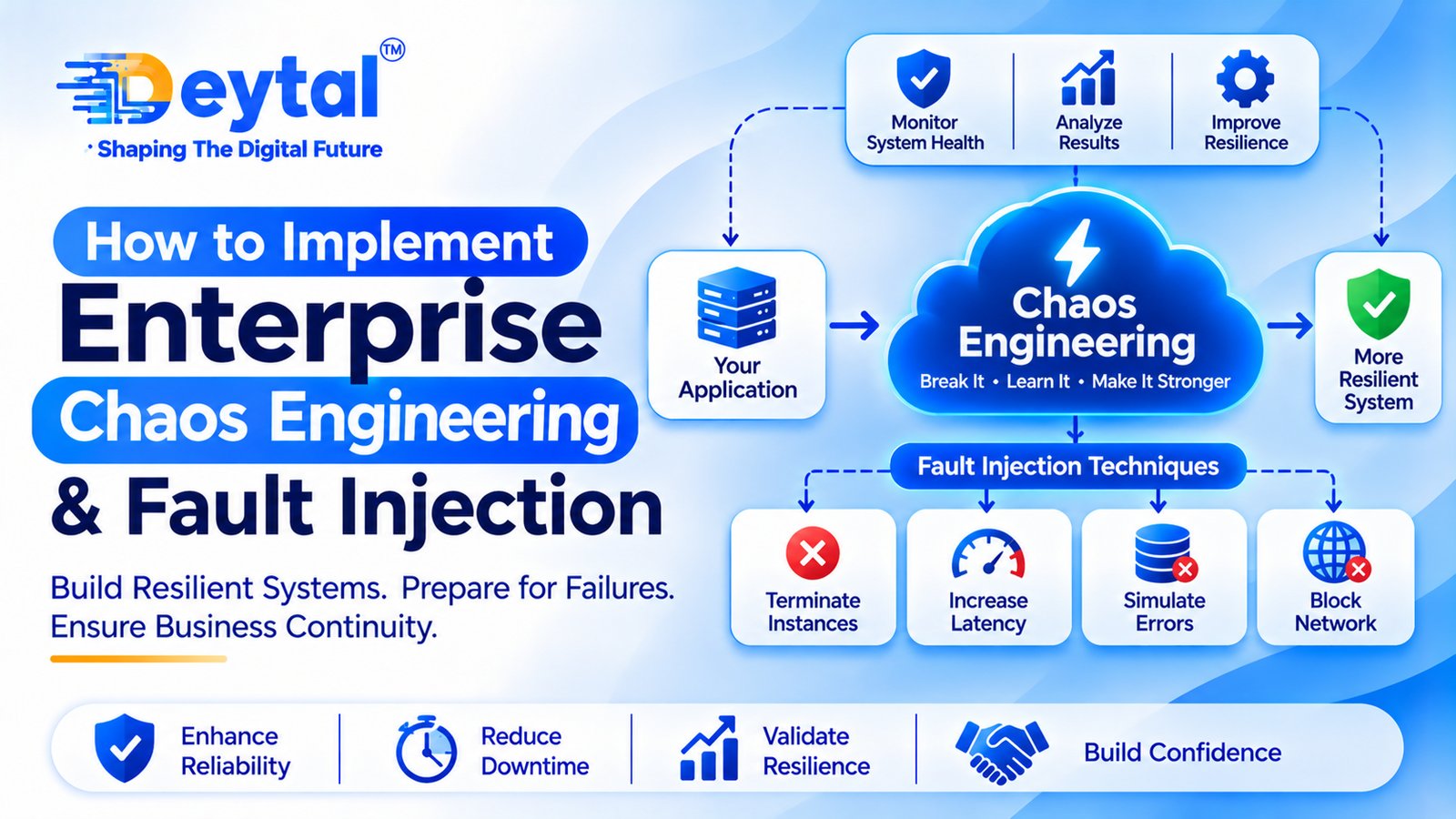
In distributed multi-cloud and microservice architectures, failure is inevitable. Hard drives corrupt, cloud availability zones experience silent network partitions, upstream third-party APIs fail with 504 Gateway Timeout errors, and garbage collection pauses trigger cascading socket timeouts across service fleets. For years, organizations approached reliability reactively: treating system crashes as anomalies, assembling post-incident war rooms, and applying retroactive code fixes.
However, waiting for real-world traffic spikes or hardware outages to expose hidden architectural flaws incurs severe financial, brand, and operational penalties. Enterprise Chaos Engineering transforms reliability from reactive firefighting into a proactive, hypothesis-driven scientific discipline.
By deliberately injecting controlled hardware, network, and application-layer faults into staging and production environments using cloud-native platforms like Chaos Mesh, LitmusChaos, and AWS Fault Injection Service (FIS), site reliability engineers systematically surface latent bugs, validate self-healing automations, and prove steady-state resilience before real customers are impacted.
The Hidden Vulnerabilities of Untested Distributed Systems
Traditional unit, integration, and end-to-end regression test suites fail to capture the emergent behaviors of distributed microservices under stress:
- Cascading Retry Storms & Connection Pool Starvation: When a downstream service slows down rather than crashing completely, upstream callers flood it with aggressive, un-jittered retries, consuming thread pools and toppling completely unrelated services.
- Brittle Failover Orchestrations: Teams write automated cross-region DNS failover scripts and multi-replica database elections, yet rarely test them under real load. When an actual outage hits, split-brain conditions or outdated failover configurations often turn minor glitches into catastrophic multi-hour downtimes.
- Silent Observability Blind Spots: Outages frequently escalate because alerts fire too late or drown on-call engineers in thousands of secondary symptom alerts while masking the root-cause failure.
- Untested Circuit Breakers & Fallback Paths: Codebases embed circuit breakers and fallback caches that remain cold and unexercised for months. When invoked during an emergency, unmaintained fallback pathways often trigger silent null-pointer exceptions or corrupted database writes.
Cloud-Native Chaos Platforms: Chaos Mesh vs. LitmusChaos vs. Gremlin
| Architecture Dimension | Chaos Mesh (CNCF Incubating) | LitmusChaos (CNCF Incubating / Harness) | Gremlin (Enterprise SaaS) |
| Primary Architectural Paradigm | Kubernetes-native CRDs (declarative YAML via kubectl) | Cloud-native platform with visual control plane & ChaosHub | Managed enterprise SaaS control plane with installed daemons |
| Experiment Definition | GitOps-driven Custom Resource Definitions | GitOps workflows, GraphQL API & pre-built ChaosHub faults | Guided web UI wizards, CLI, and RESTful API management |
| Fault Injection Capabilities | Pod, network latency/loss, I/O delays, JVM, time skew | Kubernetes resources, multi-cloud infra, network, JVM, HTTP | CPU/Memory stress, network blackholes, disk I/O, process killer |
| Blast Radius Containment | Kubernetes namespace boundaries & selector labels | Native resilience probes, ChaosGuard, & Kubernetes RBAC | Automated HALT buttons, health check monitors, & safety gates |
| Multi-Cloud / VM Support | Container/K8s focused; limited bare VM support | Hybrid multi-tenancy & VM chaos extensions (AWS, Azure, GCP) | Full cross-cloud support (Bare metal, VMs, K8s, Lambdas) |
| Licensing & Cost | 100% Free & Open-Source (Apache 2.0) | Free Open-Source core with commercial enterprise tiers | Proprietary commercial subscription with tiered SLAs |
Strategic Pillars for Architecting an Enterprise Chaos Engineering Practice
1. Automated Steady-State Verification & Blast Radius Controls
Establish quantifiable Service Level Objectives (SLOs) defining system health such as baseline p99 latency under 150ms and error rates below 0.05%. Implementing automated safety checks, automated rollback triggers, and programmatic kill-switches via custom orchestration built through Custom Software Development Services ensures experiments abort instantly if real customer experience is threatened.
2. Client Resilience & Fault-Tolerant Web Platforms
Ensure frontend user interfaces degrade gracefully when underlying microservices suffer induced packet drop or service outages. Building defensive web applications with localized component fallbacks, offline service worker caching, and optimistic UI updates via Website Development Services ensures end users experience continuous functionality even during active backend chaos drills.
3. Visual Reliability Heatmaps & Game Day Cockpit UI/UX Design
Chaos experiments require clear, cross-functional visibility during execution. Designing intuitive experiment workflow builders, live blast radius maps, and post-mortem visualization dashboards through UI/UX Design Services allows engineering leaders, developers, and SREs to collaborate effectively during enterprise Game Day simulations.
4. Resilient Edge Syncing & Mobile Circuit Breakers
Mobile applications endure unpredictable cellular packet loss and transient disconnections. Engineering client-side circuit breakers, smart retry-backoff algorithms, and offline-first persistent SQLite caches via Mobile App Development Services guarantees mobile applications remain responsive during extreme backend network partition simulations.
5. Clean Edge Availability & Unbroken Search Engine Indexing
Protect public-facing marketing portals, technical knowledge bases, and documentation hubs from search engine penalties caused by infrastructure instability. Hardening headless publishing runtimes through WordPress Development Services coupled with data-backed SEO Services prevents HTTP 5xx errors from leaking to search engine crawlers during infrastructure chaos drills, maintaining top search rank authority and optimal Core Web Vitals.
6. Reliability Certification & Enterprise B2B Trust Funnels
Leverage proven system resilience—demonstrated through rigorous chaos engineering reports, high availability uptime track records, and automated disaster recovery verifications—as a primary selling point in enterprise B2B sales pipelines, supported by Digital Marketing Services.
Build Unbreakable Systems with Deytal Technologies
Adopting chaos engineering requires more than randomly terminating containers; it requires disciplined experimental design, mature observability integration, and strict blast radius containment. Deytal Technologies Pvt. Ltd. designs, audits, and builds production-grade chaos engineering frameworks, automated CI/CD resilience pipelines, and fault-tolerant cloud architectures engineered to withstand real-world outages, maintain zero downtime, and guarantee business continuity.
Frequently Asked Questions (FAQ)
Q1: What are the fundamental steps in a formal Chaos Engineering experiment?
A formal chaos experiment follows a four-step scientific method:
- Define Steady State: Measure normal system behavior using verifiable metrics like error rate, throughput, and latency percentiles.
- Formulate a Hypothesis: Postulate how the system will behave during failure (e.g., “Injecting 500ms network latency to the payment service will trigger local cache fallbacks with zero user-facing 500 errors”).
- Inject Fault with Limited Blast Radius: Introduce a controlled failure (such as killing a database read-replica or partitioning a network) targeting a small canary cohort.
- Evaluate and Automate Fixes: Compare metrics against the steady state. If the system degraded unexpectedly, fix the underlying resilience flaw before expanding the experiment’s scope.
Q2: Should chaos experiments be executed directly in production?
While the ultimate goal is testing in production because staging environments rarely match real-world scale, traffic patterns, and third-party quirks enterprises must earn the right to test in production. Organizations should begin by running automated chaos tests in local development, progress to staging environments, and execute structured “Game Days” in production with manual safety overrides before enabling automated, continuous chaos tests on live clusters.
Q3: How do automated safety gates (kill switches) prevent uncontrolled outages during chaos tests?
Modern chaos platforms integrate directly with APM tools (such as Prometheus, Datadog, or Dynatrace) via health probes. SREs define strict abort conditions: if critical business metrics like overall transaction success rate dropping below 99.5% or global latency exceeding 400ms breach predefined thresholds, the chaos orchestrator instantly terminates the fault injection, removes network rules, and restores normal operational routing in sub-seconds.
