

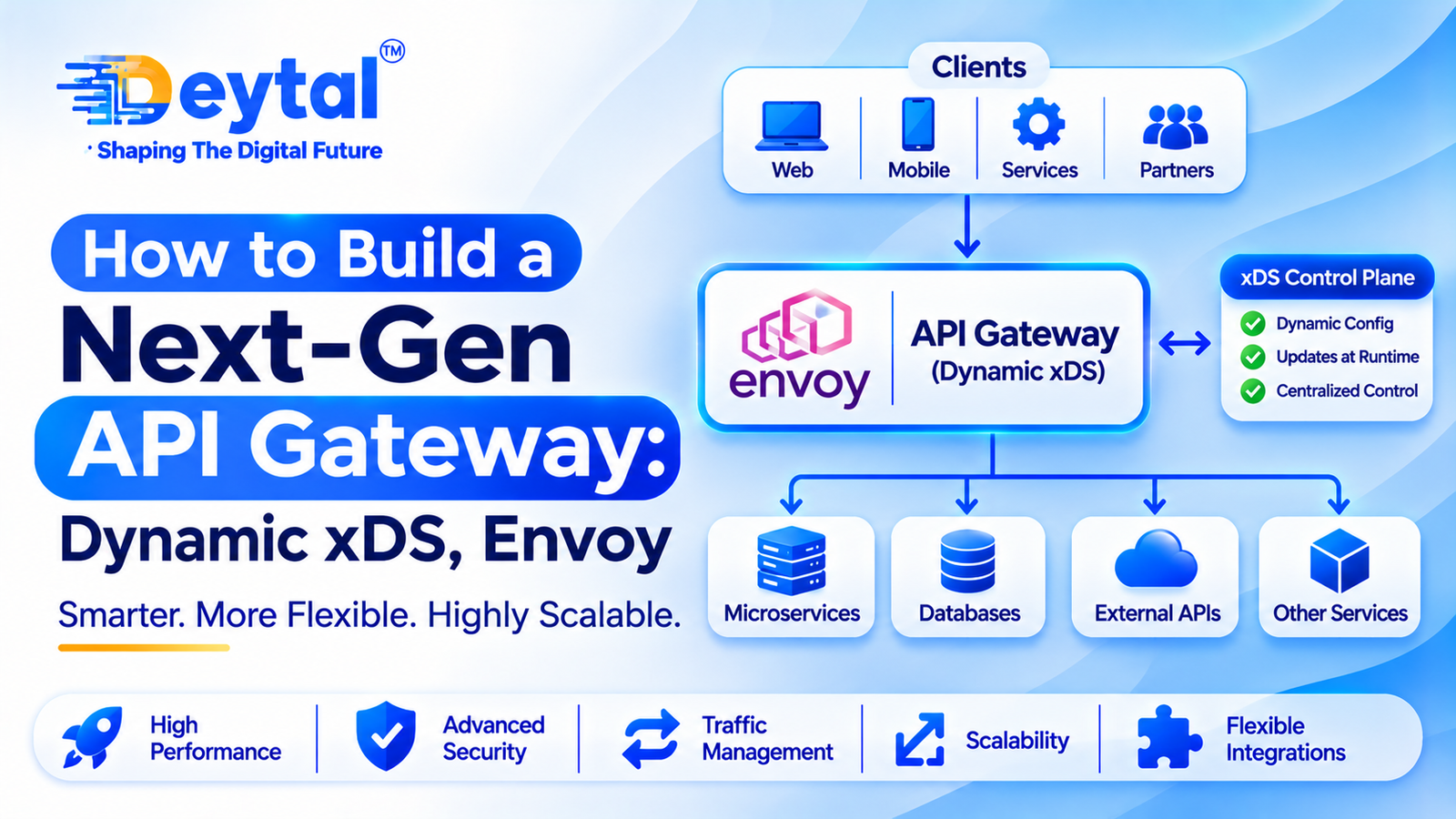
In a sprawling distributed systems topology, the API gateway serves as the front door through which every external client request enters the infrastructure. Traditionally, API gateways operated as simple reverse proxies, handling basic URL rewrites, SSL termination, and static routing via monolithic servers like standard NGINX or Apache. However, as enterprise estates scale to thousands of heterogeneous microservices handling millions of concurrent requests, these legacy reverse proxies buckle under operational strain.
Monolithic gateways struggle with dynamic service discovery, introduce significant tail latency during high-volume TLS handshakes, and force platform teams into complex reload cycles whenever routing configurations change. Next-Gen API Gateway Architecture redesigns north-south ingress by separating the declarative control plane from a high-throughput, non-blocking data plane. Leveraging high-performance C++ proxies like Envoy, cloud-native platforms like Kong, and kernel-level packet inspection powered by eBPF (Extended Berkeley Packet Filter), next-generation gateways deliver dynamic hot-reloading, zero-trust cryptographic verification, and sub-millisecond routing across hybrid multi-cloud clusters.
Ingress Bottlenecks in Legacy API Gateways
Relying on traditional reverse proxies or first-generation gateway appliances creates critical scalability hurdles:
- Static Configuration Reload Latency: Modifying a route or upstream target in legacy reverse proxies often requires a process reload (
nginx -s reload), which can drop active worker connections, spike CPU usage, and cause brief packet drops during frequent CI/CD deployments. - Excessive User-Kernel Context Switching: Standard gateways copy network packets back and forth between kernel space and user space across multiple TCP socket buffers, saturating CPU caches on high-throughput network interfaces.
- Monolithic Schema Coupling: Traditional gateways treat all backend responses as monolithic JSON blobs, forcing mobile and web clients to make dozens of round-trip calls to aggregate related data from different microservices.
- Coarse-Grained Rate Limiting: Simple IP-based rate limiting fails in the presence of shared corporate NAT gateways and modern mobile networks, while lacking the distributed coordination needed to prevent localized denial-of-service spikes across cluster nodes.
Legacy Reverse Proxies vs. Next-Gen API Gateways
| Ingress Dimension | Legacy Reverse Proxies (NGINX / HAProxy) | Next-Gen API Gateways (Envoy / Kong / eBPF) |
| Data Plane Runtime | C-based event loops with static disk configs | Non-blocking C++ (Envoy) or kernel-bypass eBPF hooks |
| Control Plane Dynamic Updates | Disk config rewrite followed by process reload | Dynamic gRPC Discovery Services (xDS API) with zero downtime |
| Observability & Tracing | Access logs written to local disk; basic metrics | Native OpenTelemetry distributed tracing, metrics, and access logs |
| Extensibility & Plugins | Static Lua scripts or recompilation of C modules | WebAssembly (Wasm) filters, dynamic plugins, and Envoy filters |
| API Protocol Support | Primarily HTTP/1.1 and basic HTTP/2 proxying | Multi-protocol: HTTP/2, HTTP/3 (QUIC), gRPC, and GraphQL |
| Service Discovery | Static IP lists or external DNS polling loops | Direct integration with Kubernetes API, Consul, or Eureka |
Strategic Pillars for Engineering a Next-Gen API Gateway
1. Dynamic xDS Control Planes & Non-Blocking Proxies
Decouple edge routing configurations from proxy runtimes by implementing dynamic xDS APIs (such as Envoy’s Cluster, Route, and Endpoint Discovery Services). Engineering customized gateway control planes, automated route registration controllers, and distributed rate-limiting backends via Custom Software Development Services ensures newly deployed microservices receive live ingress traffic instantly without dropped sockets or proxy reboots.
2. Unified Ingress Portals & High-Performance Web Frontends
Deliver sub-second response times for complex consumer and enterprise applications by orchestrating API aggregation at the edge. Designing decoupled single-page applications that communicate through optimized gateway endpoints and GraphQL federation layers via Website Development Services reduces round-trip network requests and eliminates UI render-blocking bottlenecks.
3. Ingress Observability & Gateway Control UI/UX Design
Operating a dynamic distributed gateway requires clear operational dashboards for routing engineers and site reliability teams. Designing intuitive route management consoles, real-time traffic-shaping visualizers, and latency percentile heatmaps through UI/UX Design Services makes complex L7 traffic policies and rate-limiting rules easy to configure and monitor.
4. Bandwidth-Optimized Edge Aggregation for Mobile Fleets
Mobile devices frequently operate on constrained, high-latency wireless networks where multiple round-trip API calls degrade user experience. Deploying Backend-for-Frontend (BFF) gateway patterns, response payload minification, and HTTP/3 QUIC connection pooling via Mobile App Development Services slashes mobile data usage and accelerates cold app launch times.
5. Clean Ingress Routing & Organic Search Engine Discoverability
Prevent misconfigured ingress routing rules, upstream timeouts, and SSL negotiation errors from returning HTTP 502/504 status codes to search engine crawlers. Powering high-performance headless publishing platforms through WordPress Development Services coupled with data-driven SEO Services ensures lightning-fast crawl times, rapid page indexing, and top search engine rankings across global edge domains.
6. API Monetization & B2B Developer Ecosystem Funnels
Turn internal business logic and high-throughput data streams into revenue-generating B2B APIs with self-service API key provisioning, metered billing, and developer onboarding flows managed via Digital Marketing Services.
Modernize Your Edge Ingress with Deytal Technologies
Migrating from a legacy reverse proxy to a next-generation API gateway requires deep expertise in L7 traffic engineering, distributed rate limiting, and zero-trust edge security. Deytal Technologies Pvt. Ltd. designs, audits, and builds production-grade API gateway architectures, high-throughput Envoy and Kubernetes ingress configurations, and scalable cloud-native platforms engineered for sub-millisecond routing, automated elasticity, and enterprise resilience.
Frequently Asked Questions (FAQ)
Q1: What is the Envoy xDS protocol and why does it matter for modern gateways?
The xDS (Discovery Service) protocol is a suite of dynamic gRPC and REST APIs that Envoy proxies use to fetch configuration updates from an external control plane. Instead of writing static configuration files to disk and restarting worker processes, Envoy subscribes to these streams (LDS for Listeners, RDS for Routes, CDS for Clusters, and EDS for Endpoints). This allows platform teams to add routes, rotate certificates, and update upstream endpoints dynamically with zero dropped connections.
Q2: How does eBPF enhance API gateway performance?
Traditional API gateways handle packets by receiving them in the Linux kernel and copying the data across memory boundaries into user-space proxy software to make routing decisions. eBPF allows sandboxed programs to execute directly inside the Linux kernel at network-hook points (like XDP and TC). For Layer 4 packet routing, load balancing, and DDoS filtering, eBPF handles traffic entirely within the kernel, bypassing user-space overhead and dramatically reducing CPU usage and latency.
Q3: When should an enterprise use a GraphQL Federation Gateway over REST aggregation?
A GraphQL Federation Gateway is ideal when client applications (web, iOS, Android) require disparate, highly interconnected data models scattered across multiple backend microservices. Instead of clients orchestrating sequential REST calls which wastes bandwidth and causes over-fetching a federation gateway composes multiple downstream GraphQL schemas into a single unified schema graph, fetching only the exact fields requested in a single client query.
