

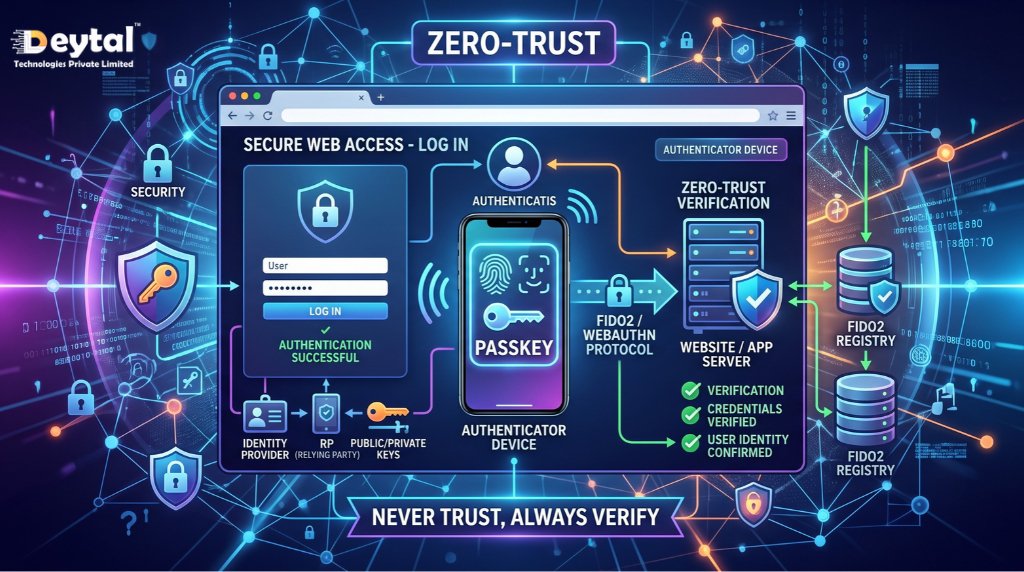
Traditional enterprise web security operated under a perimeter defense model: once an employee or customer authenticated past the external boundary, the internal network considered them trusted. Over 80% of enterprise security breaches continue to stem from compromised credentials, credential stuffing, and sophisticated adversary-in-the-middle (AiTM) phishing attacks that easily bypass standard SMS or push-based two-factor authentication (2FA).
Zero-Trust Web Architecture eliminates implicit trust across all layers of the application stack. Built on the core principle of “never trust, always verify,” modern enterprise systems pair cryptographic passwordless standards—specifically WebAuthn and FIDO2 Passkeys—with continuous, per-request authorization to protect web portals, microservices, and internal APIs against credential compromise.
The Critical Vulnerabilities of Legacy Perimeter Security
Relying on traditional authentication mechanisms introduces severe risks across enterprise portals:
- Susceptibility to Reverse-Proxy Phishing: Legacy 2FA (TOTP authenticator apps, SMS codes, push notifications) is easily intercepted by automated AiTM phishing kits that harvest active session cookies.
- High Password Management Friction: Forcing end users and corporate employees through frequent password resets fuels helpdesk support overhead, credential reuse, and user fatigue.
- Over-Privileged Session Lifetimes: Static session cookies that remain valid for hours or days allow attackers who steal tokens via cross-site scripting (XSS) to traverse systems undetected.
- Broad Network Trust Zones: Once past a basic VPN or single-sign-on (SSO) gateway, compromised accounts often enjoy broad lateral movement across internal microservices.
Traditional Perimeter Security vs. Zero-Trust Web Architecture
| Architectural Dimension | Traditional Web Perimeter | Zero-Trust Web Architecture (FIDO2/Passkeys) |
| Authentication Standard | Passwords + SMS/TOTP 2FA | Cryptographic Passkeys (WebAuthn / FIDO2) |
| Phishing Resistance | Low (Vulnerable to AiTM reverse proxies) | Complete (Domain-bound public-key cryptography) |
| Trust Verification | Verified once at login; session trusted | Continuous per-request verification and context evaluation |
| Credential Storage | Hashes stored in central databases | Private keys stay on hardware; public keys in DB |
| User Onboarding Friction | High (Complex password rules & reset loops) | Low (Instant biometric verification via Face ID/Touch ID) |
Strategic Pillars for Engineering a Zero-Trust Web Architecture
1. Cryptographic Identity & Hardened API Gateways
Replace shared secrets and static tokens with asymmetric key pairs and short-lived, digitally signed JWTs bound to client hardware. Building secure API orchestrations and token-validation middleware through Custom Software Development Services guarantees microservices verify request origins, device postures, and cryptographic signatures continuously.
2. Modern Web Interfaces with Native WebAuthn APIs
Implement friction-free authentication flows using the browser-native Credential Management API. Developing robust authentication interfaces via Website Development Services allows enterprise portals to authenticate users natively across Chromium, WebKit, and Gecko engines without reliance on fragile third-party authentication iframes.
3. Ergonomic Security & Passkey UX Design
Moving users away from passwords requires clear onboarding interfaces, recovery workflows, and cross-device sync pathways. Designing clear passkey registration modals, fallback recovery options, and session security centers through UI/UX Design Services boosts biometric adoption while preventing customer account lockouts.
4. Biometric Cross-Platform Mobile Security
Integrate platform authenticators (Apple Keychain, Google Password Manager) directly into mobile applications. Engineering native cryptographic security workflows using Mobile App Development Services guarantees seamless, biometric sign-ins that synchronize securely between native mobile and desktop browser sessions.
5. Clean Identity Architecture & Technical Performance SEO
Protect public search crawlers from broken redirects or unnecessary script overhead caused by identity verifications. Pairing decoupled, clean-coded backends via WordPress Development Services with advanced SEO Services maintains top organic search authority, fast indexing, and optimal Core Web Vitals.
6. Frictionless Customer Onboarding & High-Converting Funnels
Passwordless sign-ins eliminate login friction, directly lowering checkout drop-offs and registration abandonment, strategically analyzed and scaled through Digital Marketing Services.
Secure Your Enterprise Web Ecosystem with Deytal Technologies
Migrating an enterprise infrastructure to a zero-trust model requires careful identity provider (IdP) federation, cryptographic key lifecycle management, and phased customer rollout strategies. Deytal Technologies Pvt. Ltd. designs and implements robust zero-trust web architectures, custom passkey integrations, and enterprise-grade cloud systems engineered to defend digital assets against modern cyber threats.
Frequently Asked Questions (FAQ)
Q1: How do FIDO2 Passkeys make phishing impossible?
Passkeys rely on public-key cryptography where the private key never leaves the user’s local device secure enclave (like a TPM or Secure Enclave). When authenticating, the browser cryptographically verifies that the requesting domain matches the original origin registered with the key. If an attacker directs a user to a phishing domain (e.g., deyta1.com instead of deytal.com), the browser refuses to sign the challenge, rendering credential harvesting impossible.
Q2: What is the difference between device-bound passkeys and synced passkeys?
Device-bound passkeys are tied to a single physical hardware device (like a YubiKey) and cannot be copied or backed up. Synced passkeys (consumer passkeys) are end-to-end encrypted and synced across a user’s trusted device ecosystem (such as Apple iCloud Keychain or Google Password Manager), balancing high security with consumer-friendly recovery.
Q3: Can zero-trust authentication be integrated into existing enterprise SSO providers?
Yes. Modern Identity Providers (such as Okta, Microsoft Entra ID, Auth0, or Keycloak) support WebAuthn and FIDO2 as primary authentication methods, allowing enterprises to phase in passwordless policies without replacing existing identity governance tooling.