

The original DevOps promise “you build it, you run it” was intended to empower autonomous feature teams. In practice, as modern cloud-native systems scaled to encompass thousands of microservices, multi-region Kubernetes clusters, complex infrastructure-as-code manifests, and zero-trust security policies, that autonomy morphed into cognitive overload. Feature developers found themselves spending up to a third of their sprint cycles configuring CI/CD pipelines, debugging IAM roles, and managing cloud infrastructure rather than writing business logic.
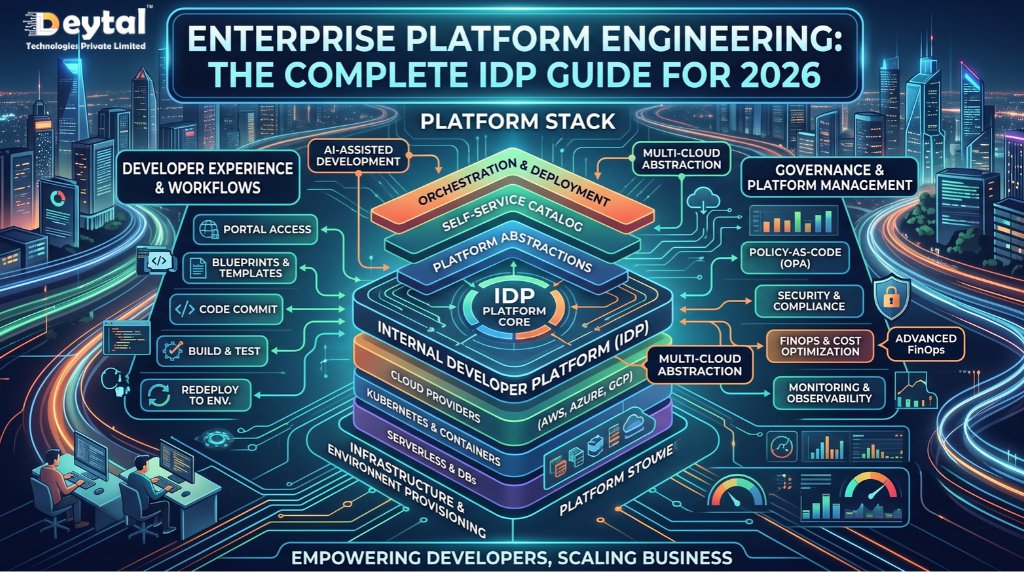
Enterprise Platform Engineering resolves this operational friction. By treating internal developer tooling as a distinct product, platform teams design and maintain an Internal Developer Platform (IDP). An IDP establishes standardized “golden paths” and self-service capabilities, allowing software engineers to provision environments, deploy applications, and monitor runtime health independently within automated enterprise guardrails.
The Structural Breakdowns of Unmanaged DevOps Sprawl
Without a formalized platform engineering layer, enterprise development velocity stalls due to several recurring bottlenecks:
- Crippling Cognitive Load: Forcing software engineers to master Kubernetes configurations, network ingress rules, and cloud provider consoles slows down feature delivery and increases burnout.
- Fragmented Snowflake Architectures: When individual squads build their own infrastructure, microservices drift into inconsistent configurations, making system-wide updates and audits difficult.
- Ticket-Based Infrastructure Queues: When operations teams attempt to regain control manually, simple requests—such as spinning up a preview environment or provisioning a database—become days-long ticket bottlenecks.
- Audit & Security Non-Compliance: Disconnected deployment scripts and uncoordinated privilege escalations introduce silent security vulnerabilities across development and production environments.
Fragmented DevOps vs. Enterprise Platform Engineering (IDP)
| Operating Dimension | Fragmented DevOps Operations | Enterprise Platform Engineering (IDP) |
| Delivery Model | Developers configure raw cloud infra manually | Self-service developer portal and CLI abstractions |
| Paved Paths / Standards | Tribal knowledge and loose documentation | Automated “Golden Paths” encoded in software templates |
| Environment Provisioning | Manual tickets or complex, slow custom scripts | Ephemeral, production-like environments in minutes |
| Security & Compliance | Retroactive audits and manual gates | Automated policy-as-code embedded in deployment gates |
| Team Cognitive Load | High (focused on infrastructure toil) | Minimal (focused strictly on core business domain logic) |
Core Pillars of a Resilient Internal Developer Platform (IDP)
1. Declarative Infrastructure Orchestration & Microservices Backends
Abstract cloud infrastructure behind clear, reusable resource definitions. Engineering automated provisioning engines and modular backend services through Custom Software Development Services enables developers to request databases, queues, and clusters without writing raw infrastructure-as-code.
2. Intuitive Developer Self-Service Portals
Surface documentation, software catalogs, and environment management in an approachable web console (leveraging frameworks like Spotify’s Backstage or Port). Constructing centralized web portals via Website Development Services gives engineering teams transparent visibility into service ownership, API dependencies, and real-time deployment status.
3. Ergonomic Developer Workflows & Console UI/UX
An internal platform only succeeds if developers choose to adopt it over manual workarounds. Designing streamlined, developer-centric interfaces and status dashboards through UI/UX Design Services ensures self-service workflows feel fast, modern, and friction-free.
4. Continuous Delivery to Native Mobile Ecosystems
Extend automated golden paths into mobile release trains. Implementing unified CI/CD pipelines and deployment automation using Mobile App Development Services guarantees fast, automated testing and seamless distribution across iOS and Android production stores.
5. Clean Platform Knowledge Bases & Enterprise SEO Performance
Deliver searchable internal documentation and public developer hubs without performance trade-offs. Pairing decoupled WordPress Development Services with technical SEO Services maintains top organic search authority, fast indexing, and pristine Core Web Vitals for external-facing portals.
6. Product-Led Engineering Culture & Measurable ROI
Treat the platform as an internal commercial product. Driving platform adoption, tracking Developer Net Promoter Scores (DevNPS), and measuring deployment frequency metrics is systematically reinforced through enterprise Digital Marketing Services.
Accelerate Enterprise Software Delivery with Deytal Technologies
Building an Internal Developer Platform requires striking a balance between autonomy and control—providing self-service speed while maintaining automated governance. Deytal Technologies Pvt. Ltd. designs and builds scalable internal developer portals, custom cloud-native orchestration engines, and high-velocity engineering workflows tailored to eliminate technical debt and accelerate delivery.
Frequently Asked Questions (FAQ)
Q1: What is the core difference between DevOps and Platform Engineering?
DevOps represents a cultural philosophy centered on breaking down silos between software development and IT operations. Platform engineering is the practical discipline of building an internal product (an IDP) that provides the tools, workflows, and self-service automation needed to execute DevOps principles at enterprise scale without overwhelming developers.
Q2: What is a “Golden Path” in platform engineering?
A Golden Path (or paved path) is an opinionated, fully supported, and automated route to build, deploy, and maintain an application. Developers who follow the Golden Path get infrastructure provisioning, security checks, CI/CD pipelines, and observability integrations automatically, while retaining the freedom to step off the path if their project requires custom engineering.
Q3: How do you measure the success of an Internal Developer Platform?
Key metrics include Lead Time for Changes (how quickly code moves from commit to production), Deployment Frequency, Mean Time to Recovery (MTTR), Environment Provisioning Time (e.g., dropping from days to minutes), and Developer Satisfaction (tracked via internal Developer NPS surveys).