

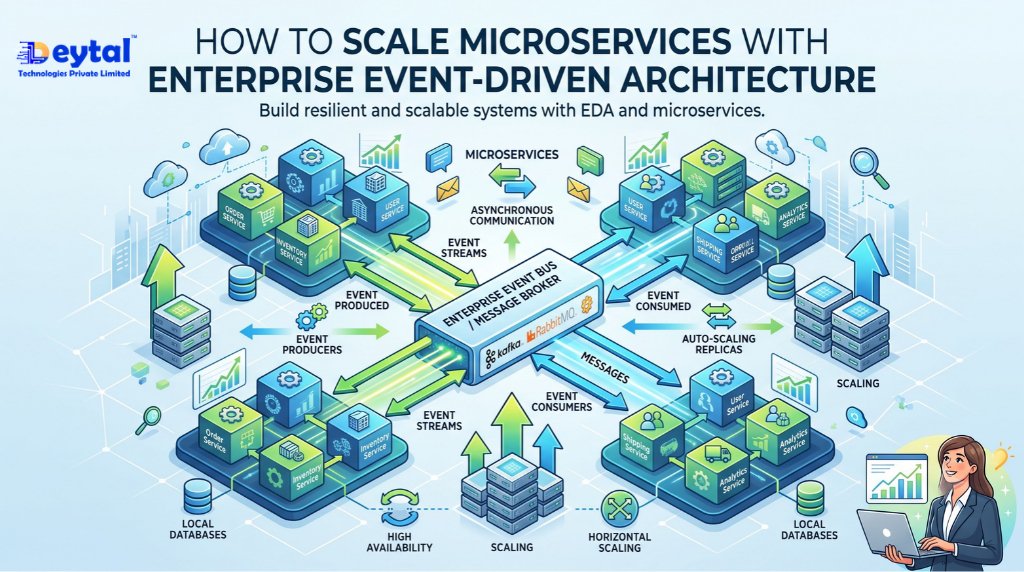
As enterprise software systems scale across global operational footprints, traditional synchronous request-response communication (HTTP/REST) creates brittle execution chains. When a single checkout or user-registration event requires sequential calls across inventory, payment processing, fraud detection, billing, and notification microservices, overall latency equals the sum of every downstream dependency. A temporary disruption or latency spike in a secondary service immediately cascades backwards, locking web server threads, causing connection timeouts, and terminating transactions.
Enterprise Event-Driven Architecture (EDA) replaces tightly coupled point-to-point HTTP orchestration with asynchronous event streams. Instead of waiting for blocking remote procedure calls, decentralized services emit immutable domain events (e.g., OrderPlaced, InvoiceSettled) to high-throughput distributed event streaming backbones like Apache Kafka, RabbitMQ, or NATS. Downstream consumers independently subscribe, process, and materialize state at their own cadence without blocking the originating producer.
The Latency and Fragility of Synchronous Request-Response Chains
Relying on synchronous REST or gRPC calls across complex microservice boundaries introduces operational friction:
- Cascading Outages & Blast-Radius Expansion: If a downstream tracking or notification API experiences latency or crashes, upstream checkout workflows freeze and fail, even though notifications are non-critical to transaction completion.
- Impedance Mismatch During Traffic Surges: High-throughput producer spikes (such as flash sales or automated financial data feeds) overwhelm slower downstream consumers, exhausting memory pools and crashing worker processes.
- Temporal and Spatial Coupling: Microservices must know the physical network locations, API contract definitions, and real-time operational availability of every system they interact with.
- Inconsistent Distributed State: Distributed two-phase commit (2PC) transactions across databases cause severe locking overhead and deadlocks, making ACID guarantees impractical across decoupled cloud microservices.
Synchronous REST Microservices vs. Enterprise Event-Driven Architecture
| Architectural Dimension | Synchronous Request-Response (REST/gRPC) | Enterprise Event-Driven Architecture (EDA) |
| Communication Coupling | Temporally and spatially coupled; blocking calls | Completely decoupled; asynchronous pub/sub messaging |
| Traffic Spike Tolerance | Downstream services must scale instantly to peak | Event brokers buffer spikes, enabling steady-state consumption |
| Failure Blast Radius | Downstream failure cascades upstream to user | Consumers fail independently; broker preserves unread events |
| Extensibility | Adding new integrations requires modifying producer code | New consumers subscribe to topics with zero producer modification |
| Data Consistency Model | Immediate consistency (high locking overhead) | Eventual consistency via Saga patterns & Outbox orchestration |
| Audit & Replay Capability | Ephemeral; state requires manual log reconstruction | Immutable append-only event logs enable point-in-time replay |
Strategic Pillars for Engineering an Enterprise Event-Driven Platform
1. Transactional Outbox Patterns & Distributed Event Streaming
Guarantee zero message loss and eliminate dual-write hazards between relational databases and message brokers. Implementing the Transactional Outbox pattern with Debezium change-data-capture (CDC) and partitioned Kafka topologies via Custom Software Development Services ensures database commits and event emissions remain strictly atomic.
2. Real-Time Reactive Frontends & Push-Based Streaming
Deliver instantaneous user updates without polling backend databases. Leveraging WebSockets, Server-Sent Events (SSE), and GraphQL subscriptions hooked into event-driven broker topics via Website Development Services ensures web portals update live shopping carts, stock levels, and order tracking sub-second.
3. Visual Workflow Observability & Event-Driven UI/UX Design
Asynchronous workflows can leave users feeling disconnected if background processing status is opaque. Designing intuitive progress feedback states, optimistic UI updates, and clear error-recovery interaction models through UI/UX Design Services ensures end users experience predictable, immediate application feedback.
4. Event-Driven Mobile Synchronization & Battery-Preserving Sockets
Replace aggressive polling loops with push-based reactive channels that conserve device battery and mobile bandwidth. Engineering resilient mobile socket managers and offline-first state machines via Mobile App Development Services guarantees seamless background data synchronization across Android and iOS runtimes.
5. Clean Data Pipeline Publishing & Organic Discovery Authority
Ensure high-velocity product and catalog updates automatically push to content repositories and edge-cached headless storefronts. Orchestrating decoupled CMS pipelines through WordPress Development Services coupled with data-driven SEO Services guarantees real-time schema markup updates, instant indexing, and optimal Core Web Vitals across public discovery channels.
6. Behavioral Trigger Automation & Real-Time Customer Journeys
Harness real-time event streams (such as cart abandons, price alerts, or milestone achievements) to trigger automated marketing messages and tailored conversion campaigns, managed and scaled through Digital Marketing Services.
Build Resilient Event-Driven Systems with Deytal Technologies
Migrating an enterprise architecture to an asynchronous, event-driven topology requires robust schema registry governance, idempotent consumer design, and distributed tracing. Deytal Technologies Pvt. Ltd. designs, audits, and deploys high-throughput Apache Kafka pipelines, CQRS state stores, and scalable cloud-native microservice backends engineered for real-time responsiveness and enterprise resilience.
Frequently Asked Questions (FAQ)
Q1: What is the difference between Command Query Responsibility Segregation (CQRS) and Event Sourcing?
CQRS separates the data model for write operations (commands) from the data model for read operations (queries), allowing each side to scale and optimize independently. Event Sourcing is a data persistence pattern where application state is stored as a sequence of immutable domain events rather than mutating a single database row. While CQRS and Event Sourcing are frequently combined, they can be implemented independently.
Q2: How do you prevent duplicate message processing in event-driven systems?
Because most distributed message brokers guarantee at-least-once delivery, consumers must be designed to be idempotent. This is achieved by tagging each event with a unique UUID idempotency key, checking a fast in-memory store (such as Redis) or a unique constraint database table prior to processing, and discarding duplicate deliveries before state mutations occur.
Q3: How does an event-driven architecture handle distributed rollbacks without two-phase commits?
Event-driven systems use the Saga Pattern instead of distributed ACID locks. A saga is a sequence of local transactions coordinated either through event choreography (services listen to domain events and execute subsequent steps) or orchestration (a central saga orchestrator coordinates steps). If a transaction fails midway, the saga publishes compensating events that reverse earlier completed steps in reverse order.
