

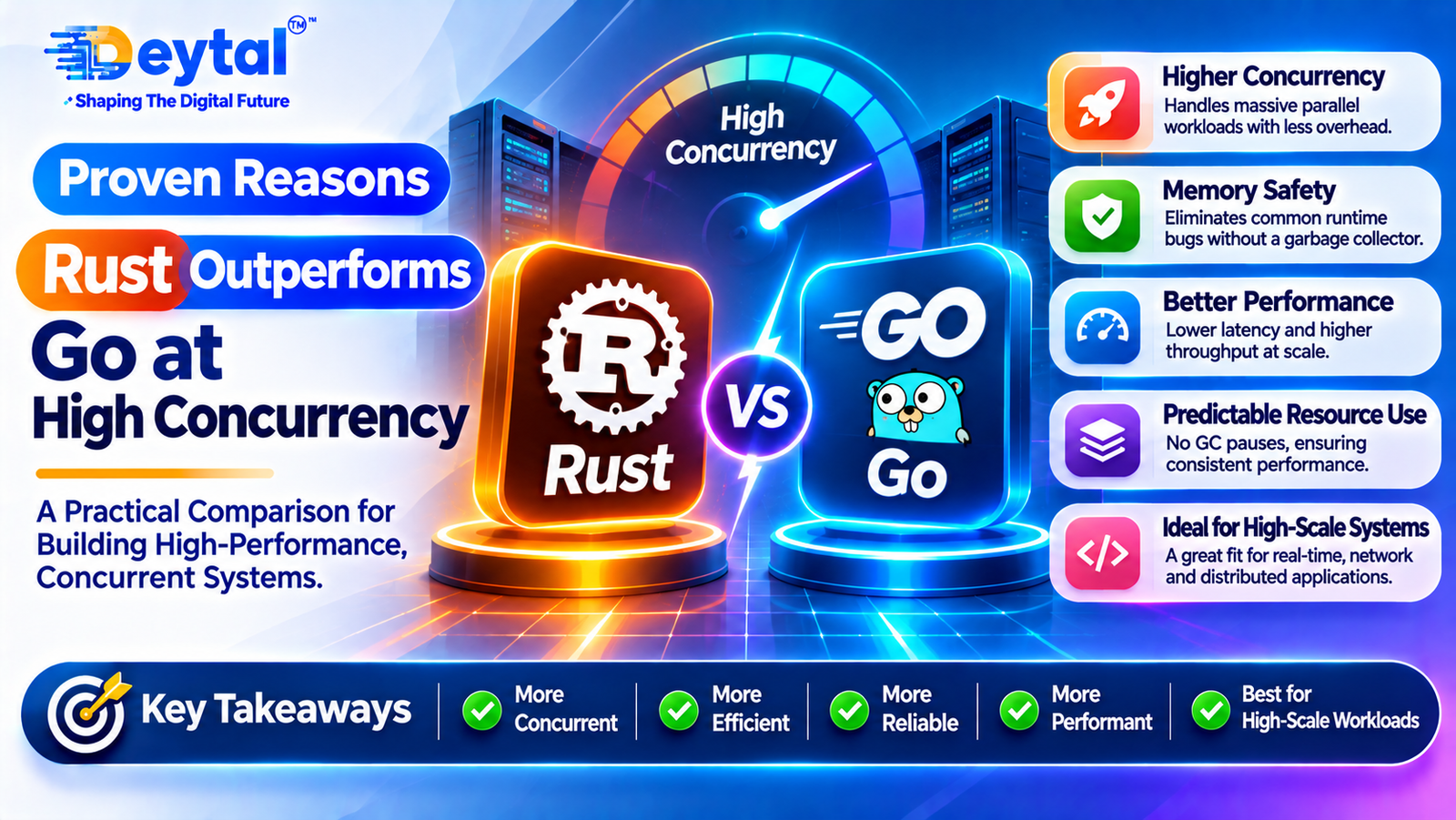
When engineering high-throughput backend services, distributed systems, and cloud infrastructure, language selection dictates operational velocity, memory consumption, and runtime predictability. Over the past decade, Go (Golang) and Rust have emerged as the premier modern languages replacing legacy C and C++ codebases while challenging traditional virtual-machine ecosystems like Java and .NET.
Yet despite their shared pedigree both offering modern tooling, static typing, cross-compilation, and strong open-source ecosystems Rust and Go were conceived to solve fundamentally divergent engineering problems.
Go, designed at Google by Robert Griesemer, Rob Pike, and Ken Thompson, prioritizes extreme developer productivity, rapid compilation, simplicity, and built-in concurrency primitives. Rust, conceived at Mozilla by Graydon Hoare, prioritizes zero-cost abstractions, absolute memory safety without a garbage collector, and deterministic hardware-level performance.
Selecting between them requires evaluating the fundamental trade-off: Go’s rapid iteration speed and lightweight concurrency versus Rust’s deterministic resource control and raw compute efficiency.
Key Architectural Constraints: Garbage Collection vs. Ownership Semantics
The primary technical dividing line between Go and Rust centers on memory management and execution determinism:
- Garbage Collection Pauses & Latency Tails: Go relies on a concurrent, tri-color mark-and-sweep garbage collector (GC). While modern Go GC pauses regularly clock under 1 millisecond, high-allocation workloads—such as in-memory caches storing millions of objects can trigger CPU overhead and latency spikes in 99th and 99.9th percentile (p99/p999) request timings.
- The Borrow Checker & Zero-Cost Abstractions: Rust dispenses with a garbage collector entirely, instead enforcing memory management at compile time through its strict ownership and borrowing model. Memory is allocated and deallocated deterministically based on lexical scope, eliminating runtime GC overhead, use-after-free bugs, and data races before code ever reaches production.
- Concurrency Models (M:N vs. 1:1): Go features runtime-managed green threads (goroutines) multiplexed across OS threads using an M:N scheduler, paired with built-in channels. Rust maps threads directly 1:1 to OS threads by default, but leverages zero-cost asynchronous runtimes (such as
tokio) powered by state-machine futures, allowing fine-grained control over executor thread pools and non-blocking I/O. - Cognitive Load & Developer Velocity: Go intentionally limits language features—avoiding inheritance, macros, and function overloading enabling large enterprise teams to onboard engineers rapidly. Rust’s steep learning curve demands deep mastery of lifetimes, traits, pinning, and memory layouts, which increases initial development time in exchange for long-term software correctness.
Rust vs. Go: Deep Architectural Comparison
| Architectural Dimension | Go (Golang) | Rust |
| Primary Design Philosophy | Simplicity, readability, fast build cycles, team productivity | Zero-cost abstractions, memory safety, complete control |
| Memory Management | Automatic via concurrent tri-color garbage collector | Compile-time ownership, borrowing, and RAII (No GC) |
| Runtime Overhead | Modest (~2MB to 4MB runtime embedded in binary) | Near-zero (no runtime, minimal standard library footprint) |
| Concurrency Primitives | Native goroutines, channels, select, CSP style | Asynchronous futures via async/await, tokio, OS threads |
| Data Race Safety | Detectable via -race runtime flag; not blocked at compile time | Formally guaranteed at compile time via Send and Sync traits |
| Compilation Speed | Blazing fast; designed for instant feedback loops | Slower; deep compiler passes, monomorphization, lifetime checks |
| Binary Footprint | Small self-contained static binaries (typically 10MB–25MB) | Ultra-compact static binaries (often <5MB with stripping) |
| Ideal Workloads | Microservices, REST/gRPC APIs, Kubernetes operators, CRUD backends | Cryptography, game engines, database internals, edge runtimes, Wasm |
Strategic Pillars for Engineering Scalable Backends
1. High-Throughput Microservice & Core Engine Development
Architect polyglot enterprise architectures that leverage each language’s native strengths: deploying Go for rapid API microservice orchestration and reserving Rust for compute-intensive processing pipelines, custom parsers, and cryptographic engines. Engineering specialized high-performance backends via Custom Software Development Services ensures core application components process millions of requests per second with rock-solid stability.
2. Lightning-Fast Real-Time Web Portals & Modern Frontends
Deliver responsive enterprise web platforms powered by high-throughput backend APIs. Designing decoupled web interfaces, real-time client endpoints, and low-latency data feeds through Website Development Services ensures users experience instant page updates and smooth, sub-100ms API interactions even during peak traffic periods.
3. Developer Tooling, System Monitoring & Console UI/UX Design
Complex systems architectures require transparent internal tooling. Designing intuitive developer dashboards, real-time service dependency graphs, and resource saturation monitors through UI/UX Design Services bridges the gap between low-level systems metrics and everyday developer workflows.
4. Native Embedded Performance for Mobile Clients
Mobile backends and edge clients demand strict CPU and battery efficiency. Compiling critical Rust modules to shared native libraries (via C-FFI) or building lightweight Go backends for cross-platform data synchronization via Mobile App Development Services keeps mobile applications responsive while conserving network bandwidth and device memory.
5. Clean Platform Architecture & Technical Search Authority
Prevent rapid infrastructure scaling and backend updates from introducing latency regressions to public-facing digital assets. Hardening content distribution tiers, optimizing server response headers, and operating high-concurrency publishing engines through WordPress Development Services paired with data-driven SEO Services ensures web assets maintain fast indexing, rapid Time to First Byte (TTFB), and top search visibility.
6. Modern Infrastructure Positioning & B2B Reliability Marketing
Highlight the tangible operational advantages of modern systems programming—such as 70% lower cloud server utilization, predictable p99 latency, and eliminated memory leak vectors—as central selling points in enterprise B2B sales cycles, reinforced by conversion-focused digital campaigns managed by Digital Marketing Services.
Modernize Your Enterprise Infrastructure with Deytal Technologies
Choosing between Go and Rust is not an all-or-nothing proposition; the most effective enterprise architectures strategically pair both languages to maximize developer throughput and system performance. Deytal Technologies Pvt. Ltd. designs, audits, and builds production-grade cloud-native platforms, high-throughput microservices, and specialized low-latency computing modules engineered to lower infrastructure overhead and deliver sustained performance at scale.
Frequently Asked Questions (FAQ)
Q1: When should an engineering team choose Go over Rust?
Choose Go when engineering standard cloud-native microservices, internal business tools, REST/gRPC APIs, or Kubernetes operators where time-to-market and developer velocity are critical. Go’s standard library, fast compilation times, and straightforward syntax allow teams to build, maintain, and onboard engineers rapidly without managing intricate memory lifetimes or wrestling with compile-time borrow checking.
Q2: When is Rust clearly superior to Go?
Rust is the superior choice for low-level systems programming where predictable latency, absolute memory safety, and raw compute efficiency are paramount. This includes writing database storage engines, network proxies (like Envoy or Linkerd), WebAssembly modules, audio/video codecs, real-time financial trading systems, and operating in memory-constrained IoT or edge environments where the CPU and memory footprint of Go’s garbage collector cannot be tolerated.
Q3: Can Go and Rust effectively interoperate in the same architecture?
Yes. In modern distributed systems, Go and Rust frequently coexist. A common enterprise pattern utilizes Go at the edge or routing layer to handle rapid business logic iterations and high-volume HTTP/gRPC routing, while delegating CPU-intensive tasks—such as image processing, cryptographic hashing, or complex data aggregation to underlying Rust services communicating over high-speed gRPC or shared-memory IPC.
