

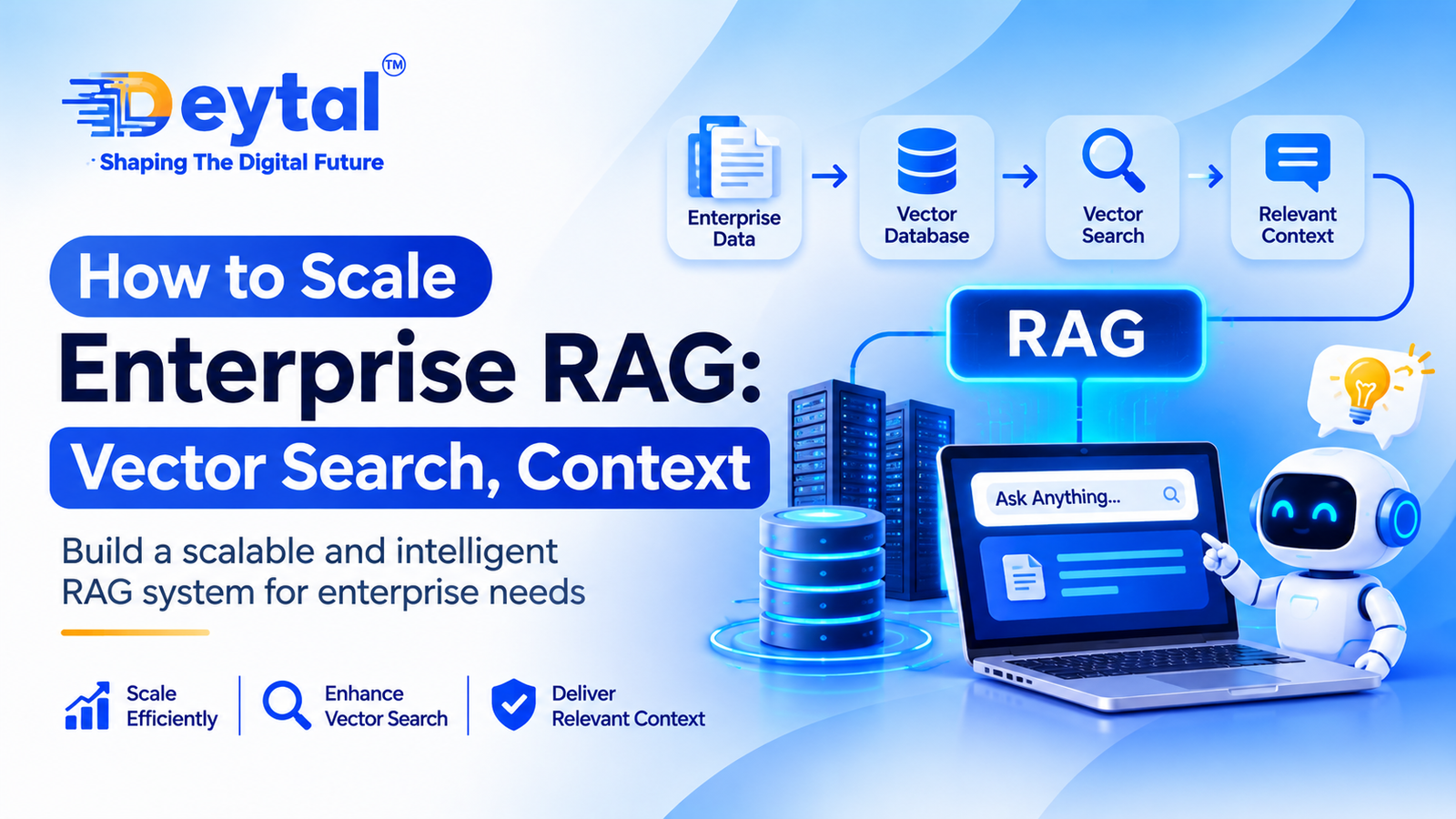
Integrating Large Language Models (LLMs) with proprietary enterprise knowledge bases has shifted from fine-tuning raw model weights toward Retrieval-Augmented Generation (RAG).
While fine-tuning injects point-in-time knowledge with significant GPU retraining overhead and severe hallucination risks, RAG dynamically retrieves authoritative, access-controlled document chunks from external data stores and injects them directly into the inference context window.
However, scaling a prototype RAG pipeline into an enterprise-grade production platform introduces severe architectural bottlenecks. Simple dense vector similarity often fails to locate exact product SKUs or compliance IDs, vector indexes become fragmented under heavy write loads, and multi-tenant security leaks emerge when document authorization layers decouple from embedding retrieval.
Enterprise RAG Database Architecture addresses these challenges by orchestrating a unified retrieval pipeline: combining hybrid search (dense semantic vectors + sparse BM25 keyword matching), two-stage cross-encoder re-ranking, and high-performance vector engines like Milvus, Qdrant, or PostgreSQL with pgvector.
The Production Traps of Naive Vector Retrieval
Building RAG upon single-vector, naive cosine similarity creates critical operational failure points:
- Keyword & Part-Number Blindspots: Pure dense semantic embeddings compress concepts into broad coordinate spaces, routinely missing exact alphanumeric matches (such as legal clause references, API error codes, or part serial numbers).
- The “Lost in the Middle” Degradation: Stuffing dozens of top-k retrieved chunks directly into an LLM context window causes the model to ignore critical data placed in the middle of long prompts, inflating inference token costs while lowering answer accuracy.
- Un-Synchronized Knowledge Drift: When source documents in object stores or CMS hubs are updated, naive pipelines fail to invalidate stale embeddings, causing the system to retrieve contradictory or superseded documentation.
- Multi-Tenant Authorization Failures: Standard vector stores lack native awareness of enterprise Role-Based Access Control (RBAC). Querying vector indexes without metadata pre-filtering risks leaking confidential internal data across department or client boundaries.
Vector Database Engine Comparison for Enterprise RAG
| Architectural Dimension | PostgreSQL + pgvector | Qdrant (Rust-Native) | Milvus (Distributed Engine) |
| Architectural Model | Relational extension on existing SQL engine | Dedicated, vector-native engine with memory-mapped storage | Disaggregated distributed storage & compute cluster |
| Optimal Vector Scale | < 5 Million vectors per instance | 1M to 50M+ vectors with complex payload filtering | 50M to Billions of vectors horizontally scaled |
| Hybrid Search Support | Native SQL tsvector + vector distance in one query | Native dense + sparse vectors with score fusion | Native multi-vector & sparse inverted index support |
| Operational Overhead | Zero additional infrastructure if using Postgres | Low; single container/binary with optional clustering | High; requires MinIO, etcd, and Pulsar/Kafka dependencies |
| Payload Filtering | Full relational joins and ACID constraints | HNSW co-optimized index filtering | Distributed execution across isolated query nodes |
| Tenant Isolation Model | PostgreSQL Row-Level Security (RLS) | Metadata payload filtering & dedicated collections | Dynamic partition keys and isolated namespaces |
Strategic Pillars for Engineering an Enterprise RAG Platform
1. Two-Stage Hybrid Retrieval & Cross-Encoder Reranking
Eliminate single-vector retrieval errors by querying both dense embeddings (capturing intent) and sparse BM25 indices (capturing exact keywords) concurrently. Merging candidate pools using Reciprocal Rank Fusion (RRF) and passing the top 30 chunks through a neural cross-encoder (such as BGE-Reranker-Large or Cohere Rerank) yields 5 to 8 high-precision chunks that maximize prompt context density. Building custom ingestion and reranking microservices via Custom Software Development Services ensures sub-second retrieval pipelines.
2. Conversational Agent Interfaces & Streaming Web Delivery
Empower enterprise teams to query private document repositories with real-time token streaming, inline citation tags, and context inspectors. Developing reactive, low-latency search frontends through Website Development Services prevents thread blocking and provides continuous user feedback over WebSockets or Server-Sent Events (SSE).
3. Cognitive Ergonomics & Explainable AI UI/UX Design
Users distrust AI outputs when systems cannot show their source material. Designing interactive citation flyouts, confidence score badges, and side-by-side source document viewers through UI/UX Design Services makes RAG retrieval transparent and builds enterprise user trust.
4. On-Device Embeddings & Resilient Mobile Client Synchronization
Deliver contextual AI assistance to field teams operating in low-connectivity environments. Implementing quantized vector search libraries (such as SQLite-vec) and offline embedding runtimes via Mobile App Development Services guarantees rapid document lookup on iOS and Android devices without mandatory cloud connectivity.
5. Clean Knowledge-Base Indexing & Headless Search Authority
Ensure public-facing technical documentation, FAQs, and product manuals feeding internal and external search indices maintain high structural integrity. Integrating structured schema workflows via WordPress Development Services alongside technical SEO Services guarantees crawl clarity, instant indexing, and optimal Core Web Vitals across public discovery portals.
6. Product-Led RAG Adoption & Inbound Enterprise Funnels
Leverage real-time search queries and document usage analytics to discover product knowledge gaps, target customer intent, and scale high-converting B2B lead generation flows through Digital Marketing Services.
Build Production-Grade Enterprise RAG with Deytal Technologies
Scaling retrieval-augmented generation from an experimental notebook to an enterprise platform requires robust chunking heuristics, hybrid search tuning, and automated index governance. Deytal Technologies Pvt. Ltd. designs, audits, and builds production-grade vector database architectures, distributed RAG pipelines, and custom enterprise AI integrations engineered for low latency, zero data leaks, and hallucination-free inference.
Frequently Asked Questions (FAQ)
Q1: Why is hybrid search superior to dense vector search alone in enterprise RAG?
Dense vector embeddings map conceptual meaning into multidimensional space, making them effective for abstract queries. However, they struggle with exact alphanumeric strings, part codes, or legal clause references. Hybrid search combines dense vector matching with sparse keyword search (BM25) using algorithms like Reciprocal Rank Fusion (RRF), ensuring the retrieval engine captures both semantic intent and exact lexical terminology.
Q2: What is cross-encoder reranking and why is it necessary?
Bi-encoders compute vector embeddings for documents and queries separately, allowing for fast similarity comparisons across millions of vectors at the cost of losing deep interaction nuances. A cross-encoder processes the user query and candidate document chunks simultaneously through a neural network, scoring their contextual relevance. Reranking the top 20–30 retrieved candidates down to the top 5 chunks before passing them to the LLM improves context precision and eliminates irrelevant chunks.
Q3: When should an enterprise choose Qdrant or Milvus over pgvector?
If an organization manages under 3 to 5 million vectors and already runs PostgreSQL, pgvector is an effective choice that avoids the overhead of managing a separate database cluster. When vector counts exceed tens of millions, or when workloads demand microsecond ANN search times under high concurrent QPS, dedicated vector engines like Qdrant (for balance and Rust performance) or Milvus (for massive distributed horizontal scaling) are preferable.
