

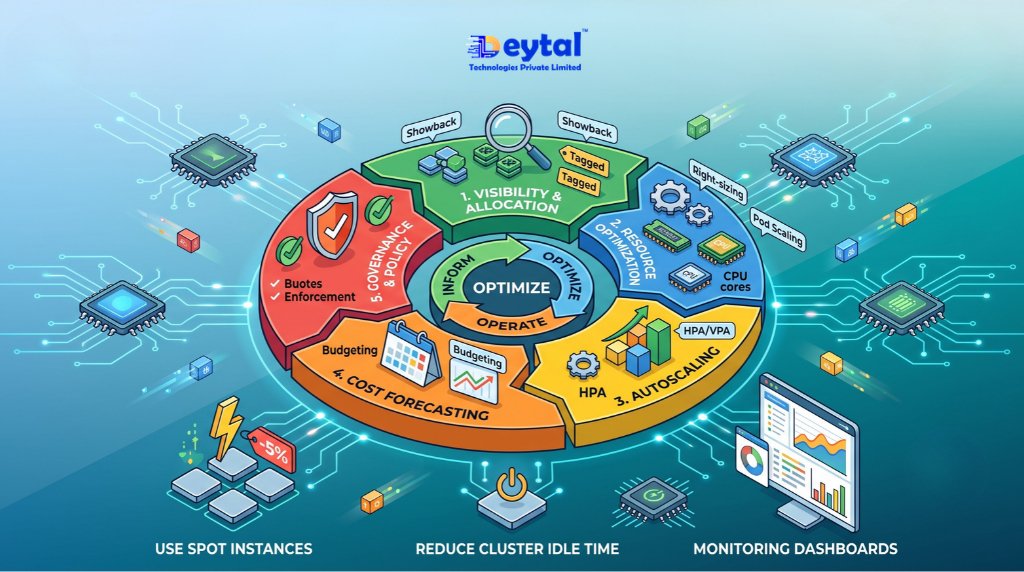
Containerization and Kubernetes orchestrations have transformed how organizations deploy modern software, offering rapid horizontal scaling and developer autonomy. However, dynamic cloud-native elasticity often triggers runaway cloud bills. Engineering squads provision generous CPU and memory requests to prevent out-of-memory (OOMKilled) crashes, leave non-production environments running over weekends, and configure unoptimized over-provisioned node pools leaving infrastructure utilization hovering between 15% and 25%.
When engineering decisions decouple from financial accountability, cloud budgets erode gross margins. Cloud FinOps for Kubernetes establishes a culture of shared financial accountability, combining real-time cost visibility, predictive workload right-sizing, and automated infrastructure governance. By pairing advanced node autoscalers like Karpenter and event-driven autoscalers like KEDA with open-source telemetry tools (such as Kubecost and OpenCost), enterprises align cloud infrastructure consumption directly with tangible business unit economics.
The Silent Drivers of Enterprise Cloud and Cluster Waste
Cloud waste inside complex containerized platforms stems from structural visibility gaps:
- Pessimistic Resource Over-Provisioning: Developers frequently request 4x to 8x the compute resources a pod actually consumes under peak load to avoid production triage calls, tying up unallocated node capacity.
- Orphaned and Idle Cloud Resources: Unattached persistent volumes (EBS/PD), idle load balancers, orphaned snapshot tiers, and continuous development staging clusters accumulate hidden monthly charges without generating business value.
- Unallocated Shared Cost Blindspots: Running multiple microservices inside shared multi-tenant clusters makes it difficult for finance teams to attribute infrastructure costs to specific departments, products, or revenue streams.
- Static, Inefficient Node Scaling: Relying on legacy Kubernetes Cluster Autoscalers creates slow node spin-up times and awkward bin-packing, forcing clusters to provision expensive, mismatched virtual machine instances.
Unmonitored Cloud Infrastructure vs. Enterprise FinOps-Driven Architecture
| FinOps Dimension | Unmonitored Cloud Infrastructure | FinOps-Driven Kubernetes Architecture |
| Cost Visibility | Aggregated monthly cloud bill surprises | Real-time namespace, pod, and service-level cost attribution |
| Resource Allocation | Manual, static over-provisioning based on guesswork | Automated right-sizing via Vertical Pod Autoscaler (VPA) |
| Node Provisioning Model | Slow, homogeneous node groups with empty headroom | Dynamic, heterogeneous instance bin-packing (Karpenter) |
| Commitment Strategy | Pay-as-you-go On-Demand rates | Strategic blending of Spot, Reserved, and Savings Plans |
| Dev/Staging Governance | 24/7 idle environments burning compute capital | Scheduled hibernation and automated ephemeral environments |
| Financial Accountability | Blamed on central IT or DevOps teams | Shift-left accountability; engineering squads track cost per transaction |
Strategic Pillars for Architecting a Kubernetes FinOps Ecosystem
1. Automated Workload Right-Sizing & Dynamic Bin-Packing
Replace static resource reservations with data-driven scheduling. Deploying modern just-in-time compute balancers like Karpenter alongside Vertical Pod Autoscalers (VPA) through Custom Software Development Services ensures pods are packed onto the most cost-effective instance families (including Graviton/ARM and Spot instances) with sub-second node lifecycle execution.
2. Lean Single-Page Web Architectures & Reduced Compute Footprints
Design client-side web platforms that shift compute load away from origin application containers to globally distributed edge caches. Modernizing web architectures via Website Development Services reduces backend server hits, lowers database query execution times, and directly shrinks container fleet overhead.
3. Ergonomic FinOps Dashboards & Real-Time Spend UI/UX
Engineers will not optimize costs if dashboards are buried inside complex cloud provider billing consoles. Designing dedicated internal cost-telemetry portals, budget anomaly alert banners, and team-specific unit economics dashboards through UI/UX Design Services makes financial metrics actionable for developers.
4. Efficient Mobile API Gateways & Reduced Server Ingress
Reduce serverless compute executions and ingress data transfer costs by optimizing mobile network communication. Engineering consolidated API aggregators, protobuf messaging, and efficient caching within client applications via Mobile App Development Services slashes continuous background API calls and backend node processing.
5. Edge-Optimized CMS Workflows & Organic Search Performance
Eliminate dynamic PHP execution bottlenecks and costly origin compute runs for public-facing web traffic. Deploying statically pre-rendered content delivery models through WordPress Development Services coupled with data-driven SEO Services maintains top organic search authority, fast indexing, and optimal Core Web Vitals at a fraction of standard hosting compute costs.
6. ROI-Driven Customer Acquisition & Growth Efficiency
Align infrastructure cost-per-user metrics directly with customer lifetime value (LTV) and acquisition campaigns, tracked and scaled through high-performance Digital Marketing Services.
Optimize Your Cloud Economics with Deytal Technologies
Controlling cloud expenditure without throttling engineering velocity requires deep container profiling, automated infrastructure scaling, and unified cost attribution models. Deytal Technologies Pvt. Ltd. audits, refactors, and builds production-grade Kubernetes infrastructures, FinOps governance frameworks, and high-performance cloud applications engineered for maximum capital efficiency, automated scaling, and enterprise reliability.
Frequently Asked Questions (FAQ)
Q1: How does Karpenter improve Kubernetes cost efficiency compared to the standard Cluster Autoscaler?
The standard Kubernetes Cluster Autoscaler relies on cloud provider node groups, which often forces clusters to provision instances of identical size, resulting in wasted memory and CPU slots. Karpenter is a flexible, group-less autoscaler that directly provisions customized mixtures of compute instances (evaluating hundreds of instance types, architectures, and pricing models in real time) to pack unscheduled pods into the cheapest viable compute footprint within seconds.
Q2: What is the difference between resource requests and limits in Kubernetes FinOps?
- Resource Requests: The guaranteed baseline of CPU or memory allocated to a container. Cloud providers bill based on node sizing dictated by these requests, making over-inflated requests the primary source of cloud waste.
- Resource Limits: The hard ceiling a container cannot exceed. If a container breaches its memory limit, the Linux kernel terminates it with an
OOMKilledstatus. FinOps teams focus on bringing requests closer to historical 95th percentile consumption while leaving limits high enough to absorb short-term traffic spikes.
Q3: How do Spot Instances fit into an enterprise Kubernetes FinOps strategy?
Spot Instances provide surplus cloud compute capacity at up to a 70% to 90% discount compared to on-demand pricing. Because cloud providers can reclaim Spot instances with a two-minute warning, FinOps architectures leverage them for stateless web services, asynchronous background workers, and CI/CD pipelines, using tools like AWS Node Termination Handler or Karpenter to gracefully migrate pods onto surviving nodes without interrupting user sessions.
