

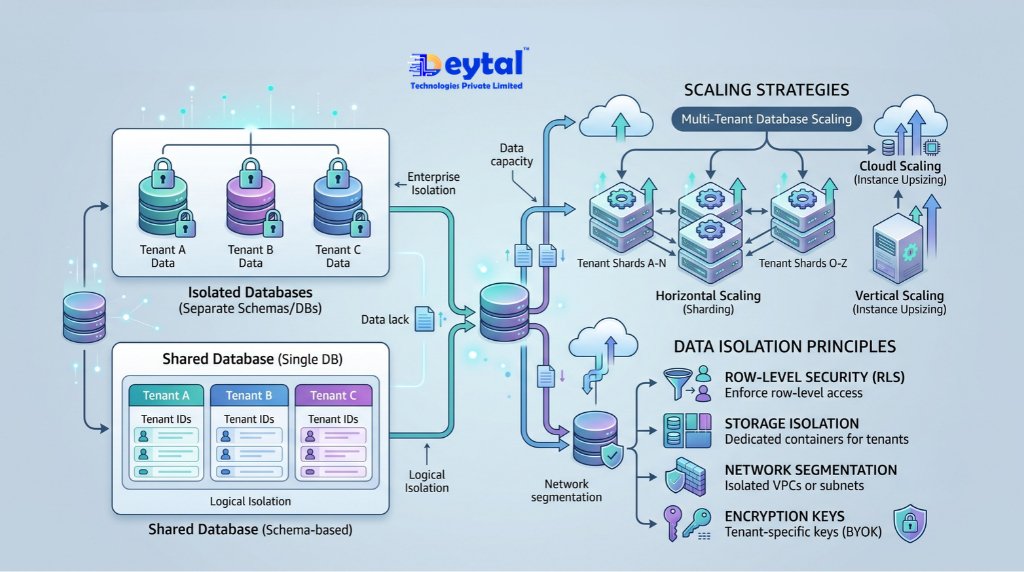
Building software-as-a-service (SaaS) for enterprise buyers introduces a core architectural trade-off: operational density versus strict data isolation. While running thousands of customers across a shared application cluster maximizes resource utilization and keeps infrastructure costs low, enterprise procurement teams routinely demand strict security boundaries, compliance certifications (HIPAA, SOC 2, GDPR), and contractual guarantees against data leaks.
A single missing tenant_id filter in an application query can trigger catastrophic cross-tenant data exposure. Concurrently, resource-heavy operations executed by one large enterprise customer can starve CPU, memory, and database connection pools for every other customer sharing the instance the classic “noisy neighbor” dilemma.
Multi-Tenant SaaS Database Architecture dictates how data is partitioned, isolated, and queried across customer accounts. By implementing structural data isolation models ranging from pooled shared-schema tables with PostgreSQL Row-Level Security (RLS) to siloed database-per-tenant topologies engineering organizations can balance marginal operating costs with enterprise security and regulatory compliance.
The Operational Risks of Poor Tenant Partitioning
Relying on informal application-layer filtering without database-enforced boundaries introduces severe risks:
- Accidental Cross-Tenant Data Leaks: Relying entirely on developers remembering to append
WHERE tenant_id = ?to every raw SQL statement or ORM query inevitably fails as codebases grow, risking massive data breach liabilities. - The Noisy Neighbor Bottleneck: High-volume analytics runs or sudden API spikes by a single enterprise tenant consume database IOPS and exhaust connection limits, degrading performance for all other tenants.
- Asymmetric Backup and Restore Failures: If an enterprise customer accidentally drops a table or demands a point-in-time restore to 24 hours prior, restoring an entire shared-schema database overwrites data for every other tenant on the platform.
- Migration Friction at Scale: Applying schema migrations, table alters, or index builds across millions of rows locked by active tenants can cause database downtime and query timeouts across the entire platform.
Comparison of Multi-Tenant Database Isolation Models
| Architectural Dimension | Shared Database, Shared Schema (Pooled) | Shared Database, Schema-per-Tenant (Bridge) | Dedicated Database-per-Tenant (Siloed) |
| Isolation Mechanism | Row-level (tenant_id column & PostgreSQL RLS) | Dedicated schema namespace per customer | Physically isolated database instance |
| Infrastructure Cost | Lowest marginal cost per tenant; highest density | Moderate; shared instance with schema overhead | Highest infrastructure and compute footprint |
| Blast Radius | High; single bug or outage risks entire user base | Moderate; database crash affects all, schemas isolated | Zero; tenant issues are fully self-contained |
| Schema Migrations | Run once globally across all tables | Must be executed across hundreds of schemas | Complex orchestration across distinct instances |
| Point-in-Time Restore | Extremely difficult for an individual tenant | Moderate complexity; dump and restore schema | Simple; standard native database instance restore |
| Compliance Viability | Fails strict data residency/isolation mandates | Acceptable for low-tier compliance frameworks | Meets HIPAA, PCI-DSS, SOC 2, and sovereign cloud rules |
Strategic Pillars for Architecting an Enterprise Multi-Tenant SaaS Platform
1. Automated Context Propagation & Row-Level Security (RLS)
Enforce database-level tenant isolation rather than relying on application code. Engineering PostgreSQL Row-Level Security policies tied to session parameters (SET LOCAL app.current_tenant_id) and building custom connection pool wrappers through Custom Software Development Services guarantees queries are structurally sandboxed even if developers omit explicit filters.
2. Dynamic Subdomain Routing & Tenant-Aware Web Frontends
Build modern web frontends capable of dynamically resolving tenant context via subdomains (tenant.app.com), custom domains, or signed JWT claims. Engineering edge-routed, multi-tenant single-page applications via Website Development Services ensures seamless tenant-specific branding, automated asset bundling, and sub-second route transitions.
3. Enterprise Admin Cockpits & Tenant Management UI/UX
Tenant administrators require granular visibility into their organization’s usage, team permissions, and security controls. Designing self-service workspace provisioning, role-based access control (RBAC) matrices, and audit logging consoles through UI/UX Design Services makes complex enterprise security administration straightforward and transparent.
4. Secure Multi-Tenant Mobile Runtimes & Local Sandboxing
Ensure multi-tenant mobile applications prevent cached data leakage when users switch between different organization workspaces. Developing isolated SQLite/SQLCipher databases per tenant workspace within native mobile apps via Mobile App Development Services guarantees complete local data segregation on iOS and Android devices.
5. Programmatic Landing Pages & Scalable Headless Content
SaaS platforms often require thousands of programmatic landing pages, product category indexes, and localized documentation hubs. Pairing high-performance CMS infrastructure via WordPress Development Services with data-backed SEO Services maintains top organic search authority, fast indexing, and optimal Core Web Vitals across multi-tenant knowledge bases.
6. Product-Led Onboarding Funnels & Account Expansion Architecture
Automate the conversion funnel from freemium self-serve users into high-ACV enterprise tiers through in-app feature gating, usage notifications, and data-driven upsell tracking, orchestrated and optimized through Digital Marketing Services.
Engineer Enterprise SaaS Platforms with Deytal Technologies
Migrating a software platform to a scalable multi-tenant architecture requires balancing infrastructure overhead against strict enterprise compliance mandates. Deytal Technologies Pvt. Ltd. designs and implements secure multi-tenant database systems, automated tenant provisioning pipelines, and high-performance cloud applications engineered for complete data isolation, zero downtime, and massive horizontal scale.
Frequently Asked Questions (FAQ)
Q1: What is the “hybrid multi-tenant database model” and why do enterprises use it?
A hybrid model combines pooled and siloed approaches. Standard and freemium accounts share a pooled database using row-level security to minimize operational costs. High-value enterprise customers who demand dedicated resources or specific data residency compliance are transparently routed to dedicated, siloed database instances within the same application codebase.
Q2: How does PostgreSQL Row-Level Security (RLS) enforce tenant isolation?
PostgreSQL RLS applies security policies directly at the database engine level. When an application establishes a connection, it sets a session variable containing the active tenant ID (e.g., app.current_tenant_id). The database engine automatically appends security constraints to every SELECT, UPDATE, and DELETE query, making rows belonging to other tenants completely invisible.
Q3: How do you handle database connection pooling in multi-tenant architectures?
In shared-database models, connection poolers like PgBouncer or AWS RDS Proxy manage a shared pool of connections efficiently. In database-per-tenant architectures, connection pooling must be carefully managed to avoid connection exhaustion, often requiring dynamic connection routing, tenant-based connection eviction, and serverless database compute tiers (such as Amazon Aurora Serverless).
