

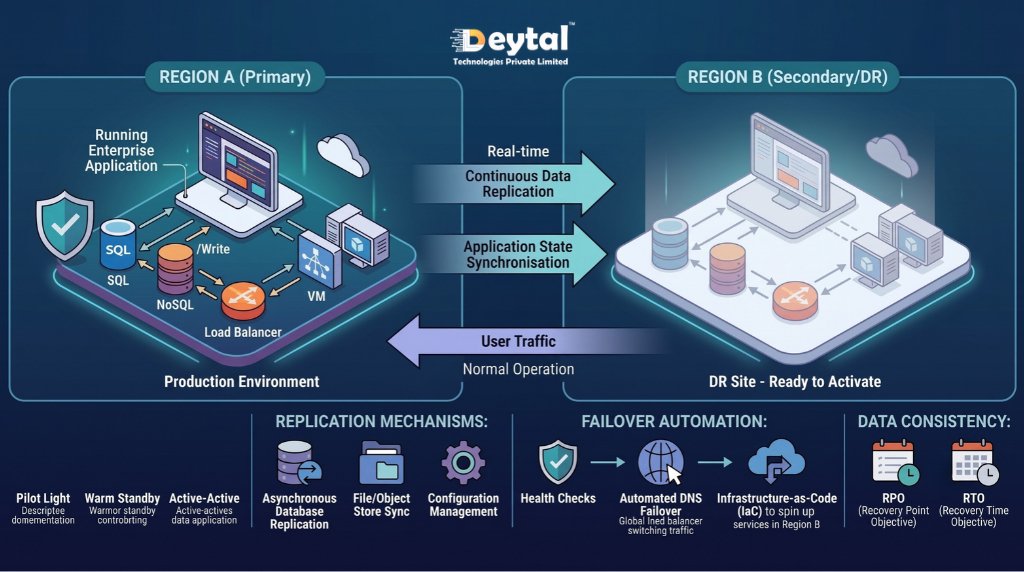
In modern distributed software ecosystems, the cost of cloud downtime has escalated from an operational annoyance into millions of dollars in lost transaction volume, legal liability, and brand erosion. Despite cloud providers offering robust Service Level Agreements (SLAs), centralized availability zone disruptions, fiber cuts, and catastrophic control plane outages remain inevitable. Traditional backup-and-restore paradigms relying on daily database snapshots and manual virtual machine provisioning are entirely inadequate for platforms requiring continuous 99.999% availability.
Cloud-Native Disaster Recovery Architecture transitions business continuity from reactive recovery into automated, platform-level survivability. By utilizing multi-region active-active configurations, globally distributed database replication topologies (such as CockroachDB, Amazon Aurora Global Database, or Google Cloud Spanner), automated DNS routing health checks, and continuous chaos engineering pipelines, enterprises achieve near-zero Recovery Point Objectives (RPO) and instant Recovery Time Objectives (RTO).
The Hidden Vulnerabilities of Legacy Backup-and-Restore Strategies
Relying on traditional cold or warm standby strategies introduces critical operational vulnerabilities during an infrastructure failure:
- Crippling Data Loss Windows (High RPO): Scheduled nightly or hourly snapshots mean any catastrophic outage permanently destroys all transaction records, cart states, and user actions committed since the last backup pass.
- Prolonged Manual Failover Latency (High RTO): Manual DNS re-routing, restoring database dumps, and re-provisioning container clusters during an active regional outage take hours, keeping customer portals dark.
- Split-Brain & Asynchronous Reconciliation Failures: When database failovers occur under panic conditions without automated distributed consensus algorithms, cross-region write conflicts corrupt relational schemas and financial ledger balances.
- Unvalidated Recovery Runbooks: Disaster recovery documentation written months prior frequently fails during production emergencies because underlying infrastructure, dependencies, and environmental secrets have drifted.
Legacy Cold/Warm Standby vs. Cloud-Native Disaster Recovery Architecture
| Architectural Dimension | Legacy Standby / Snapshot Recovery | Cloud-Native Active-Active Disaster Recovery |
| Traffic Routing Model | Active-Passive; secondary region remains cold or idle | Active-Active; traffic concurrently served across global regions |
| Recovery Point Objective (RPO) | Hours (bounded by snapshot backup intervals) | Near-Zero / Sub-second (synchronous or low-latency Raft consensus) |
| Recovery Time Objective (RTO) | Hours to Days (manual infrastructure rebuilds) | Seconds to Milliseconds (automated edge health check diversion) |
| Data Consistency Protocol | Nightly backup dumps with manual restore scripts | Distributed consensus-driven replication across geographically dispersed nodes |
| Failover Validation | Infrequent, disruptive scheduled drill windows | Continuous validation via automated production Chaos Engineering |
| Compute Resource Efficiency | Idle secondary infrastructure incurring dead capital | 100% utilized active infrastructure sharing dynamic global load |
Strategic Pillars for Engineering a Resilient Cloud-Native Disaster Recovery Platform
1. Distributed Data Consensus & Resilient Custom Orchestration
Architect geo-replicated data pipelines and event streaming topologies capable of handling continuous multi-region writes without lock contention. Engineering fault-tolerant state synchronization, dead-letter reprocessing queues, and idempotency keys through Custom Software Development Services ensures zero transaction loss during abrupt regional connectivity severances.
2. Globally Distributed Edge Storefronts & Anycast Routing
Decouple frontend delivery from single origin datacenters by deploying web applications across globally distributed edge nodes using Anycast BGP and automated latency-based DNS routing. Developing high-availability edge platforms via Website Development Services ensures visitors are transparently routed to the nearest healthy region if an entire cloud zone degrades.
3. Ergonomic Status Telemetry & Incident Command UI/UX Design
During a regional failover event, operational chaos compounds if engineers cannot instantly diagnose split-brain risks or observe region health. Designing real-time observability cockpits, automated service dependency graphs, and clear incident drill consoles through UI/UX Design Services keeps engineering squads informed and operational under high-stress incident scenarios.
4. Offline-First Mobile Architectures & Client-Side Resiliency
Protect mobile applications from catastrophic cloud degradation by embedding local cryptographic databases and optimistic client state management. Integrating resilient offline-first data synchronization runtimes within native applications via Mobile App Development Services allows users to continue browsing and queuing transactions even during backend API blackouts.
5. Clean Edge-Cached CMS Governance & Search Engine Continuity
Ensure sudden infrastructure failovers do not return HTTP 5xx errors that harm search crawler confidence or de-index critical landing pages. Deploying static-first headless content workflows through WordPress Development Services coupled with data-driven SEO Services maintains top organic search authority, 100% crawl uptime, and uninterrupted Core Web Vitals across multi-region environments.
6. Brand Reputation Defense & Crisis Communication Funnels
Maintain customer trust and programmatic acquisition momentum during infrastructure maintenance by serving pre-rendered, edge-cached communication channels and automated status page updates, systematically managed and scaled via Digital Marketing Services.
Architect Zero-Downtime Cloud Systems with Deytal Technologies
Transitioning an enterprise ecosystem to a resilient cloud-native disaster recovery architecture requires complex distributed database tuning, global network orchestration, and automated failure-injection testing. Deytal Technologies Pvt. Ltd. designs, audits, and builds mission-critical multi-region cloud infrastructures, distributed transactional backends, and fault-tolerant web applications engineered for total enterprise survivability.
Frequently Asked Questions (FAQ)
Q1: What is the technical difference between RPO and RTO in disaster recovery?
- Recovery Point Objective (RPO): The maximum acceptable amount of data loss measured in time (e.g., an RPO of 5 minutes means the system can tolerate losing up to 5 minutes of transactional data during an outage).
- Recovery Time Objective (RTO): The maximum acceptable duration of system downtime before business operations must be fully restored (e.g., an RTO of 30 seconds means the failover must complete and accept traffic within 30 seconds).
Q2: How do active-active multi-region architectures prevent database write conflicts?
Active-active systems resolve write conflicts using distributed consensus algorithms (such as the Raft or Paxos protocols) implemented in distributed SQL engines, or by adopting Conflict-Free Replicated Data Types (CRDTs) and Last-Write-Wins (LWW) timestamps in NoSQL datastores. Alternatively, architectures partition write authority geographically by pinning customer accounts to their primary local region while keeping read replicas active globally.
Q3: Why is Chaos Engineering essential for modern cloud-native disaster recovery?
Disaster recovery mechanisms frequently fail during real incidents because modern distributed microservices change continuously. Chaos Engineering proactively injects controlled failures such as killing virtual nodes, inducing artificial network latency, or simulating total regional cloud outages into production or staging environments to validate that automated failover triggers operate as designed before an unplanned disaster strikes.
