

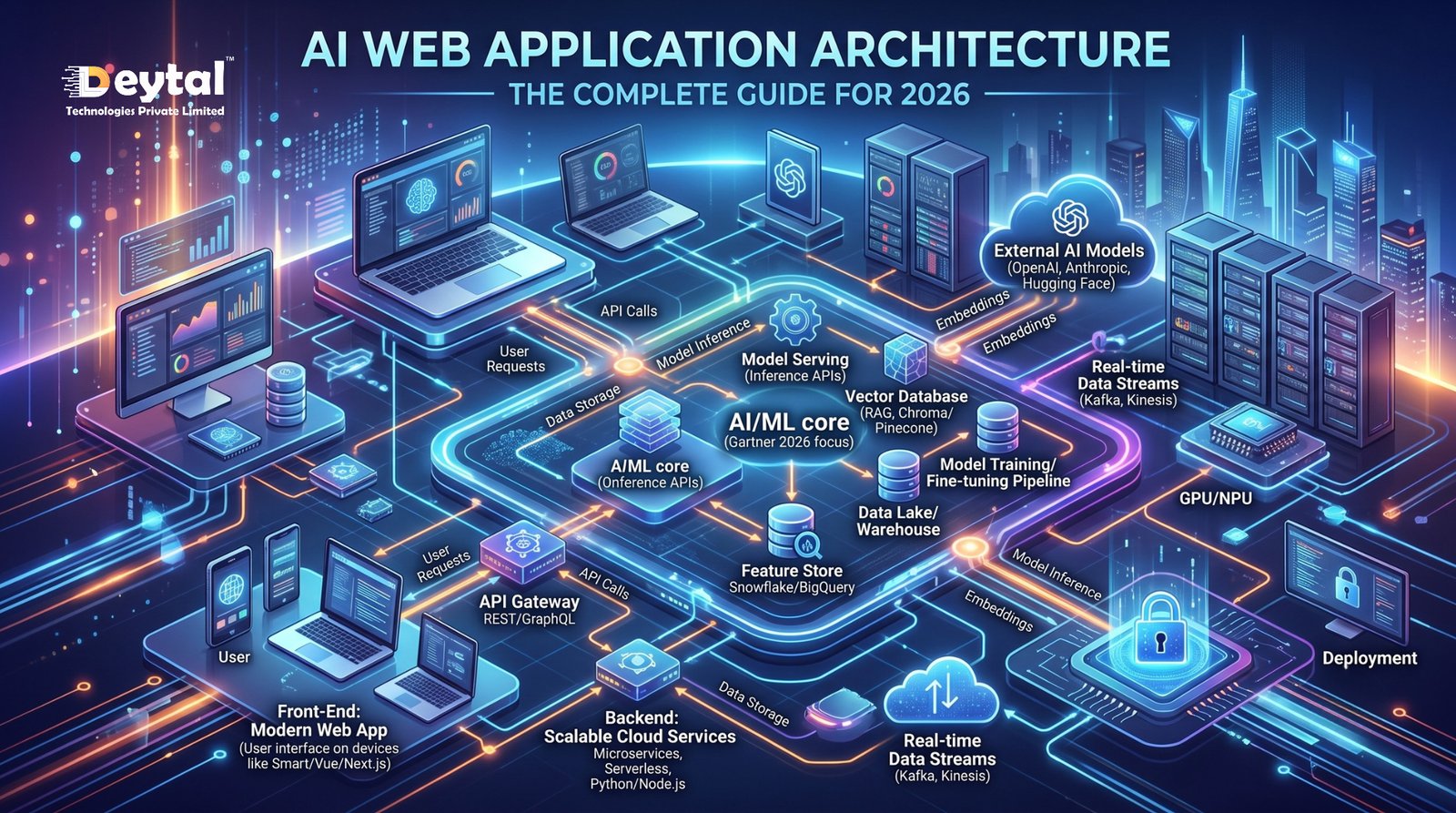
Embedding superficial, iframe-based AI chatbots onto static web pages is no longer enough to satisfy enterprise expectations. Customers and internal stakeholders require intelligent digital portals capable of understanding complex user intent, executing autonomous multi-step tasks, and synthesizing proprietary corporate knowledge with zero hallucinations and strict data privacy.
Engineering production-grade AI Web Application Architecture requires moving beyond simple third-party API wrappers. Modern enterprise portals integrate Retrieval-Augmented Generation (RAG) pipelines, low-latency vector databases (such as Pinecone, Qdrant, or pgvector), and asynchronous event streaming directly into the web platform to deliver contextual, real-time user experiences.
The Operational Failures of Superficial AI Integrations
Hasty, bolt-on generative AI implementations create serious security and operational issues:
- Severe Hallucinations & Factual Inaccuracy: Querying raw public LLMs without proprietary grounding leads to inaccurate responses that erode customer trust.
- Data Leakage & Privacy Violations: Passing unscrubbed enterprise queries or sensitive user data into public training models violates strict enterprise compliance standards (such as GDPR, SOC 2, and HIPAA).
- Crippling Latency & Poor UX: Unoptimized AI pipelines introduce multi-second Time-to-First-Token delays, causing user frustration and high bounce rates.
- Runaway Cloud Compute Costs: Unbounded context windows and un-cached LLM API requests cause cloud inference bills to escalate uncontrollably.
Basic AI Wrappers vs. Enterprise-Grade AI Web Architecture
| Architectural Dimension | Basic AI Wrappers / Chatbots | Enterprise-Grade AI Web Architecture |
| Knowledge Grounding | Generic public training data | Retrieval-Augmented Generation (RAG) over private data |
| Data Storage & Retrieval | Standard relational keyword lookups | High-dimensional vector embeddings & semantic search |
| Data Privacy & Governance | Data exposed to vendor model training | Zero-data-retention, encrypted enterprise VPC tunnels |
| Response Latency | High wait times (5–15+ seconds) | Sub-second token streaming via WebSockets / SSE |
| Action Capability | Passive text generation only | Agentic tool-calling & automated API transactions |
Strategic Pillars for Engineering Scalable AI Web Applications
1. Secure RAG Pipelines & Enterprise Vector Infrastructure
Build robust document ingestion, chunking, and embedding pipelines that transform unstructured enterprise knowledge into searchable vector spaces. Structuring enterprise-grade API gateways and secure middleware through Custom Software Development Services ensures proprietary data is scrubbed, vectorized, and retrieved with strict role-based access control (RBAC).
2. High-Performance Frontends & Token Streaming Interfaces
Eliminate perceived latency by delivering real-time, streaming token responses using Server-Sent Events (SSE) and WebSockets. Developing responsive, state-aware web interfaces via Website Development Services ensures interactive AI components render smoothly without freezing the browser’s main thread.
3. Human-Centered AI Interaction & UI/UX Design
AI applications require specialized user feedback loops to maintain trust. Designing intuitive citation cards, confidence indicators, multimodal input prompts, and fallback interfaces through UI/UX Design Services keeps users informed and in control of AI interactions.
4. Low-Latency Mobile AI Gateways
Bring conversational search and contextual intelligence to mobile touchpoints. Implementing optimized, offline-tolerant mobile clients using Mobile App Development Services guarantees synchronized AI interactions across iOS and Android ecosystems.
5. Intelligent Content Automation & Technical SEO
Power dynamic content assembly and contextual recommendation engines without degrading search engine crawlability. Combining headless WordPress Development Services with advanced SEO Services maintains top organic search authority, fast indexing, and pristine Core Web Vitals scores.
6. AI-Driven Personalization & High-Yield Performance Funnels
Leverage real-time intent analysis to dynamically adapt landing page copy, pricing tiers, and product recommendations, systematically managed and scaled through Digital Marketing Services.
Build Enterprise-Grade AI Portals with Deytal Technologies
Moving from proof-of-concept AI scripts to resilient, high-concurrency enterprise web platforms requires specialized expertise in vector databases, asynchronous streaming, and cloud security. Deytal Technologies Pvt. Ltd. designs and engineers production-ready AI web applications, custom RAG architectures, and scalable cloud solutions built to drive measurable business transformation.
Frequently Asked Questions (FAQ)
Q1: How does Retrieval-Augmented Generation (RAG) eliminate AI hallucinations?
RAG grounds language models by first retrieving verified, relevant documents from an enterprise’s private vector database based on the user’s semantic query. It then passes this factual context to the model with strict instructions to generate answers solely using the retrieved source data, accompanied by direct citations.
Q2: How do vector databases differ from traditional SQL relational databases?
Traditional relational databases index data by exact keywords, numbers, or dates. Vector databases index high-dimensional numerical representations (embeddings) of text, audio, or images, allowing systems to search by conceptual meaning, semantic intent, and contextual similarity.
Q3: Can we deploy AI web applications without sharing our proprietary data with third-party LLM vendors?
Yes. Enterprises can deploy self-hosted open-source models (such as Llama 3 or Mistral) inside their own isolated Virtual Private Cloud (VPC) or utilize private enterprise endpoints from providers that guarantee strict zero-data-retention and non-training policies.