

Enterprises have historically relied on monolithic, all-in-one software suites for their digital presence, e-commerce, and operational backbones. While unified suites promised turnkey convenience, they produced crippling vendor lock-in, sluggish release cycles, and exorbitant upgrade costs. Swapping out an obsolete search tool, updating a checkout funnel, or introducing AI-driven features often forced teams into multi-year, multi-million-dollar replatforming projects.
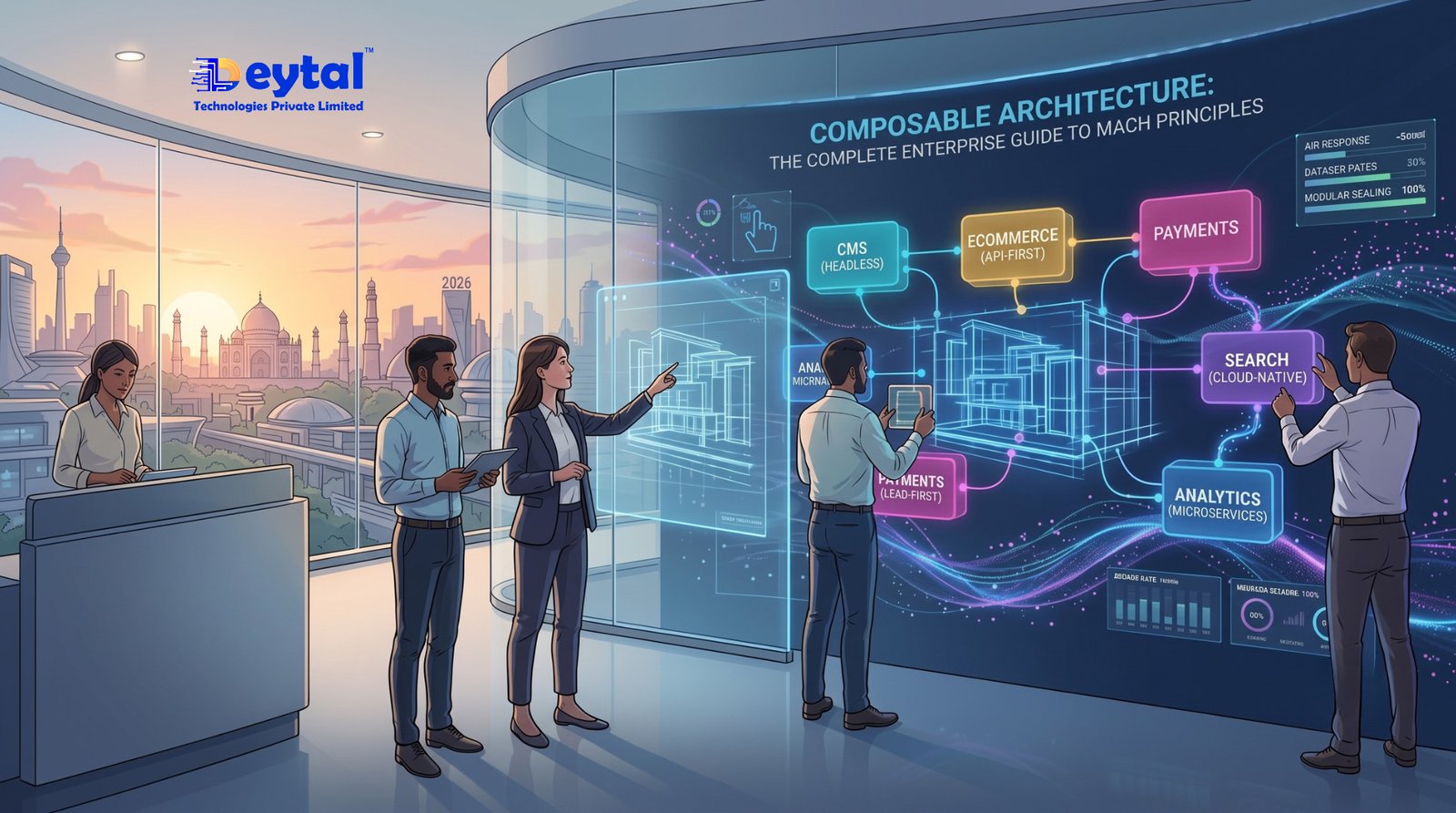
Composable Architecture replaces all-in-one stacks with a modular ecosystem built on MACH principles (Microservices, API-first, Cloud-native SaaS, and Headless). By assembling digital applications from independent, pluggable components, enterprises gain the agility to swap, scale, and iterate on individual services without destabilizing the broader system.
The Bottlenecks of Monolithic Enterprise Suites
Relying on rigid, closed-ecosystem platforms introduces major strategic risks:
- Crippling Vendor Lock-In: Organizations become tethered to a single vendor’s roadmap, forcing them to accept mediocre features rather than adopting best-of-breed solutions.
- Disruptive Upgrade Cycles: Routine vendor updates often alter underlying databases and dependencies, requiring extensive regression testing and downtime.
- High Barrier to Innovation: Incorporating emerging technologies like generative AI search or edge workflows demands complex custom middleware around legacy code.
- Single Points of Failure: When a core monolithic module experiences performance degradation or downtime, connected customer portals and internal tools stall simultaneously.
Monolithic Enterprise Suites vs. Composable MACH Architecture
| Architectural Dimension | Monolithic Software Suites | Composable MACH Architecture |
| Component Coupling | Tightly coupled, unified codebase | Loosely coupled, independent modular services |
| Tool Selection | One-size-fits-all suite features | Best-of-breed selection for every business capability |
| System Upgrades | High-risk, disruptive replatforming | Continuous, non-breaking background updates |
| Vendor Independence | Locked into a single vendor ecosystem | Pluggable components that can be replaced anytime |
| Time-to-Market | Multi-month rollout cycles | Rapid deployment of specific features via APIs |
The Four Pillars of MACH Architecture
1. M — Microservices
Decompose applications into independent, domain-driven services that handle distinct business capabilities (such as inventory, payments, or authentication). Building modular backends through Custom Software Development Services ensures every service can scale or deploy independently without impacting the entire application.
2. A — API-First
Every component in the ecosystem communicates through documented, standardized APIs (REST or GraphQL). Developing robust digital platforms with Website Development Services establishes clean API orchestrations that allow frontends, third-party tools, and backends to exchange data seamlessly.
3. C — Cloud-Native SaaS
Leverage software delivered as fully managed, elastic cloud services. Eliminating on-premise maintenance and manual patch management guarantees automated scaling, continuous feature releases, and high multi-region availability.
4. H — Headless
Completely decouple the presentation layer from backend logic. Engineering intuitive, responsive frontends via UI/UX Design Services empowers marketing and design teams to craft custom brand experiences across any digital touchpoint without touching core databases.
Strategic Advantages of Composable Architecture for High-Growth Brands
- Cross-Platform Delivery: Deploy shared API data pipelines to mobile devices. Developing native interfaces via Mobile App Development Services guarantees uniform customer experiences across iOS, Android, and web.
- Decoupled Content Management & Technical SEO: Deliver high-velocity content across channels using headless WordPress Development Services coupled with technical SEO Services to ensure sub-second page loads, pristine Core Web Vitals, and strong organic search authority.
- Agile Growth & Campaign Optimization: Integrate best-of-breed marketing technology stacks to run dynamic audience targeting and frictionless conversion funnels, strategically driven through Digital Marketing Services.
Transition to Composable Architecture with Deytal Technologies
Migrating from a monolithic suite to a composable MACH ecosystem requires careful API orchestration, data pipeline synchronization, and domain modeling. Deytal Technologies Pvt. Ltd. designs and implements composable enterprise architectures, custom microservices integrations, and scalable headless web solutions built to give your business long-term competitive flexibility.
Frequently Asked Questions (FAQ)
Q1: What is the main advantage of composable architecture over a traditional software suite?
Composable architecture allows enterprises to choose best-of-breed components for every specific business need (such as search, CMS, or checkout) rather than accepting mediocre sub-tools within an all-in-one suite. It also allows individual components to be replaced without re-engineering the rest of the stack.
Q2: Does adopting a composable architecture increase engineering overhead?
Managing multiple decoupled services requires mature API governance, distributed monitoring, and a solid DevOps foundation. However, it significantly reduces technical debt and eliminates the expensive multi-year replatforming cycles typical of monolithic suites.
Q3: Can an enterprise migrate to composable architecture incrementally?
Yes. Most enterprises use the “Strangler Fig” pattern, gradually replacing specific capabilities of their legacy monolith (e.g., swapping search or product reviews first) with composable microservices over time, avoiding the risk of a high-stakes “big bang” migration.