

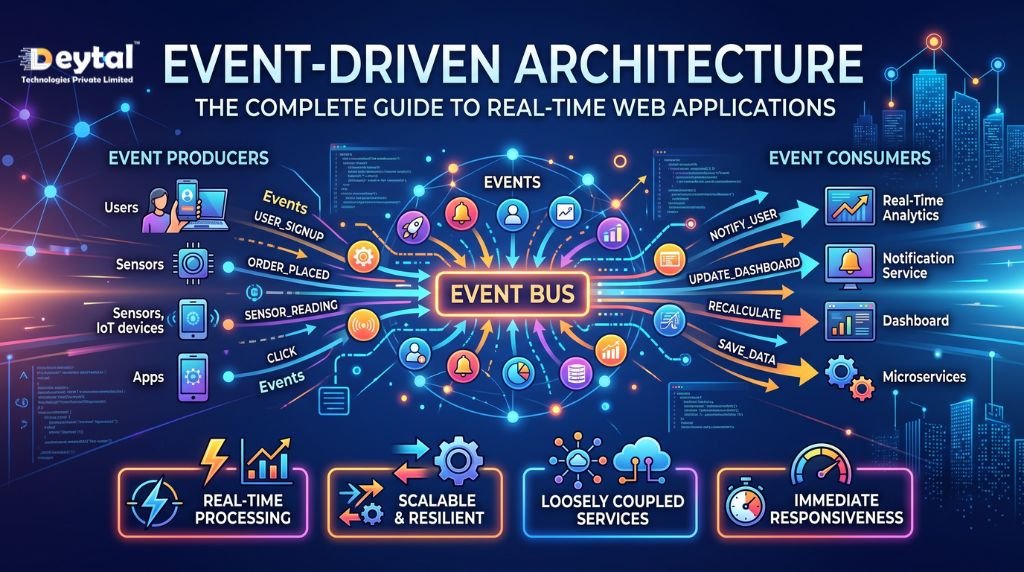
Traditional synchronous request-response models (HTTP REST polling) force web systems into rigid dependency chains. When a user submits an order, books a seat, or updates a profile, downstream databases and third-party APIs must all process in real time before returning a response. If a single downstream service lags or fails, the user experience grinds to a halt.
An Event-Driven Architecture (EDA) decouples components completely. Instead of waiting for sequential responses, services publish and subscribe to state changes (“events”) asynchronously via high-throughput message brokers delivering instantaneous response times, infinite horizontal scalability, and zero cascading failures.
The Bottlenecks of Synchronous Request-Response Web Systems
Scaling modern digital applications solely on synchronous HTTP calls creates critical systemic vulnerabilities:
- High Request Latency: Tying client-side responses to multiple sequential backend operations inflates page load and interaction times.
- Cascading Failures: An outage or slowdown in an analytics logger or email service halts the entire checkout or signup funnel.
- Database Deadlocks under Traffic Surges: Spikes in concurrent traffic overwhelm relational databases with simultaneous read/write locks, causing 504 Gateway Timeouts.
- Tight Architectural Coupling: Updating or refactoring one service requires modifying and redeploying connected services across the application.
Synchronous Web Architecture vs. Event-Driven Architecture
| Architectural Dimension | Synchronous (REST/HTTP) | Event-Driven (EDA) |
| Communication Style | Point-to-point, blocking calls | Asynchronous, publish-subscribe (Pub/Sub) |
| System Coupling | Tightly coupled (producer knows consumer) | Loosely coupled (producers emit events blindly) |
| Throughput & Latency | Limited by slowest downstream dependency | Near-instant client response via decoupled queues |
| Fault Resilience | Low (failure cascades upstream to user) | High (events persist in queue until recovery) |
| Scalability | Scale entire chain to handle peak loads | Scale only the specific lagging consumer workers |
Core Engineering Pillars of Event-Driven Web Platforms
1. Scalable Message Brokers & Asynchronous Pipelines
Implement distributed event streaming engines like Apache Kafka, RabbitMQ, or AWS EventBridge. Engineering resilient message queues and idempotent consumer logic through Custom Software Development Services ensures zero message loss even under millions of concurrent events.
2. Reactive, Real-Time Web Frontends
Deliver instantaneous updates to client browsers without polling. Deploying modern WebSocket-driven frontends via Website Development Services allows users to see live order updates, stock counts, and notifications seamlessly.
3. Event Observability & Telemetry Dashboards
Asynchronous flows require clear tracking across distributed services. Designing centralized event-tracing dashboards and message-flow UI via UI/UX Design Services equips technical teams to monitor consumer lag and dead-letter queues effortlessly.
4. Low-Latency Real-Time Mobile Integration
Keep mobile apps synchronized with live application states. Building lightweight background synchronization services via Mobile App Development Services guarantees instant push updates without draining mobile device battery life.
5. Decoupled Content Distribution & SEO Stability
Isolate high-frequency real-time event streams from public marketing assets. Leveraging headless WordPress Development Services and technical SEO Services maintains top organic search authority and lightning-fast Core Web Vitals.
6. Data-Driven Funnels & Automated Campaign Triggers
Turn user-behavior events directly into real-time conversion triggers. Fuel your growth pipeline using responsive marketing automation managed by Digital Marketing Services.
Build High-Throughput Event-Driven Platforms with Deytal Technologies
Transitioning to an asynchronous, event-driven model requires meticulous message schema design, error-handling protocols, and deep distributed systems expertise. Deytal Technologies Pvt. Ltd. designs and develops high-performance event-driven architectures, custom microservices pipelines, and scalable cloud platforms built for enterprise reliability.
Frequently Asked Questions (FAQ)
Q1: What is the core difference between an event and a message?
A message is a raw data packet sent to a specific destination expecting a specific action. An event is a record of an immutable state change that has already occurred, published without knowledge of who consumes it.
Q2: How does event-driven architecture prevent system downtime during traffic spikes?
Event queues buffer incoming requests during massive surges. Consumer workers process transactions at their optimal rate without crashing upstream servers or dropping user transactions.
Q3: What are Dead-Letter Queues (DLQ) in an event-driven system?
A Dead-Letter Queue is a designated holding queue where messages that fail repeatedly (due to formatting errors or temporary service outages) are safely stored for debugging without halting the main pipeline.