

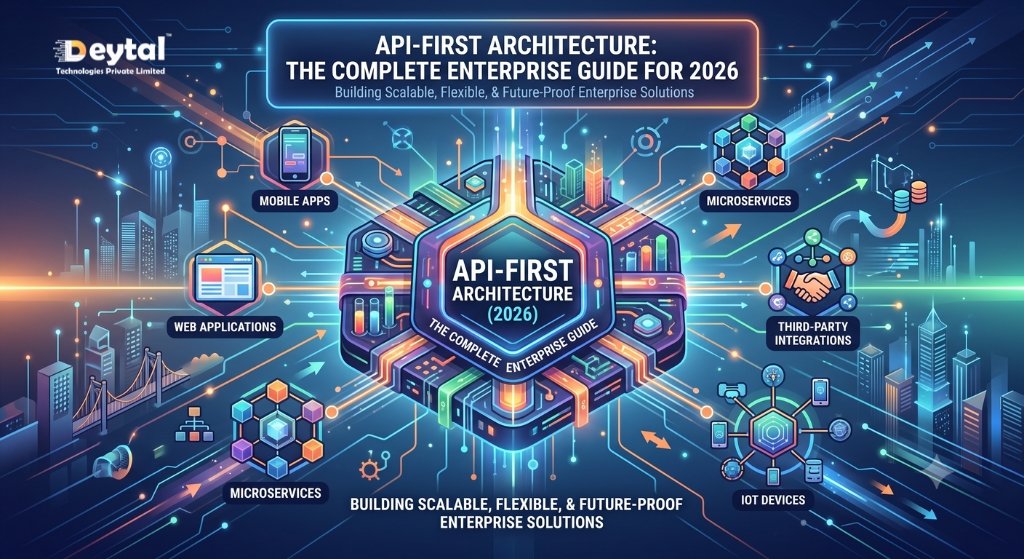
When engineering modern digital platforms, building web interfaces before defining backend data contracts often leads to costly architectural friction. When organizations attempt to connect mobile applications, third-party SaaS tools, or IoT channels, they are forced to write fragile custom wrappers around rigid, monolithic code.
An API-First Architecture inverts this legacy model. By treating Application Programming Interfaces (APIs) as the primary product designing and standardizing contracts before writing implementation code enterprises create modular, reusable systems capable of connecting to any digital touchpoint instantly.
The Costly Bottlenecks of Code-First & Monolithic Systems
Approaching software development from a UI-first or monolithic code-first angle creates compounded technical constraints:
- Siloed Channel Integrations: Building separate backends for web, iOS, and Android results in duplicate business logic, inconsistent data, and increased maintenance costs.
- Prolonged Development Cycles: Frontend and backend teams are blocked until full features are coded, slowing down release cadences.
- Brittle Third-Party Connections: Integrating external ERPs, CRMs, or payment providers requires messy custom middleware that breaks during system updates.
- High Refactoring Costs: Changing a database schema or business rule often cascades into breaking UI errors across multiple platforms.
Code-First Legacy Systems vs. API-First Modern Architecture
| Architecture Metric | Code-First Legacy Approach | API-First Modern Architecture |
| Development Workflow | Sequential (Frontend waits on Backend) | Parallel (Teams build against mock API contracts) |
| Omnichannel Support | Difficult (Requires custom adapters per channel) | Native (Single API serves Web, Mobile, IoT, Kiosks) |
| Reusability of Logic | Low (Tied to specific user interfaces) | High (Core services reused across multiple apps) |
| System Extensibility | Complex and prone to regression bugs | Modular plug-and-play microservices |
| API Documentation | Outdated or generated after deployment | Auto-generated from OpenAPI/Swagger contracts |
Strategic Pillars of an API-First Digital Transformation
1. Modular API Pipelines & Microservices Engineering
Design resilient RESTful and GraphQL endpoints that act as the single source of truth for business logic. Structuring modular API gateways through Custom Software Development Services guarantees low-latency, secure data flow across your entire digital stack.
2. High-Performance, API-Driven Web Platforms
Consume modular endpoints via modern static and server-rendered frontends. Deploying responsive user interfaces with Website Development Services ensures sub-second page loads and seamless real-time interactivity.
3. Developer-Centric & Interactive UI/UX Design
APIs are only as good as the applications built on top of them. Designing intuitive developer portals, client dashboards, and interactive user flows via UI/UX Design Services makes data consumption straightforward for all users.
4. Unified Mobile Application Experiences
Deploy shared API contracts across iOS and Android ecosystems simultaneously. Building synchronized mobile frontends via Mobile App Development Services eliminates platform discrepancies and ensures instant feature rollout.
5. Decoupled Content Management & Technical SEO
Power public-facing marketing hubs with headless, API-driven content distribution. Combining decoupled WordPress Development Services with advanced SEO Services maintains top organic search visibility and lightning-fast Core Web Vitals.
6. Automated Growth & Dynamic Campaign Funnels
Leverage real-time API integrations with marketing automation tools to capture and qualify enterprise leads, driven by performance-focused Digital Marketing Services.
Build Future-Proof API Ecosystems with Deytal Technologies
Migrating to an API-first framework requires strict contract governance, robust security protocols, and clean full-stack execution. Deytal Technologies Pvt. Ltd. designs and develops scalable API-first architectures, enterprise web applications, and custom cloud integrations tailored for sustainable commercial growth.
Frequently Asked Questions (FAQ)
Q1: What is the core principle of an API-First approach?
The core principle is treating APIs as first-class citizens. API contracts (schemas and data structures) are designed, reviewed, and finalized before writing backend business logic or frontend interfaces.
Q2: How does API-First architecture speed up development?
Because API schemas are defined upfront using standards like OpenAPI, frontend, mobile, and backend engineers can build and test their components concurrently using mock servers without waiting for finished backends.
Q3: What is the difference between API-First and Headless Architecture?
Headless architecture specifically refers to decoupling the frontend UI from the content or commerce backend. API-First is the broader engineering design methodology that makes headless, microservices, and omnichannel platforms possible.