

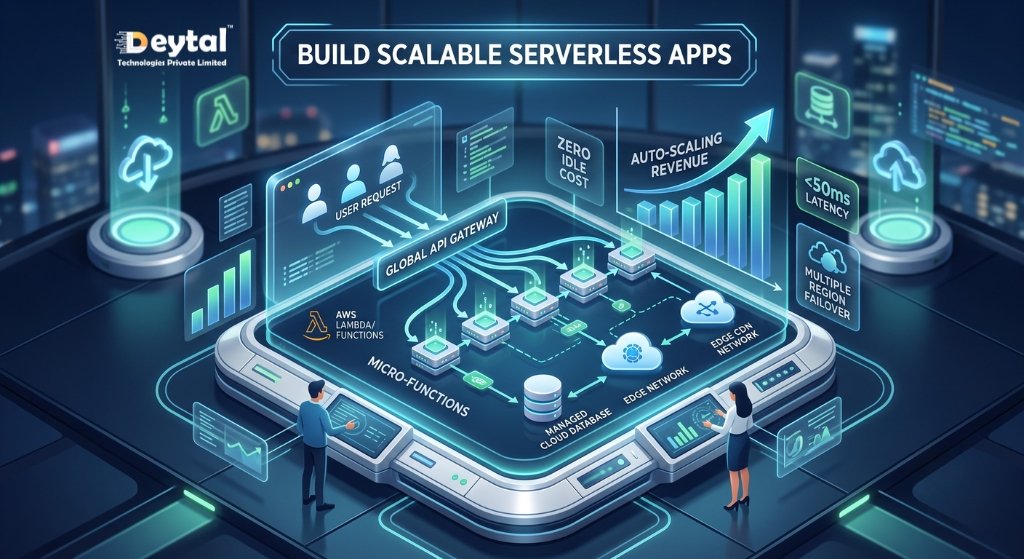
Managing physical or virtual server infrastructure requires constant provisioning, security patch cycles, and manual capacity forecasting. When web applications experience sudden surges in user activity, under-provisioned servers slow down or crash, while over-provisioning leads to excessive, wasted monthly hosting expenses.
Serverless Web Development abstracts server management entirely. By running application logic in stateless, event-driven compute environments (such as AWS Lambda, Google Cloud Functions, or Cloudflare Workers), applications auto-scale on demand and charge only for the exact execution time consumed.
The Operational Drawbacks of Traditional Server Infrastructure
Maintaining dedicated server environments introduces distinct bottlenecks as application complexity grows:
- Idle Compute Waste: Dedicated servers run 24/7, requiring businesses to pay for peak compute capacity even during hours of zero traffic.
- Complex Infrastructure Management: Engineering teams spend substantial time configuring OS updates, monitoring load balancers, and managing security certificates instead of shipping features.
- Slow Scaling Response Times: Traditional auto-scaling groups often require several minutes to spin up, configure, and register new virtual machine instances during traffic spikes.
- High Maintenance Overhead: Disaster recovery and multi-zone failovers require complex custom routing configurations and dedicated DevOps resources.
Traditional Dedicated Hosting vs. Serverless Architecture
| Metric / Capability | Traditional Dedicated Server | Serverless Architecture |
| Server Provisioning | Manual server setups & OS maintenance | Zero server management (fully abstract) |
| Scaling Mechanism | Auto-scaling groups (takes minutes) | Instant, event-driven scaling per request |
| Pricing Model | Fixed monthly cost per provisioned instance | Pay-per-execution (billed to the millisecond) |
| High Availability | Requires complex multi-zone load balancers | Built-in fault tolerance and multi-region routing |
| Deployment Speed | Heavy monolithic build and deployment pipelines | Granular function-level deployments via CI/CD |
Strategic Pillars of High-Performance Serverless Web Development
1. Event-Driven Backend Architecture & Micro-Functions
Deconstruct backend logic into isolated, purpose-built functions triggered by HTTP requests, database events, or file uploads. Engineering clean event pipelines via Custom Software Development Services ensures sub-second execution speeds without infrastructure bottlenecks.
2. Modern Edge-Rendered Frontends
Pair serverless backends with statically generated or edge-rendered user interfaces. Deploying high-speed web platforms via Website Development Services ensures near-zero Time to First Byte (TTFB) and high Core Web Vitals scores globally.
3. Intuitive Monitoring & Dashboard UI
Operating event-driven platforms requires clear operational metrics. Designing intuitive telemetry interfaces, real-time error dashboards, and user access portals through UI/UX Design Services simplifies system visibility.
4. Low-Latency Mobile Application Endpoints
Extend serverless execution to mobile ecosystems. Developing lightweight, event-triggered API gateways via Mobile App Development Services guarantees responsive data synchronization across iOS and Android apps without maintaining persistent connections.
5. Decoupled Content Management & Technical SEO
Serve static, headless content assets powered by serverless APIs. Combining modern Jamstack deployments with WordPress Development Services and technical SEO Services maintains top organic search authority and rapid page indexing.
6. Automated High-Traffic Funnel Execution
Take full advantage of serverless scalability by running high-volume marketing campaigns that convert traffic seamlessly without performance degradation, managed through Digital Marketing Services.
Build Modern Serverless Platforms with Deytal Technologies
Adopting serverless architecture requires robust API design, event orchestration, and modern cloud deployment frameworks. Deytal Technologies Pvt. Ltd. designs and develops high-performance serverless web applications, custom API pipelines, and scalable cloud solutions built to accelerate digital growth.
Frequently Asked Questions (FAQ)
Q1: What is a “cold start” in serverless computing, and how is it mitigated?
A cold start is the slight initialization latency when a function is invoked after being idle. It is mitigated by optimizing function package sizes, using lightweight runtimes, and enabling provisioned concurrency on high-priority endpoints.
Q2: Is serverless architecture suitable for enterprise web applications?
Yes. Enterprise organizations use serverless architectures for API backends, real-time data streaming, e-commerce checkout pipelines, and background processing due to its automated scalability and high fault tolerance.
Q3: How does serverless development reduce cloud infrastructure costs?
Serverless eliminates costs associated with idle server capacity. Compute resources are charged only when a function actively executes, making it exceptionally cost-effective for variable and dynamic workloads.