

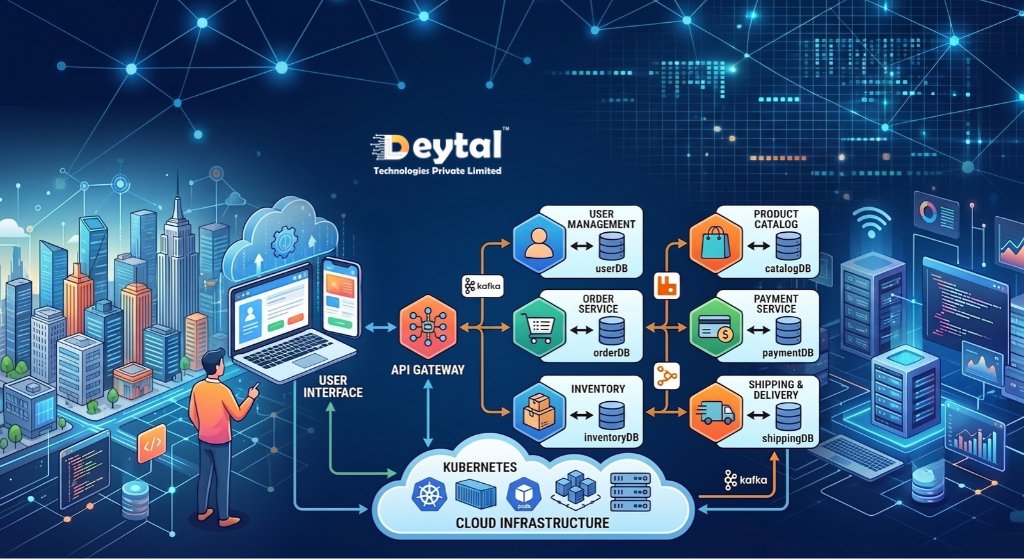
As enterprise web platforms scale to handle millions of concurrent users, tightly coupled monolithic applications inevitably hit a performance wall. A single database deadlock or runaway process can bring down the entire ecosystem, while deploying minor feature updates turns into a high-risk operational headache.
Transitioning to a Microservices Architecture breaks complex web platforms into modular, independently deployable services that communicate via lightweight APIs delivering elastic scalability, continuous uptime, and rapid development agility.
The Bottlenecks of Legacy Monolithic Web Systems
Continuing to scale a monolithic codebase introduces critical operational risks as business logic expands:
- Single Point of System Failure: In a monolith, an error in one module (such as payment processing or report generation) can crash the entire web application.
- Deployment Gridlock: Multiple development teams working on a single shared codebase face code merge conflicts, prolonged testing cycles, and risky release schedules.
- Inefficient Resource Scaling: Monoliths force you to scale the entire application instance even if only one specific background task is experiencing high traffic.
- Technology Stack Lock-in: Upgrading a single framework or adopting a new language requires rewriting or refactoring the entire codebase.
Monolithic Architecture vs. Microservices Architecture
| System Metric | Monolithic Architecture | Microservices Architecture |
| System Resilience | Low (Single failure can crash entire system) | High (Fault isolation prevents cascading downtime) |
| Deployment Speed | Slow, coordinated full-app deployments | Rapid, independent continuous delivery (CI/CD) per service |
| Scalability Model | Vertical (Scaling the entire monolith instance) | Horizontal & Granular (Auto-scale individual high-traffic services) |
| Tech Stack Freedom | Rigid (Unified stack across the entire codebase) | Polyglot (Choose the best language/database per service) |
| Codebase Complexity | High cognitive load in massive repos | Small, clean, single-responsibility service repositories |
Core Pillars of a Resilient Microservices Web Platform
1. Modular Backend Services & API Gateway Routing
Decompose monolithic systems into focused domain services connected via centralized API gateways. Structuring clean REST and gRPC endpoints through Custom Software Development Services ensures smooth, secure, and low-latency communication across distributed services.
2. High-Speed, Decoupled Web Frontends
Pair distributed microservices with fast, modular frontend architectures. Implementing decoupled, responsive interfaces using Website Development Services ensures web applications deliver sub-second response times regardless of backend complexity.
3. Streamlined Service Management & Observability UI
Managing a distributed microservices network requires clear system visibility. Designing intuitive administrative dashboards and real-time monitoring portals through UI/UX Design Services gives engineering teams full control over service health and logs.
4. Real-Time Mobile App Service Endpoints
Ensure distributed data updates reach mobile users instantly. Extending microservices endpoints to mobile platforms via Mobile App Development Services guarantees responsive data synchronization across iOS and Android ecosystems.
5. High-Performance CMS Integration & Technical SEO
Decouple public marketing assets from transactional application services. Combining independent content microservices with WordPress Development Services and specialized SEO Services preserves organic search authority and guarantees top Core Web Vitals performance.
6. Automated Growth & Dynamic Funnel Scaling
Harness the elasticity of microservices to drive high-volume acquisition campaigns without platform lag, supported by data-driven Digital Marketing Services.
Build Resilient Microservices Platforms with Deytal Technologies
Migrating from a monolith to microservices requires seasoned architectural planning, robust API governance, and expert DevOps engineering. Deytal Technologies Pvt. Ltd. designs and builds scalable microservices architectures, custom API integrations, and cloud-native software platforms engineered for sustained business growth.
Frequently Asked Questions (FAQ)
Q1: When should a business transition from a monolith to microservices?
The transition makes sense when team sizes expand, deployment cycles become bottlenecks, or specific modules need independent horizontal auto-scaling under heavy traffic.
Q2: How do microservices communicate securely?
Microservices typically communicate through an API Gateway using secure lightweight protocols such as HTTPS/REST, gRPC, or asynchronous message brokers like RabbitMQ or Apache Kafka with OAuth2/mTLS authentication.
Q3: Does microservices architecture increase infrastructure costs?
While distributed services require initial container orchestration setup (such as Kubernetes or Docker), granular auto-scaling typically reduces long-term cloud costs by allocating compute resources only where active traffic requires them.