

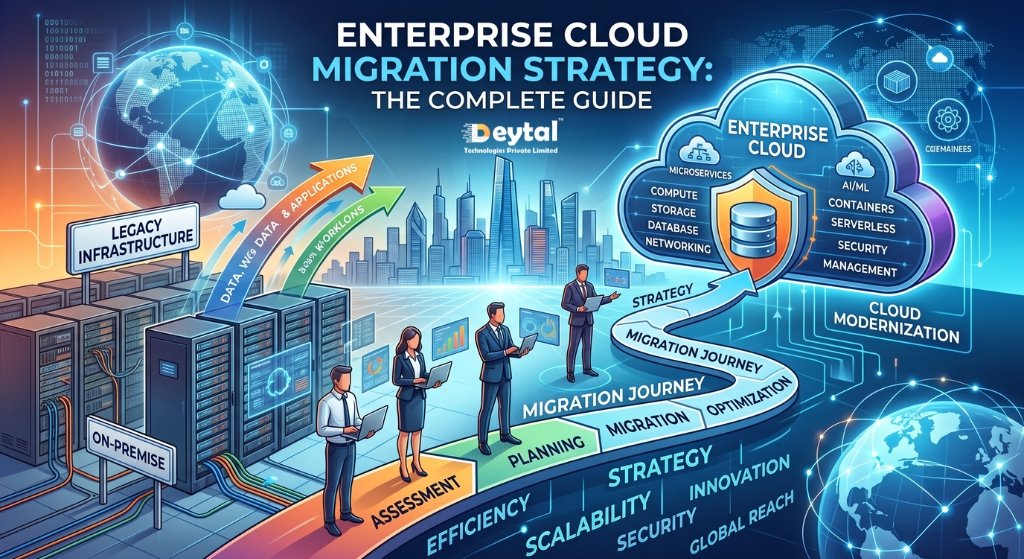
Relying on on-premise hardware or outdated monolithic hosting environments introduces severe operational risks—ranging from unpredictable downtime during traffic surges to compounding maintenance costs. As organizations scale, legacy infrastructure quickly becomes the primary constraint on digital agility and feature deployment.
A structured Enterprise Cloud Migration Strategy transitions mission-critical databases, business applications, and customer portals to scalable cloud environments, ensuring zero data loss, sub-second latency, and continuous operational resilience.
The Real Risks of Retaining Legacy On-Premise Stacks
Organizations that postpone infrastructure modernization face compounded technical and business risks:
- High Infrastructure Overhead: Maintaining physical servers requires substantial upfront capital, recurring licensing fees, and dedicated physical maintenance resources.
- Vulnerability to Outages: On-premise setups lack the distributed multi-region failover safeguards native to modern cloud networks, risking severe operational downtime.
- Scalability Bottlenecks: Provisioning additional hardware to handle unexpected traffic spikes takes weeks, leading to dropped customer connections during peak periods.
- Security & Compliance Exposures: Outdated operating systems and unpatched legacy server software leave business-critical data vulnerable to sophisticated cyber threats.
Legacy On-Premise Infrastructure vs. Modern Cloud Architecture
| Capability / Metric | Legacy On-Premise Infrastructure | Modern Cloud Architecture |
| Resource Scaling | Manual, expensive hardware procurement | Auto-scaling compute instances within seconds |
| High Availability & Disaster Recovery | Single point of failure; complex manual backups | Multi-region automated failover and instant recovery |
| Cost Model | Heavy upfront CapEx with fixed running costs | Pay-as-you-scale OpEx with dynamic cost controls |
| Deployment Agility | Slow, manual release cycles prone to errors | Continuous Integration & Automated CI/CD Pipelines |
| Security Standards | Dependent on internal firewalls and patches | Built-in zero-trust security, encryption, and compliance |
Core Pillars of a Seamless Enterprise Cloud Migration
1. Scalable Cloud Backend Engineering & Microservices
Deconstruct monolithic application architectures into containerized, independent microservices. Engineering modular cloud backends through Custom Software Development Services ensures individual services scale automatically during traffic surges without system-wide crashes.
2. Modern Cloud-Native Web Platform Architecture
Re-architect public portals and enterprise customer dashboards for the cloud. Deploying lightweight, headless frontends via Website Development Services ensures lightning-fast global delivery via edge networks.
3. Frictionless Management Portals & Monitoring UI
Managing multi-cloud resources requires clear administrative visibility. Crafting intuitive analytics dashboards and real-time infrastructure controls through UI/UX Design Services empowers technical and non-technical stakeholders alike.
4. Real-Time Mobile Cloud Integrations
Ensure enterprise field applications maintain synchronized data access anywhere in the world. Developing cloud-synchronized endpoints via Mobile App Development Services delivers real-time database synchronization across distributed teams.
5. Cloud-Hosted CMS & Technical SEO Scalability
Protect organic traffic during migration by shifting content systems to resilient cloud environments. Pairing secure WordPress Development Services with technical SEO Services maintains top-tier search visibility and near-instant page response times globally.
6. Automated Demand Capture & Performance Funnels
Take full advantage of elastic cloud infrastructure by driving high-volume enterprise campaigns with data-driven Digital Marketing Services, confident that the infrastructure will handle sudden spikes without latency.
Modernize Your Enterprise Infrastructure with Deytal Technologies
Migrating mission-critical enterprise systems requires deep full-stack engineering expertise, rigorous security compliance, and detailed execution planning. Deytal Technologies Pvt. Ltd. designs, manages, and executes end-to-end cloud migrations, custom backend architectures, and scalable cloud solutions built to accelerate digital transformation.
Frequently Asked Questions (FAQ)
Q1: How do you prevent data loss during an enterprise cloud migration?
Zero data loss is achieved by using automated incremental synchronization, dual-write protocols during the transition phase, and comprehensive validation tests before finalizing the DNS cutover.
Q2: What is the difference between “Lift and Shift” and “Re-architecting”?
“Lift and Shift” (Rehosting) moves existing applications to cloud virtual machines without modifying the underlying code. “Re-architecting” rewrites core components into cloud-native microservices to fully utilize auto-scaling and serverless benefits.
Q3: How does cloud migration improve page speed and Core Web Vitals?
Cloud networks leverage global Content Delivery Networks (CDNs) and edge computing, allowing assets and data to be served from servers physically closest to the end user, drastically lowering Time to First Byte (TTFB).