

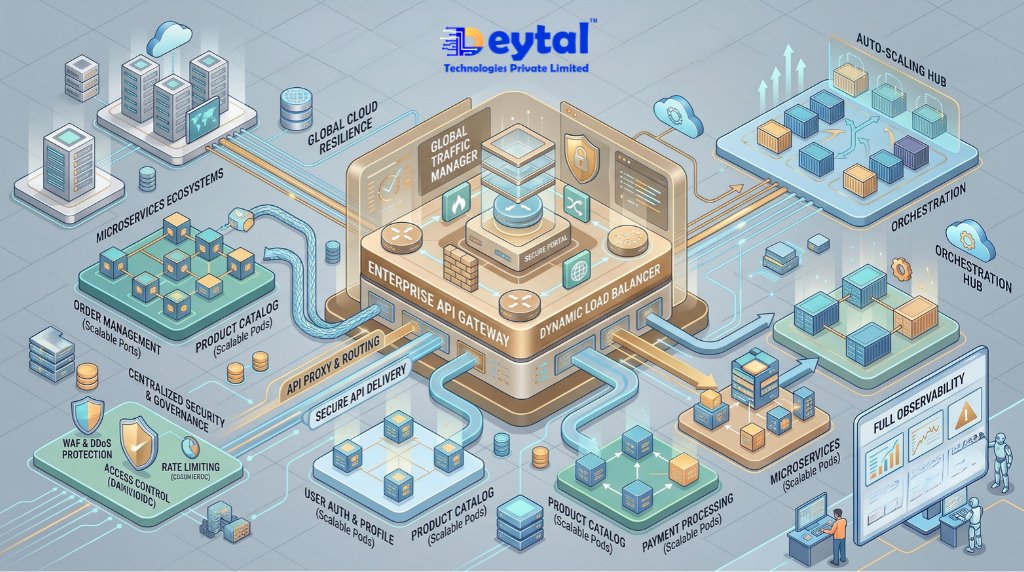
As software organizations decompose monolithic backends into dozens or hundreds of autonomous microservices, managing client-to-service communication becomes a major operational bottleneck. Exposing individual microservice endpoints directly to the public internet forces client applications to execute dozens of round-trip HTTP requests to render a single dashboard view, exposes internal network topology to attackers, and scatters cross-cutting concerns—such as authentication, SSL termination, and rate limiting—across fragmented backend codebases.
Enterprise API Gateway Architecture establishes a centralized, high-throughput reverse proxy layer that sits between external clients (web, mobile, third-party partners) and internal microservices. Operating as the authoritative ingress point, modern enterprise API gateways (such as Kong, Envoy, and AWS API Gateway) orchestrate traffic routing, enforce mutual TLS (mTLS) security, execute request/response payload transformation, and govern distributed rate limiting without burdening upstream application code.
The Security and Latency Costs of Ungoverned Microservices
Operating microservice fleets without a unified API gateway creates predictable engineering debt:
- Chatty Network Roundtrips: Frontends must query multiple backend services sequentially (e.g., Auth, Catalog, Inventory, Reviews), drastically inflating mobile latency and network payload sizes.
- Scattered Security Policies: When every microservice team implements its own JWT validation, OAuth scopes, and CORS headers, security vulnerabilities and unpatched authentication bypasses inevitably multiply.
- Vulnerability to DDoS and Traffic Spikes: Without centralized, distributed rate limiting and token-bucket algorithms at the ingress layer, sudden traffic surges can cascade down to internal databases and cause widespread outages.
- Lack of Centralized Observability: Tracking distributed transactions, debugging latency spikes, and auditing API consumption requires piecing together uncoordinated logs across dozens of decoupled services.
Direct Client-to-Service Access vs. Enterprise API Gateway Architecture
| Architectural Dimension | Direct Client-to-Service Access | Enterprise API Gateway Architecture |
| Ingress Topology | Public exposure of multiple backend endpoints | Single, hardened ingress entry point with private backends |
| Authentication & Authorization | Duplicated across every individual microservice | Centralized at the edge via OAuth 2.0, JWT, and mTLS |
| Network Latency & Calls | Multiple client-side requests per view (Chatty) | Single API call with server-side aggregation / federation |
| Traffic Shaping & Throttling | Inconsistent, custom rate limits per service | Distributed token-bucket rate limiting and circuit breaking |
| Observability & Auditing | Fragmented, non-standardized logs across fleets | Unified distributed tracing (OpenTelemetry), metrics, and logs |
| Protocol Translation | Clients must support internal protocols directly | Bridges HTTP/REST or GraphQL to internal gRPC/message queues |
Strategic Pillars for Engineering an Enterprise API Gateway Layer
1. High-Throughput Routing & Custom Proxy Orchestration
Engineer lightweight, non-blocking reverse proxy layers capable of handling tens of thousands of concurrent connections with sub-millisecond overhead. Constructing resilient request transformation plugins, circuit breakers, and custom cache invalidation layers through Custom Software Development Services ensures core application microservices remain protected against downstream traffic surges.
2. Lightning-Fast Aggregation for Web Frontends
Implement Backend-for-Frontend (BFF) patterns and GraphQL federation layers within the gateway to consolidate multiple data dependencies into a single response payload. Developing composable web frontends via Website Development Services ensures browsers receive pre-shaped, optimized JSON structures that minimize rendering blocking and memory consumption.
3. API Telemetry Dashboards & Ergonomic Developer Portals
An enterprise gateway is only as effective as its operational visibility. Designing intuitive API consumer dashboards, interactive Swagger/OpenAPI documentation portals, and real-time usage analytics interfaces through UI/UX Design Services accelerates internal developer onboarding and streamlines third-party partner integrations.
4. Low-Bandwidth Endpoints & Mobile Traffic Shaping
Tailor API gateway response payloads specifically for bandwidth-constrained handheld devices by stripping unnecessary fields and compressing headers. Engineering dedicated mobile gateway endpoints using Mobile App Development Services reduces mobile data consumption, accelerates API parsing, and preserves battery life across iOS and Android runtimes.
5. Clean Edge Caching & Technical Content Discovery
Ensure public-facing API routes and headless content feeds leverage edge-caching policies that protect upstream origin databases while maintaining real-time freshness. Pairing robust CMS data endpoints via WordPress Development Services with data-driven SEO Services maintains top organic search authority, fast indexing, and optimal Core Web Vitals across dynamically driven web assets.
6. Partner Monetization & Scalable Inbound Lead Funnels
Leverage API consumption metrics and usage tiers to power enterprise monetization models, developer acquisition campaigns, and targeted integration marketing, continuously tracked and scaled via Digital Marketing Services.
Modernize Your Cloud Architecture with Deytal Technologies
Implementing an enterprise API gateway architecture requires comprehensive traffic profiling, security policy hardening, and low-latency proxy configuration. Deytal Technologies Pvt. Ltd. designs and deploys production-ready API gateway solutions, distributed service meshes, and custom cloud-native backend integrations engineered to deliver maximum throughput, strict zero-trust security, and seamless developer workflows.
Frequently Asked Questions (FAQ)
Q1: What is the difference between an API Gateway and a Service Mesh?
An API Gateway primarily manages “north-south” traffic (incoming requests from outside clients to internal systems), handling external concerns like public authentication, rate limiting, and API monetization. A Service Mesh (such as Istio or Linkerd) manages “east-west” traffic (communication between internal microservices), focusing on service discovery, internal mTLS encryption, and granular circuit breaking inside the cluster.
Q2: How does an API Gateway prevent the “noisy neighbor” problem?
Gateways use distributed rate-limiting algorithms, such as the Token Bucket or Leaky Bucket models, backed by high-speed in-memory datastores like Redis. By assigning strict rate limits, burst thresholds, and concurrency quotas based on API keys, IP addresses, or user tiers, the gateway drops excess requests before they consume upstream microservice resources.
Q3: Can an API Gateway translate protocols between clients and microservices?
Yes. Enterprise API gateways frequently perform protocol mediation, accepting standard HTTP/JSON or GraphQL requests from public web and mobile clients and translating them into high-performance binary protocols (like gRPC or Apache Kafka event messages) for internal microservice communication, reducing internal latency and network overhead.