

Deploying machine learning models to production has shifted focus from training architectures to edge inference efficiency. As computer vision, real-time speech synthesis, and small language models (SLMs) move directly to edge devices, industrial gateways, and autonomous robots, systems engineers face strict physical constraints: limited thermal envelopes, tight VRAM limits, and low-latency Service Level Agreements (SLAs).
Running unoptimized PyTorch or TensorFlow graphs in production consumes excessive memory, exhibits high cold-start overhead, and fails to saturate underlying hardware.
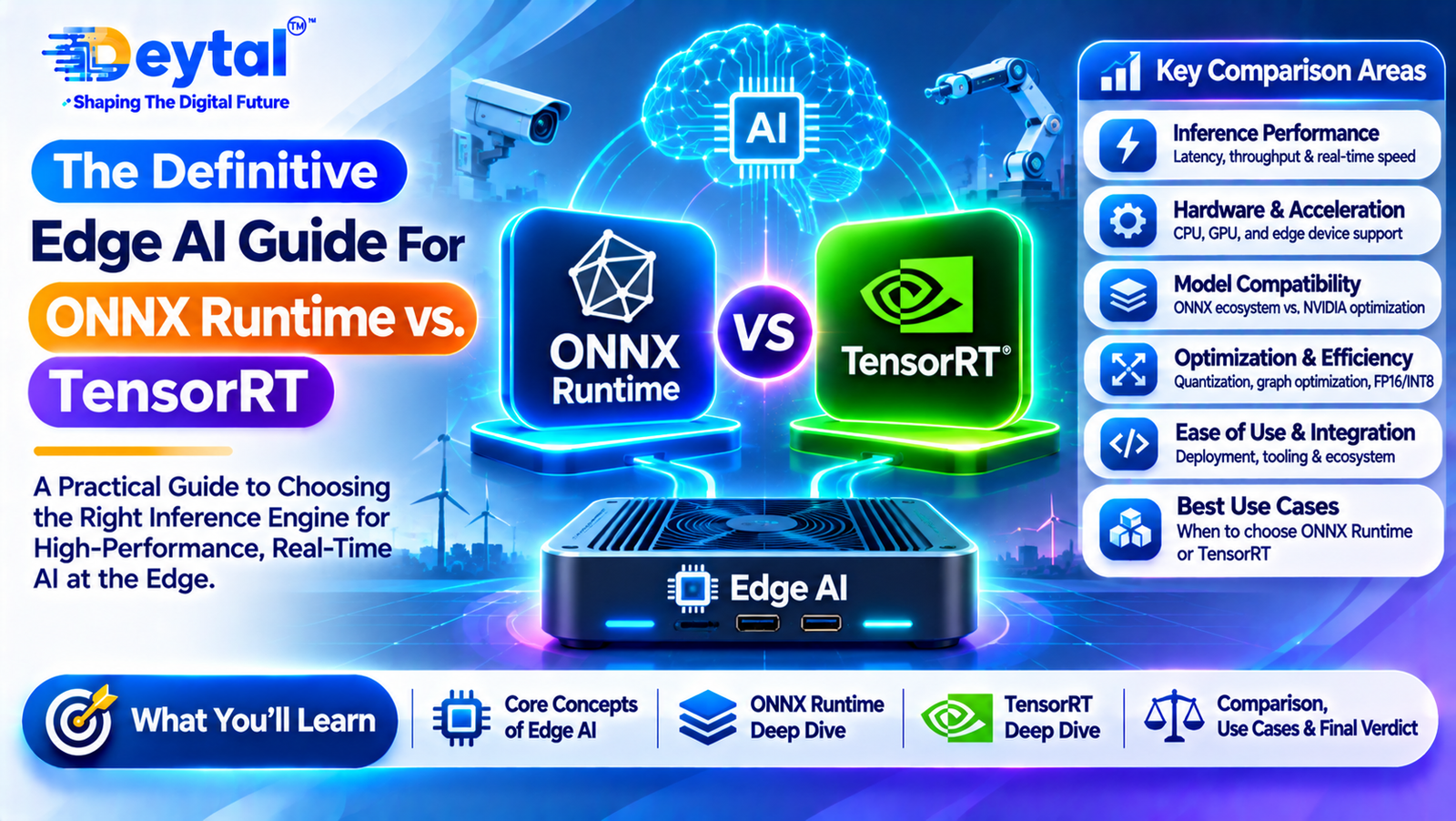
Maximizing inference throughput requires modern execution compilers and runtimes. In edge computing environments, ONNX Runtime (ORT) and NVIDIA TensorRT represent the two leading acceleration frameworks.
- ONNX Runtime, developed by Microsoft, serves as a cross-platform, hardware-agnostic inference engine capable of targeting heterogenous silicon through pluggable Execution Providers (EPs).
- TensorRT, developed by NVIDIA, is an inference software development kit (SDK) designed for NVIDIA GPUs, featuring kernel auto-tuning, layer fusion, and precision calibration.
Choosing the right runtime dictates whether an edge platform achieves sub-millisecond real-time execution or risks hardware budget overruns.
Key Architectural Hurdles in Edge AI Model Serving
Deploying deep learning inference at the edge introduces unique engineering constraints compared to cloud-hosted clusters:
- Heterogeneous vs. Specialized Silicon: Edge fleets frequently contain mixed hardware topologies—combining x86/ARM host CPUs, NVIDIA Jetson modules, Qualcomm NPUs, and Intel edge chips. Building separate runtime pipelines for each architecture creates massive deployment complexity.
- Kernel Launch Overhead and Graph Bloat: High-level training frameworks execute neural network graphs node by node. At batch size 1 (typical for real-time edge streaming), memory transfers and kernel launch overheads often dominate execution time instead of actual floating-point compute.
- Precision Calibration & Quantization Trade-offs: Running models in full 32-bit floating-point (FP32) precision on edge devices exhausts thermal limits and saturates memory bandwidth. Quantizing weights down to FP16 or INT8 requires careful calibration to avoid severe accuracy degradation in mission-critical detection or classification tasks.
- Engine Serialization & Hardware Coupling: Serialized inference engines compiled for a specific GPU microarchitecture (e.g., Ada Lovelace, Hopper, or Ampere/Orin) cannot be transferred to a different GPU family without a complete rebuild. Managing dynamic engine building during boot cycles can dramatically increase edge deployment startup times.
ONNX Runtime vs. TensorRT: Deep Architectural Comparison
| Architectural Dimension | ONNX Runtime (ORT) | NVIDIA TensorRT |
| Primary Philosophy | “Write once, run anywhere” cross-platform acceleration | Hardware-specific performance optimization for NVIDIA GPUs |
| Hardware Compatibility | Heterogeneous: CPUs, GPUs, NPUs, FPGAs (ARM, x86, Apple, Qualcomm) | Strictly locked to NVIDIA hardware (GeForce, RTX, Jetson, Data Center GPUs) |
| Execution Architecture | Pluggable Execution Providers (CUDA, TensorRT, OpenVINO, DirectML, QNN) | Direct compilation into serialized .plan / .engine binary files |
| Kernel Optimization | Broad graph optimizations, constant folding, and operator fusion | Aggressive layer/tensor fusion and low-level kernel auto-tuning for exact GPU cores |
| Quantization Support | Dynamic and static INT8 quantization, FP16, and FP8 | Post-Training Quantization (PTQ) and Quantization-Aware Training (QAT) with INT8 calibration |
| Engine Portability | Model format (.onnx) is fully portable across different devices and OSs | Serialized engines are locked to the specific GPU architecture used to build them |
| Dynamic Shape Handling | Native dynamic axis evaluation with zero engine rebuilds | Requires explicit optimization profiles for minimum, optimal, and maximum input shapes |
| Ideal Production Use Case | Mixed-silicon fleets, CPU edge fallbacks, rapid continuous deployments | Latency-critical production, dedicated NVIDIA Jetson/RTX edge deployments |
Strategic Pillars for Engineering Production-Grade Edge AI
1. High-Performance Model Acceleration & Pipeline Engineering
Deploying optimized inference pipelines requires tailoring graph compilation to available hardware constraints. Converting models from raw PyTorch checkpoints into optimized ONNX graphs or compiling tailored TensorRT engines through Custom Software Development Services ensures edge systems maintain maximum frame rates and lowest latency profiles without hardware instability.
2. Responsive Edge AI Interfaces & Real-Time Web Dashboards
Edge models provide minimal operational value if diagnostic streams and real-time inference telemetry cannot be visualized. Constructing low-latency video streaming interfaces, interactive operational consoles, and telemetry web portals via Website Development Services allows field operators to monitor inference accuracy and edge model throughput in real time.
3. Vision Analytics & AI Dashboard UI/UX Design
Complex edge AI outputs—such as bounding boxes, segmentation masks, and anomaly heatmaps—require intuitive operator interfaces. Designing unified monitoring consoles, bounding box annotation views, and threshold calibration controls through UI/UX Design Services bridges the gap between deep neural network predictions and frontline decision-making.
4. On-Device Inference SDKs for Native Mobile Applications
Deploying AI to mobile devices demands lightweight runtimes that preserve battery life and memory. Building cross-platform on-device inference engines using ONNX Runtime Mobile or CoreML/NNAPI bindings via Mobile App Development Services guarantees mobile applications execute face verification, document OCR, and audio filtering locally without relying on continuous cloud connectivity.
5. High-Speed Technical Publishing & Knowledge Graph SEO
Documenting enterprise technical architectures and edge model capabilities requires high-speed, crawlable digital infrastructure. Operating clean, schema-optimized publishing platforms through WordPress Development Services coupled with data-backed SEO Services ensures technical case studies, AI benchmarks, and developer resources maintain top search visibility and fast Time to First Byte (TTFB).
6. Edge AI Market Positioning & Enterprise ROI Messaging
Translate technical optimizations—such as 4x inference throughput, eliminated cloud egress fees, and 99.9% local uptime—into tangible financial benefits for enterprise decision-makers, supported by data-driven positioning and high-conversion funnels managed by Digital Marketing Services.
Deploy Edge AI at Scale with Deytal Technologies
Bridging the gap between a trained deep learning model and an optimized edge deployment requires deep systems engineering across CUDA streams, quantization calibration, and runtime integration. Deytal Technologies Pvt. Ltd. designs, audits, and builds production-grade edge AI pipelines, hardware-accelerated computer vision backends, and multi-platform inference systems engineered to maximize hardware efficiency and eliminate edge latency bottlenecks.
Frequently Asked Questions (FAQ)
Q1: Can ONNX Runtime run TensorRT under the hood?
Yes. ONNX Runtime includes a TensorrtExecutionProvider (TensorrtEP). When enabled, ONNX Runtime partitions the computational graph, offloading supported subgraphs to TensorRT for hardware-tuned execution while falling back to standard CUDA or CPU execution providers for unsupported operators. This hybrid approach offers TensorRT-level performance while maintaining the fallback safety and portability of ONNX Runtime.
Q2: What is the primary difference between FP16 and INT8 quantization in TensorRT?
FP16 (half-precision) reduces memory bandwidth and doubles mathematical throughput on NVIDIA Tensor Cores with virtually zero loss in model accuracy, requiring no calibration dataset. INT8 quantization reduces weight precision to 8-bit integers, delivering massive speedups and up to 75% memory footprint reduction. However, INT8 requires a representative calibration dataset to build an activation dynamic range profile, preventing quantization noise from degrading model accuracy.
Q3: Why can’t a TensorRT engine file (.plan / .engine) be transferred between different GPU models?
TensorRT generates target-specific assembly code by benchmarking different convolution, GEMM, and attention algorithms directly on the physical GPU during the engine build phase. The resulting binary is tightly coupled to the GPU’s specific SM (Streaming Multiprocessor) count, memory bus width, cache hierarchy, and CUDA compute capability. Attempting to load an engine built on an RTX 4090 onto a Jetson Orin will fail; engines must always be compiled on the exact target hardware.
