

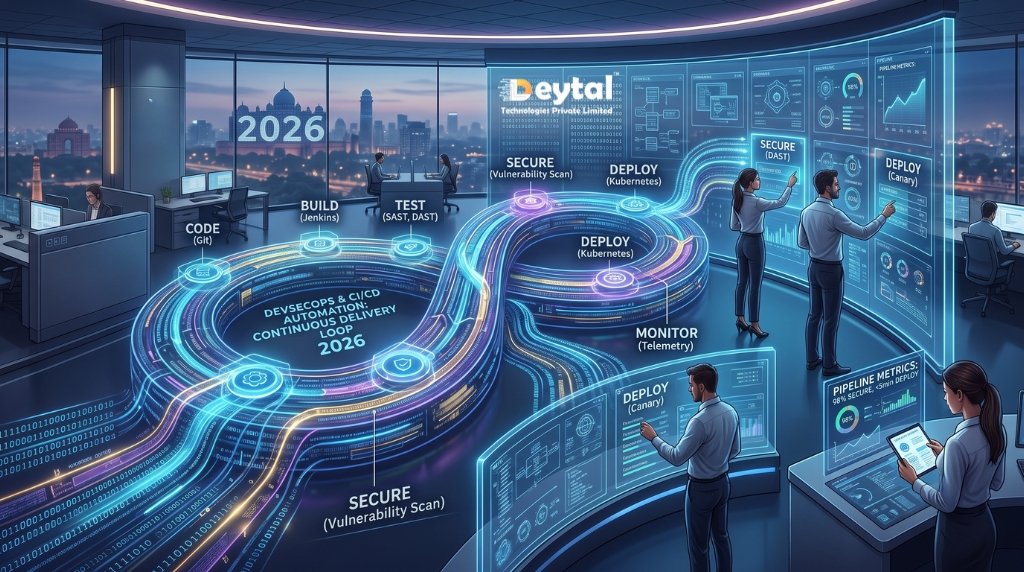
Modern engineering teams face an intense operational conflict: product stakeholders demand daily feature deployments, while compliance and security teams require exhaustive audits before production releases. When security checks remain manual gates positioned at the very end of the development lifecycle, releases are delayed, hotfixes become chaotic, and critical vulnerabilities slip into live environments.
DevSecOps & CI/CD Pipeline Automation resolves this friction by “shifting security left.” By embedding automated vulnerability analysis, compliance validation, and Infrastructure as Code (IaC) linting directly into continuous integration and delivery pipelines, enterprises deploy high-quality code at velocity without sacrificing protection.
The Costly Bottlenecks of Legacy Software Delivery
Treating security as a post-build afterthought creates critical delivery bottlenecks:
- Late-Stage Vulnerability Discovery: Identifying critical architectural flaws just hours before a planned production rollout causes expensive release delays and engineer burnout.
- Fragile Manual Deployment Gates: Manual reviews and spreadsheet-based compliance sign-offs throttle delivery velocity and introduce human error.
- Dependency & Supply Chain Risks: Third-party open-source libraries introduced without automated Software Bill of Materials (SBOM) tracking leave production applications exposed to known exploits.
- Configuration Drift & Inconsistent Environments: Discrepancies between staging, testing, and production servers create subtle bugs that only surface under live user traffic.
Traditional DevOps vs. Modern DevSecOps Pipelines
| Pipeline Dimension | Traditional DevOps Delivery | Automated DevSecOps Pipeline |
| Security Validation | Manual audit at end of release cycle | Automated checks running on every git push |
| Vulnerability Scanning | Periodic, scheduled external audits | Continuous SAST, DAST, and container image scans |
| Infrastructure Management | Manual cloud provisioning & scripts | Declarative Infrastructure as Code (Terraform) |
| Developer Feedback Loop | Days or weeks (from dedicated SecOps teams) | Near-instant feedback via pull request comments |
| Deployment Cadence | Bi-weekly or monthly high-risk releases | Multiple continuous, automated, zero-downtime releases |
Strategic Pillars of an Automated DevSecOps Architecture
1. Secure-by-Design Backend Systems & Automated Testing
Integrate static application security testing (SAST) and automated regression suites into application repositories. Structuring modular services through Custom Software Development Services ensures every commit passes rigorous unit, integration, and security checks before artifact creation.
2. Zero-Downtime Deployment & Modern Web Platforms
Implement automated blue/green or canary deployment strategies that route traffic gradually to new releases. Deploying resilient web applications via Website Development Services ensures end-users experience continuous platform availability during continuous updates.
3. Developer Tooling & Pipeline Telemetry UI/UX
Development velocity accelerates when operational pipelines are easy to monitor. Designing clear build visualizers, deployment status consoles, and developer feedback interfaces through UI/UX Design Services simplifies complex multi-branch pipelines for engineering teams.
4. Continuous Mobile App Delivery Pipelines
Automate testing, code signing, and binary distribution for iOS and Android environments. Building streamlined mobile CI/CD pipelines via Mobile App Development Services eliminates manual build configurations and speeds up app store deployment workflows.
5. Automated Content Deployment & Technical SEO Integrity
Ensure continuous theme, plugin, and content updates never introduce broken links or slow down page performance. Combining automated deployment workflows for WordPress Development Services with proactive SEO Services guarantees pristine Core Web Vitals and stable organic search rankings.
6. Continuous Conversion Optimization & Dynamic Funnels
Leverage rapid, reliable deployments to roll out high-converting landing pages and personalized marketing experiments instantly, scaled through Digital Marketing Services.
Accelerate Secure Delivery with Deytal Technologies
Implementing an automated DevSecOps workflow requires container expertise, pipeline security tooling, and cloud infrastructure orchestration. Deytal Technologies Pvt. Ltd. designs and implements secure CI/CD pipelines, automated testing suites, and enterprise cloud architectures engineered to help software teams ship code faster and safer.
Frequently Asked Questions (FAQ)
Q1: What is the core difference between SAST and DAST in a CI/CD pipeline?
Static Application Security Testing (SAST) analyzes application source code or binaries for vulnerabilities without running the program, catching bugs during development. Dynamic Application Security Testing (DAST) evaluates running applications from the outside, testing for vulnerabilities like SQL injection and cross-site scripting in staging environments.
Q2: How does DevSecOps lower software development costs?
Fixing a vulnerability during the code commit or pull request phase is exponentially cheaper than discovering and patching the same vulnerability in production, where it can require emergency rollbacks or cause data breaches.
Q3: Can small engineering teams implement DevSecOps without high tooling overhead?
Yes. Modern CI/CD platforms (like GitHub Actions and GitLab CI) provide native, lightweight security scanning actions that can be added to existing deployment pipelines with minimal configuration.