

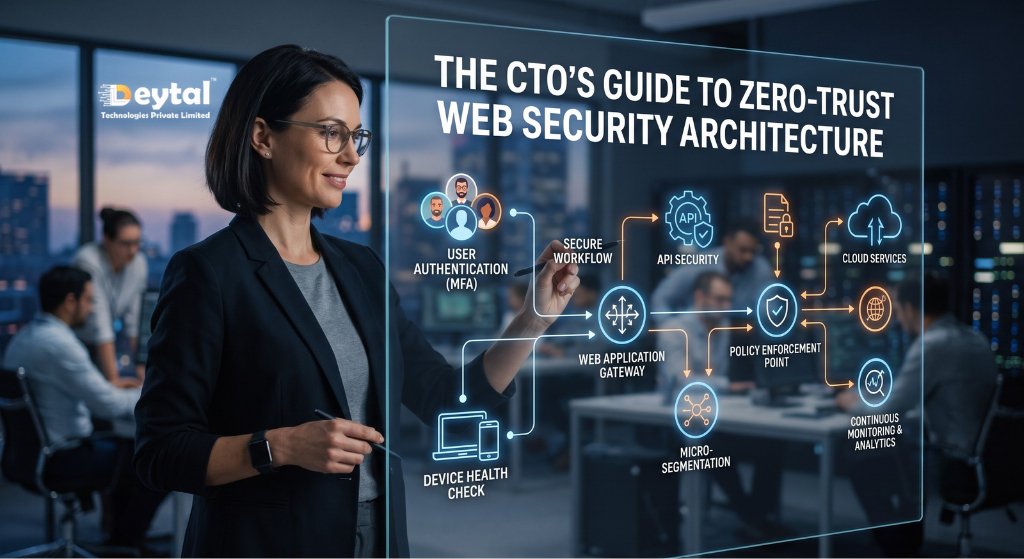
Traditional perimeter-based security models often called “castle-and-moat” architectures assume everything inside the corporate network can be trusted. In a decentralized landscape powered by multi-cloud infrastructure, remote workforces, and third-party APIs, this outdated approach creates severe attack surfaces. Once an attacker breaches the perimeter, they gain unrestricted lateral access to internal databases and proprietary code.
A Zero-Trust Web Security Architecture shifts the defensive paradigm from implicit trust to continuous verification: “Never trust, always verify.”
The Hidden Vulnerabilities of Perimeter-Based Security
Relying solely on traditional firewalls and VPNs exposes modern digital platforms to sophisticated attack vectors:
- Unchecked Lateral Movement: An attacker gaining access to a minor staging environment or non-critical service can move laterally into core financial or user databases.
- API Exploitation & Token Hijacking: Exposed REST endpoints without strict per-request validation are vulnerable to credential stuffing, broken object-level authorization (BOLA), and man-in-the-middle attacks.
- Insider Threats & Compromised Credentials: Stolen developer or admin credentials grant attackers unfettered access if access privileges are not continuously authenticated.
- Compliance & Data Privacy Penalties: Inadequate access control frameworks risk heavy financial penalties and reputational loss under global data regulations like GDPR and ISO 27001.
Perimeter Security vs. Zero-Trust Web Architecture
| Security Dimension | Traditional Perimeter Defense | Zero-Trust Web Security |
| Trust Model | Implicit trust within the internal network | Zero implicit trust; verify every single request |
| Access Control | Broad, network-level access via VPN | Least-privilege access scoped to individual micro-resources |
| Authentication Policy | Single sign-on / one-time login gate | Continuous adaptive authentication & MFA triggers |
| Data Encryption | Primarily at perimeter edges | End-to-end encryption in transit (mTLS) and at rest |
| Incident Blast Radius | Wide (entire internal network compromised) | Contained to a single isolated microsegment |
Core Engineering Pillars of Zero-Trust Web Systems
1. Microsegmentation & Resilient Backend Engineering
Isolate mission-critical business logic into segregated microservices with strict access boundaries. Engineering hardened data validation layers and encrypted endpoints via Custom Software Development Services stops lateral threat propagation.
2. Secure, Hardened Web Application Frontends
Defend client-side web platforms against Cross-Site Scripting (XSS), Clickjacking, and CSRF vulnerabilities. Implementing strict Content Security Policies (CSP) and secure session management through Website Development Services ensures ironclad user protection.
3. Frictionless Identity & Access Management (IAM) UI
Security should never derail user experience. Designing intuitive multi-factor authentication (MFA), role-based access dashboards, and biometric login flows using UI/UX Design Services makes compliance natural for users.
4. End-to-End Encrypted Mobile App Integrations
Secure data transmitted to mobile devices with certificate pinning, runtime application self-protection (RASP), and secure biometric storage via Mobile App Development Services.
5. Hardened CMS Infrastructure & Technical SEO Safeguards
Keep public-facing content assets resilient against brute-force attacks and malicious script injections. Pairing enterprise-grade WordPress Development Services with proactive SEO Services maintains top organic search authority without risking site downtime.
6. Compliant Lead Capture & Growth Funnels
Acquire enterprise customers through verified, privacy-first landing funnels engineered to comply with international data security standards, managed by Digital Marketing Services.
Secure Your Enterprise Infrastructure with Deytal Technologies
Implementing zero-trust principles across web applications, APIs, and cloud infrastructure requires deep architectural knowledge and precise technical execution. Deytal Technologies Pvt. Ltd. designs and builds secure web architectures, custom backend systems, and scalable cloud platforms engineered to protect business-critical data.
Frequently Asked Questions (FAQ)
Q1: What is the core principle of Zero-Trust Architecture?
The core principle is “Never Trust, Always Verify.” Every user, device, and API request must be authenticated, authorized, and continuously validated before access to any internal resource is granted.
Q2: How does mutual TLS (mTLS) contribute to zero-trust web platforms?
Mutual TLS ensures that both the client and the server authenticate each other’s cryptographic certificates simultaneously, preventing unauthorized services from communicating with internal APIs.
Q3: Does a zero-trust model slow down web application performance?
No. When engineered with modern lightweight token verification (such as signed JWTs or edge authentication proxies), zero-trust validation occurs in milliseconds without noticeable latency for users.